
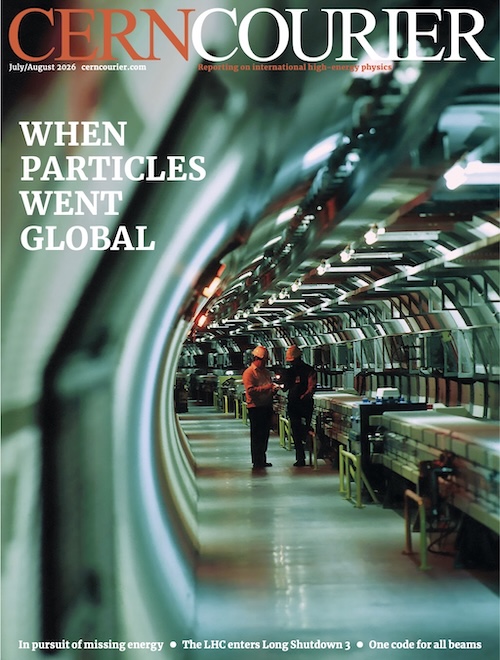
When the Large Electron–Positron collider (LEP) switched on, in 1989, the field had never worked at such a scale. Approved eight years earlier, it collided electrons and positrons until the turn of the century, marking two decades in which discovery truly turned global. Last November, some 200 physicists and historians gathered at CERN to take stock of those years, while the Large Hadron Collider, built in LEP’s tunnel, delivered its final collisions in June.
For 10 years, NA64 has fired probes onto a target and watched for missing energy, seeking a dark sector too faint to catch otherwise. It will now undergo a full round of upgrades, to sustain much higher intensities and increase its dataset by up to two orders of magnitude.
This edition of CERN Courier also explores Xsuite, the open-source framework that gathered the field’s scattered beam-simulation tools. Today, it designs the colliders to come, tunes those already running and models synchrotrons to treat cancer.
In May, the CERN Council updated the European Strategy for Particle Physics. The preferred next flagship is once again an electron–positron collider, the FCC-ee. Council president Costas Fountas weighs what must fall into place before a decision, targeted for 2028.