
The November/December 2026 issue of the CERN Courier is out
—
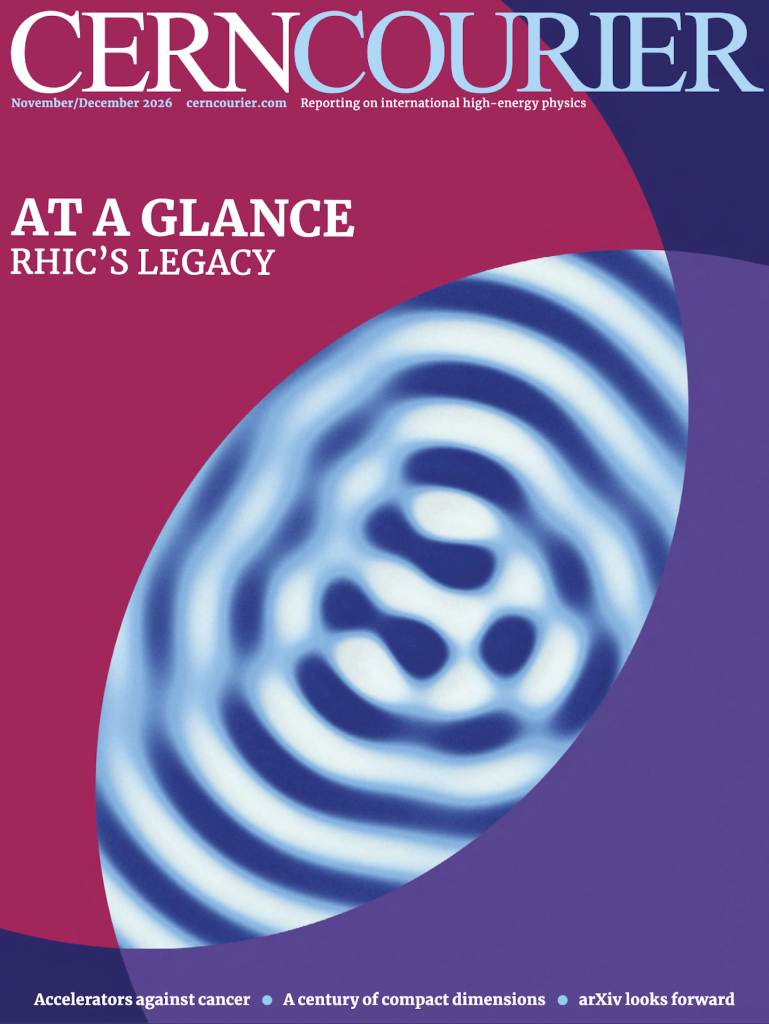
The universe is thought to have spent its first microseconds as a plasma of quarks and gluons. CERN announced evidence of that state in 2000, the same year the Relativistic Heavy Ion Collider (RHIC) began colliding gold ions at Brookhaven National Laboratory. By 2005, RHIC’s experiments had found the plasma to be a near-perfect liquid with almost no internal friction. The machine delivered its last collisions in February, after a quarter century of discovery.
While CERN transforms the LHC and its experiments to collect several times more data, medicine seeks to make its accelerators smaller, more reliable and easier to maintain. Research at CERN and beyond aims to provide them, and so to narrow the gap in access to modern radiotherapy between higher- and lower-income countries.
This edition of CERN Courier also turns to arXiv, which has left Cornell University to become an independent non-profit. Meanwhile, submissions are surging, a growing number of them written or assisted by artificial intelligence.
The 2026 Nobel Prize in Physics went to Francis Halzen, for showing – in his own words – that neutrino astronomy “exists”. Around 1990, he and colleagues proposed freezing photomultipliers into the Antarctic ice. The idea grew into IceCube, where a recent search found no sign of extra dimensions in neutrino oscillations. The notion of a fifth dimension curled up too small to see goes back to 1926, when Oskar Klein closed it into a circle only a few hundred Planck lengths around.
To subscribe to the magazine, please visit: https://cerncourier.com/p/about-cern-courier