
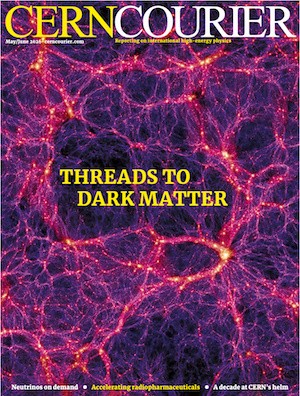
Most of the universe is void. Of the rest, most is invisible. Yet it weaves a sprawling cosmic web, lit at its nodes by clusters of galaxies. Stack many cluster pairs and a faint radio glow appears between, brighter than diffuse intergalactic gas alone can account for. Theorist Elena Pinetti explains how the excess may set new constraints on dark-matter models.
A more earthly web threads Europe, carrying vital radiopharmaceuticals for modern cancer therapy. Produced in accelerators, reactors and mass separators, the isotopes must reach their destination before they decay. The supply chain that now sustains clinics began as an instrument of fundamental science.
This edition of CERN Courier also explores neutrino tagging, a technique for taming the systematics that limit next-generation oscillation experiments. Conceived by Bruno Pontecorvo in 1979, it has come within reach of modern fast-timing technology, and a dedicated CERN facility has been proposed to do it at scale.
In December, the European Strategy Group recommended the FCC-ee as CERN’s next flagship collider. Alain Blondel, one of the earliest advocates of a circular Higgs factory, traces the case back half a century.