
AMS experiment embarks on first leg of mission into space
—
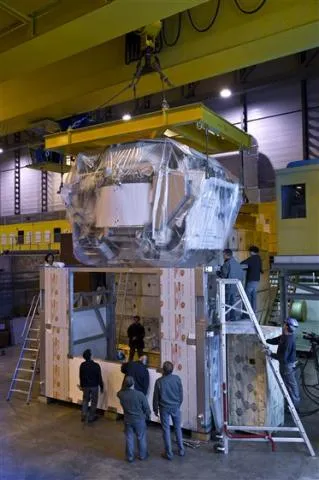
Geneva, 12 February 2010. The Alpha Magnetic Spectrometer (AMS) left CERN1 this morning on the first leg of its journey to the International Space Station (ISS). A special convoy carrying the experiment is due to arrive at the European Space Agency’s research and technology centre, ESTEC, at Noordwijk in the Netherlands in six days time. Once there, the detector will undergo testing of its ability to survive a shuttle lift-off and to operate in space. Twenty members of the AMS collaboration will accompany the detector on its journey.
Geneva, 12 February 2010. The Alpha Magnetic Spectrometer (AMS) left CERN1 this morning on the first leg of its journey to the International Space Station (ISS). A special convoy carrying the experiment is due to arrive at the European Space Agency’s research and technology centre, ESTEC, at Noordwijk in the Netherlands in six days time. Once there, the detector will undergo testing of its ability to survive a shuttle lift-off and to operate in space. Twenty members of the AMS collaboration will accompany the detector on its journey.
Construction of the AMS detector components was carried out by an international team with significant contributions from CERN Member States France, Germany, Italy, Portugal Spain and Switzerland, as well as China, China (Taipei) and the USA. Assembly was carried out at CERN with help from the Laboratory’s engineering services. From 4 February until Tuesday morning, the detector was put through its paces using a test beam from the Super Proton Synchrotron accelerator. This was the first of a series of tests on the fully assembled detector and it gave excellent results, demonstrating AMS’s ability to work as a coherent whole once it reaches space. A beam of primary protons from the SPS was used to check the detector’s momentum resolution, and it qualified the spectrometer’s ability to measure particle curvature and momentum. AMS’s ability to distinguish electrons from protons was also tested. This is very important for the measurement of cosmic rays, 90% of which are protons and constitute a natural background for other signals that AMS scientists are interested in. AMS will be looking for an abundance of positrons and electrons from space, one of the possible markers for dark matter.
Once at ESTEC, AMS will be placed in ESA’s thermo vacuum room that simulates space vacuum to test the detector’s capacity of exchanging heat and thus maintain its thermal balance, which is essential for the functioning of the detector’s electronics and especially of its unique superconducting magnet, which is the first of its kind to be launched into space.
“This is a very important milestone for AMS, as it’s the first time that it is going to be tested in vacuum. After the test, AMS may come back to CERN for a final check and then it’s off to the Kennedy Space Center for launch,” said the experiment’s Nobel-prize winning spokesman, Professor Sam Ting. “The contribution of CERN has been crucial. Without the work of CERN’s accelerator, magnet and vacuum groups we wouldn’t be at this stage here today.”
AMS will leave ESTEC towards the end of May aboard a special US Air Force flight to the Kennedy Space Center in Florida. Lift-off aboard the space shuttle Discovery is scheduled for July. Once docked to the ISS, AMS will examine fundamental issues about matter and the origin and structure of the Universe directly from space. Its main scientific target is the search for dark matter and antimatter in a programme that is complementary to that of the Large Hadron Collider. AMS data from space will be transmitted from the ISS to Houston, USA, and on to CERN, where the detector control centre will be located, and a number of regional physics analysis centres set up by the collaborating institutes.
AMS Experiment Participating Institutes
| Country | Institute |
|---|---|
| China | National Laboratory for Aeronautics and Astronautics (NLAA) |
| China | Institute of Electrical Engineering (IEE), Chinese Academy of Sciences |
| China | Institute of High Energy Physics (IHEP), Chinese Academy of Sciences |
| China | Shandong University (SDU) |
| China | Shanghai Jiaotong University (SJTU) |
| China | Southeast University (SEU) |
| China | Sun Yat-sen University (SYSU) |
| Denmark | University of Aarhus |
| Finland | Helsinki University of Technology, Metsahovi Radio Observatory |
| Finland | University of Turku, Space Research Laboratory |
| France | Groupe d'Astroparticules de Montpellier (IN2P3), Universite Montpellier II |
| France | Laboratoire d'Annecy-Le-Vieux de Physique des Particules |
| France | Laboratoire de Physique Subatomique et de Cosmologie (LPSC) |
| Germany | I. Physikalisches Institut, RWTH Aachen |
| Germany | Max-Planck-Institut für Extraterrestrische Physik |
| Germany | University of Karlsruhe, Institute for Experimental Nuclear Physics |
| Italy | Center for Advanced Research in Space Optics, University of Trieste |
| Italy | Istituto di Ricerca sulle Onde Elettromagnetiche (IROE) |
| Italy | University of Bologna and INFN-Sezione di Bologna |
| Italy | University of Milano and INFN-Sezione di Milano |
| Italy | University of Perugia and INFN-Sezione di Perugia |
| Italy | University of Pisa and INFN-Sezione di Pisa |
| Italy | University of Roma "La Sapienza" and INFN-Sezione di Roma |
| Italy | University of Siena and INFN-Sezione di Siena |
| Italy | Agenzia Spaziale Italiana |
| Korea | EWHA Women's University |
| Korea | Kyungpook National University |
| Mexico | Universidad Nacional Autonoma de Mexico (UNAM) |
| Netherlands | European Space Agency, European Space and Technology Centre ESTEC |
| Netherlands | National Aerospace Laboratory (NLR) |
| Netherlands | National Institute for Nuclear Physics and High Energy Physics (NIKHEF) |
| Portugal | Laboratory of Instrumentation and Experimental Particle Physics |
| Romania | University of Bucharest |
| Russia | Institute of Theoretical and Experimental Physics (ITEP) |
| Russia | Russian Research Centre, Kurchatov Institute |
| Russia | Skobeltsyn Institute of Nuclear Physics, Moscow State University |
| Spain | Centro de Investigaciones Energéticas Medioambientales y Tecnológicas (CIEMAT) |
| Spain | Instituto Astrofísico de Canarias |
| Switzerland | ETH-Eidgenössische Technische Hochschule Zürich, Labor für Hochenergiephysik |
| Switzerland | Université de Genève, D.P.N.C. |
| China (Taipei) | Academia Sinica, Institute of Physics |
| China (Taipei) | Chung Shan Institute of Science and Technology (CSIST) |
| China (Taipei) | National Central University |
| China (Taipei) | National Cheng Kung University |
| China (Taipei) | National Chiao Tung University |
| China (Taipei) | National Space Program Office (NSPO) |
| USA | Florida A&M University |
| USA | Florida State University |
| USA | Johns Hopkins University |
| USA | Massachusetts Institute of Technology |
| USA | NASA Goddard Space Flight Center |
| USA | NASA Johnson Space Center |
| USA | University of Maryland, Department of Physics |
| USA | University of Maryland, East-West Space Science Center |
| USA | Texas A&M University, College Station |
| USA | Yale University, Department of Physics |