
Category: At CERN
-
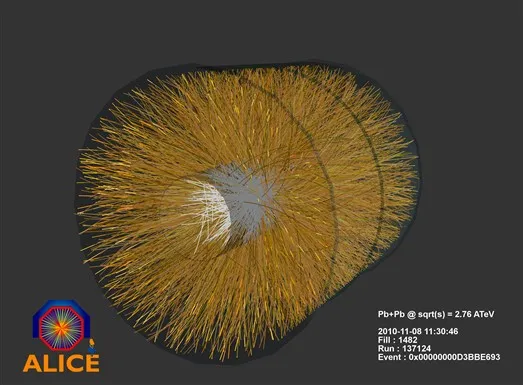
CERN completes transition to lead-ion running at the LHC
Geneva, 8 November 2010. Four days is all it took for the LHC operations team at CERN1 to complete the transition from protons to lead ions in the LHC. After extracting the final proton beam of 2010 on 4 November, commissioning the lead-ion beam was underway by early afternoon. First collisions were recorded at 00:30
-
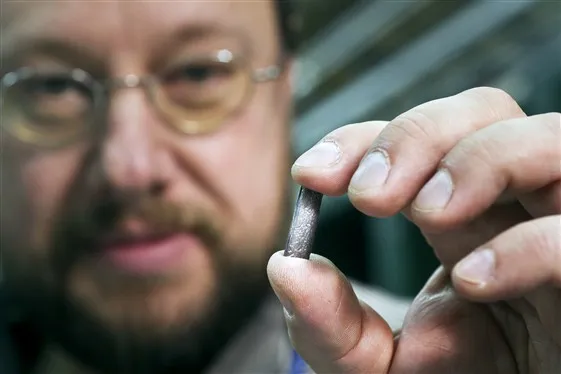
The LHC enters a new phase
Geneva, 4 November 2010. Proton running for 2010 in the LHC at CERN1 came to a successful conclusion today at 08:00 CET. Since the end of March, when the first collisions occurred at a total energy of 7 TeV, the machine and experiment teams have achieved all of their objectives for the first year of
-
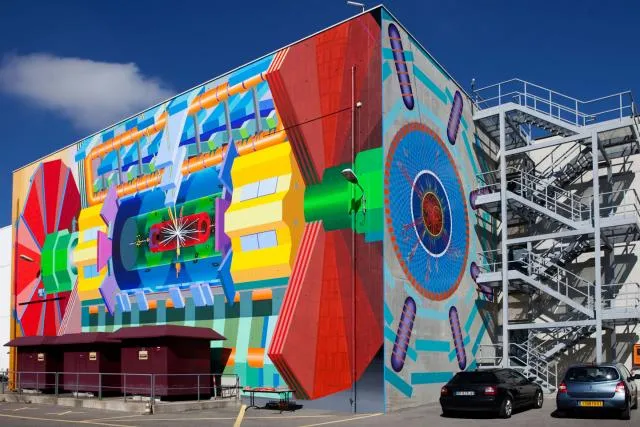
The ATLAS collaboration at CERN unveils giant mural
Geneva, 6 October 2010. The ATLAS1 collaboration at CERN2 today officially unveiled a giant mural depicting the ATLAS particle detector, which is currently collecting data at the world’s most powerful particle accelerator, the Large Hadron Collider. Installed in a cavern 100 metres underground, the ATLAS detector is no longer open for visits. The mural, painted
-
CERN council approves the laboratory’s medium term plan
Geneva, 17 September 2010. During an intense series of meetings, which concludes today, the CERN1 Council overwhelmingly approved the laboratory’s revised Medium Term Plan for the period 2011 to 2015. The plan was originally presented to Council at its June session, at which Council asked CERN management to introduce cost-saving measures. In the revised plan,
-
Be a researcher for an evening on European researchers’ night, Friday 24 September
Geneva, 16 September 2010. On Friday 24 September, CERN1 will be one of 260 European locations involved in the 5th edition of the European Researchers’ Night, an initiative funded by the European Union’s Science and Society programme aimed at highlighting the appeal of being a researcher and promoting scientific research among young Europeans. CERN is
-
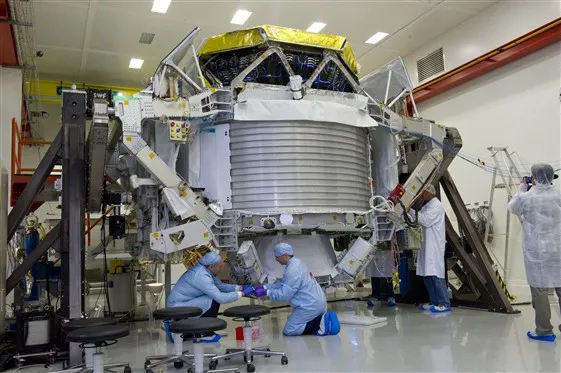
AMS experiment takes off for Kennedy Space Center
Geneva, 18 August 2010. The Alpha Magnetic Spectrometer (AMS), an experiment that will search for antimatter and dark matter in space, leaves CERN1 next Tuesday on the next leg of its journey to the International Space Station. The AMS detector2 is being transported from CERN to Geneva International Airport in preparation for its planned departure
-
World’s particle physics labs take amateur photographers behind the scenes
Geneva, 8 July 2010. Picture this: For the first time, amateur photographers around the world collide with the past, present and future of particle physics. Five of the world’s leading particle physics laboratories will make the image a reality when they join together to host a Particle Physics Photowalk on 7 August. More than 200
-
CERN Council opens the door to greater integration
Geneva, 18 June 2010. At its 155th session today, the CERN1 Council strongly congratulated the Laboratory on the excellent performance of the LHC since its start-up for physics on 30 March this year. Council also opened the door to greater integration in particle physics when it unanimously adopted the recommendations of a working group set
-
CERN inaugurates its new permanent “Universe of Particles” exhibition
Geneva, 15 June 2010. CERN1 has recently started operating the LHC, one of the most sophisticated scientific tools ever built to explore new territories of knowledge. To share this exciting adventure with the general public, CERN is opening a visitor centre that is as high-tech and futuristic as its accelerator. The "Universe of Particles" exhibition,
-
Physicists and medics set out strategy on physics for health
Geneva 3 June 2010. Following a workshop hosted by the CERN1 European particle physics laboratory in February, doctors and physicists today published a strategy for harnessing physics for health. Techniques developed for physics research have a long history of application in medicine. Today’s news recognises that synergy, and sets out a programme of strengthened collaboration.