
Category: News Page
-
European Union gives 9.8 million Euros for GRID development
Geneva, 11 January 2001. A 9.8 million euro funding over three years in support of the DataGrid project was authorized by the EC Information Society Programme (within the Fifth Framework Research Programme for technology development) at the end of December 2000 and a contract has been awarded to CERN1 as leader of the project. This
-
CERN moves into the LHC era
Geneva, 15 December 2000. The CERN Council, where the representatives of the 20 Member States of the Organization decide on scientific programmes and financial resources, held its 116th session on 15 December under the chairmanship of Dr. Hans C. Eschelbacher (DE). BROKEN IMAGE NOT MOVED (drupal url : https://home.cern/news/press-release/cern/cern-moves-lhc-era) Geneva, 15 December 2000. The CERN
-
Britain at CERN
Geneva, 14 November 2000. From 14 to 17 November 30 British companies will exhibit leading edge technologies at CERN1. This is Britain’s 18th exhibition at CERN since 1968. Out of the 30 companies, which attended the Britain at CERN exhibition in 1998, 25 have received an order or a contract relating to CERN during the
-
A Webcast on antimatter live from CERN
Geneva, 14 November. Dive into the anti-world from the Web ! On 18 and 21 November, you will be able to discover antimatter thanks to a Webcast live from CERN1. An hour long show for the general public broadcast through the Internet will show you how and why CERN’s antimatter factory is producing anti-particles. Interviews,
-
LEP shuts down after eleven years of forefront research
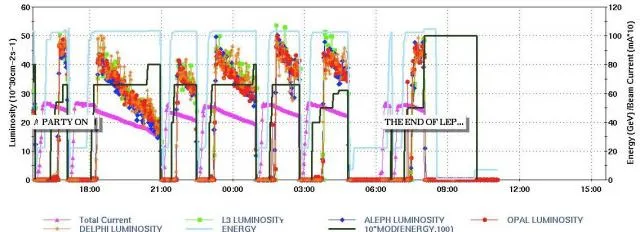
Geneva, 8 November 2000. After extended consultation with the appropriate scientific committees, CERN1‘s Director-General Luciano Maiani announced today that the LEP accelerator had been switched off for the last time. LEP was scheduled to close at the end of September 2000 but tantalising signs of possible new physics led to LEP’s run being extended until
-
Physics in the Spotlight
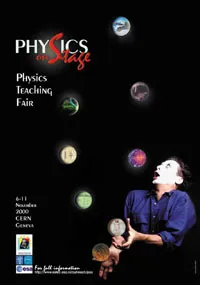
CERN, ESA and ESO put Physics on Stage Geneva, 18 October 2000. Can you imagine how much physics is in a simple match of ping-pong, in throwing a boomerang, or in a musical concert? Physics is all around us and governs our lives. The World-Wide Web and mobile communication are only two examples of technologies
-
Poland at CERN
Geneva, 17 October 2000. On 17 October 2000, the second Polish industrial and technological exhibition opens at CERN1. The first one was held five years ago and nine of the companies that were present then have come back again this year. Six of those companies were awarded contracts with CERN in 1995. Three Polish officials
-
CERN celebrates LEP – the accelerator that changed the face of particle physics
Geneva, 9 October 2000. Members of government from around the world gathered at CERN1 on 9 October to celebrate the achievements of the Large Electron Positron collider (LEP), the Laboratory’s flagship particle accelerator. Over the eleven years of its operational lifetime, LEP has not only added greatly to mankind’s pool of knowledge about the Universe,
-
The LEP story
Geneva, 9 October 2000. The LEP story begins in the late 1970s when CERN1 Member State physicists got together to discuss the long term future of high energy physics in Europe. A new picture of fundamental interactions, unifying the electromagnetic and weak forces, was emerging, and LEP would be the machine to study it. After
-
CERN is first to demonstrate a 10 Gigabit/sec network with four major computer manufacturers
Geneva, 15 September 2000. CERN1 has made another important step forward in high-speed computing and state of the art networking. On 15 September a Gigabyte System Network (GSN) network with a capacity of 10 Gbit per second ramped up successfully at CERN, connecting together computers from different computer companies (Compaq, IBM, SGI and Sun). It