
Category: News Page
-
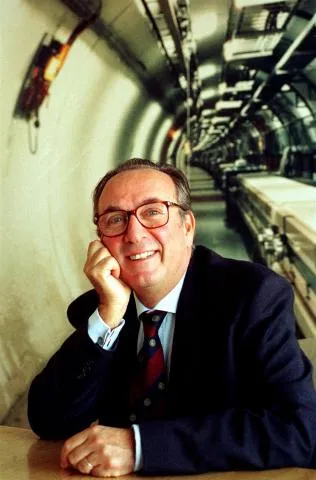
Professor Luciano Maiani is new President of CERN Council
Prof. Luciano Maiani (IT), next President of Council. Geneva, 26 September 1996. The delegates of the CERN1 Council, the body which decides on the scientific programme and financial resources of the Organisation, elected Prof. Luciano Maiani (IT) as the next President of Council. Prof. Maiani was elected for a period of one year and will
-
First results from LEP2
Geneva, 10 July 1996. CERN1‘s Large Electron-Positron collider, LEP, produced its first pair of fundamental particles known as W+ and W- today, taking particle physics research into new and unexplored territory. This follows a busy winter of upgrades which have transformed LEP into a new accelerator, earning it the name LEP2. Hundreds of physicists from
-
CERN looks forward to exciting future
Geneva, 21 June 1996. The CERN1 Council, where the representatives of the 19 Member States of the Organization decide on scientific programmes and financial resources, held its 104th session today under the chairmanship of Prof. Hubert Curien (F). Director General's Report On Scientific Activities Prof. Christopher Llewellyn Smith, Director General of CERN, reported to Council
-
First Czech industrial exhibition at CERN
Geneva, 11 June 1996. On 7 June, Mr Radomir Sabela, Deputy Minister for Industry and Trade of the Czech Republic together with CERN Director General Prof. Chris Llewellyn Smith formally opened the first ever exhibition of Czech hi-tech companies at CERN1. Mr Sabela stressed that the exhibition will hopefully prove that the Czech Republic, despite
-
Accolade for Inventors of the World-Wide Web
Geneva, 15 February 1996. Nearly seven years after it was invented at CERN1, the World-Wide Web has woven its way into every corner of the Internet. On Saturday, 17 February, the inventors of the Web, Tim Berners-Lee, now at Massachusetts Institute of Technology (MIT), and Robert Cailliau of CERN’s Electronics and Computing for Physics (ECP)
-
First atoms of antimatter produced at CERN
Geneva, 4 January 1996. In September 1995, Prof. Walter Oelert and an international team from Jülich IKP-KFA, Erlangen-Nuernberg University, GSI Darmstadt and Genoa University succeeded for the first time in synthesising atoms of antimatter from their constituent antiparticles. Nine of these atoms were produced in collisions between antiprotons and xenon atoms over a period of
-
103rd Meeting of CERN Council
Geneva, 15 December 1995. The CERN1 Council, where the representatives of the 19 Member States of the Organization decide on scientific programmes and financial resources, held its 103rd session on 15 December under the chairmanship of Prof. Hubert Curien (F). Director General's Report From the lowest energy levels at ISOLDE to the highest at LHC,
-
Poland at CERN from 28 November to 1 December
Geneva, 28 November 1995. On 28 November 1995 the first Polish industrial and technological exhibition opened at CERN1. In his inaugural speech Prof Aleksander Luczak, the Polish Deputy Prime Minister, announced : “The first Polish exhibition which I am opening today indicates a new stage of our presence at CERN. It provides an opportunity for
-
CERN takes off for higher energies
Geneva, 6 November 1995. CERN1‘s Large Electron-Positron Collider LEP has moved up a gear. On 31 October, particle collisions were observed for the first time at 130 GeV, the highest energy ever achieved in an electron-positron collider. After six years of studying the elementa ry particle known as the Z, LEP moved smoothly up to
-
Holland at CERN
Geneva, 17 October 1995. On 17 October the third industrial exhibition, “Holland at CERN1” was officially opened by Dr R.J. van Duinen, President of the Dutch Organisation for Scientific Research (NWO). In his opening speech he encouraged scientific organisations such as CERN* to take full advantage of industry’s ability to design and invent new processes