
Eyes on the sky: a rare solar eclipse will be visible from CERN on 12 August
Find out how to watch the 2026 eclipse safely
Written by:
HSE Department
—
On 12 August 2026, the CERN community will have the opportunity to observe one of the most spectacular astronomical events visible from our region in decades. While a total solar eclipse will cross parts of Spain and the North Atlantic, observers in Geneva will experience a deep partial eclipse, with about 93% of the Sun covered by the Moon at maximum eclipse (this app helps you find the best spot to watch).
Although most of the Sun will be obscured, looking directly at it without appropriate protection remains dangerous and may cause permanent retinal damage. Because the retina has no pain receptors, eye injury can occur without immediate warning signs.
The eclipse will begin at approximately 19:26 CEST, reach its maximum around 20:20 CEST, and end shortly before sunset. Because the Sun will be very low in the western sky, a location with a clear horizon will provide the best view.
As daylight fades, observers may notice an unusual quality of light and a slight drop in temperature. However, the remaining sunlight will still be intense enough to damage the eyes.
To observe the eclipse safely:
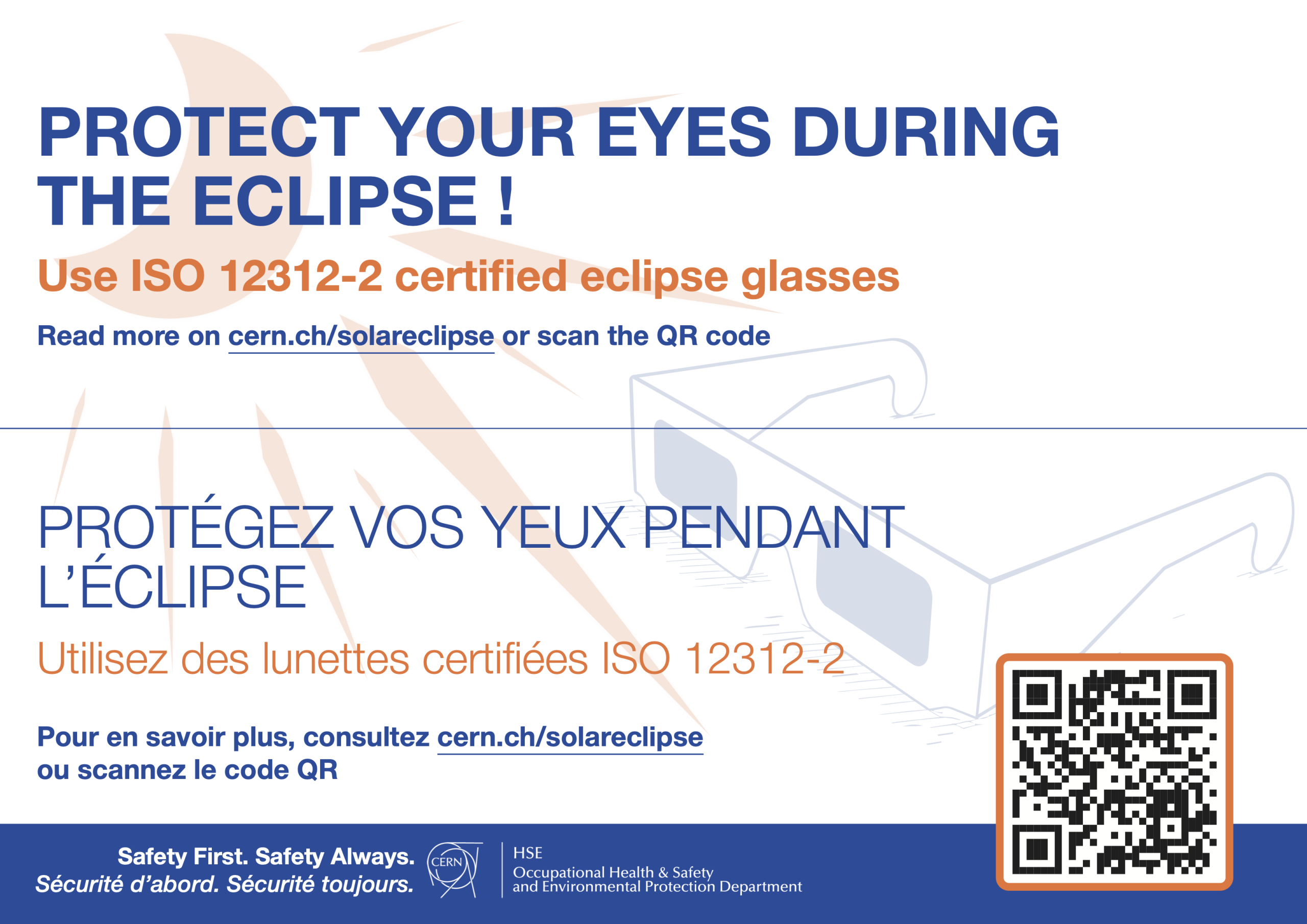
- Use only eclipse glasses certified to the ISO 12312-2 standard. Ordinary sunglasses, smoked glass and homemade filters do not provide adequate protection.
- Never look at the Sun through binoculars, a telescope or a camera unless the device is fitted with an appropriate solar filter placed in front of the optics.
- If eclipse glasses are not available, observe the event indirectly using a pinhole projector or another indirect viewing method, which projects an image of the eclipsed Sun onto a surface.
- Children should always be supervised while observing the eclipse.
If you experience blurred vision, dark spots or any change in your central vision after observing the eclipse, seek medical advice immediately. Members of the CERN community may also contact the CERN Medical Service if they have any concerns.
For further eclipse safety recommendations, consult the Swiss Federal Office of Public Health’s dedicated guidance page.
Enjoy this exceptional astronomical event while protecting your eyesight and encouraging those around you to do the same!