Accelerators
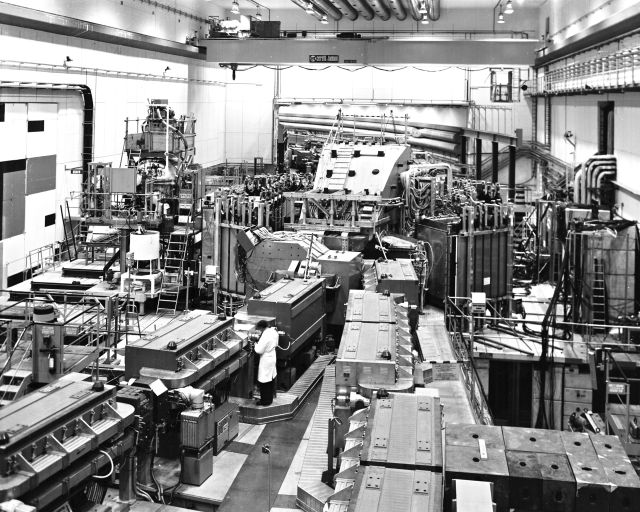
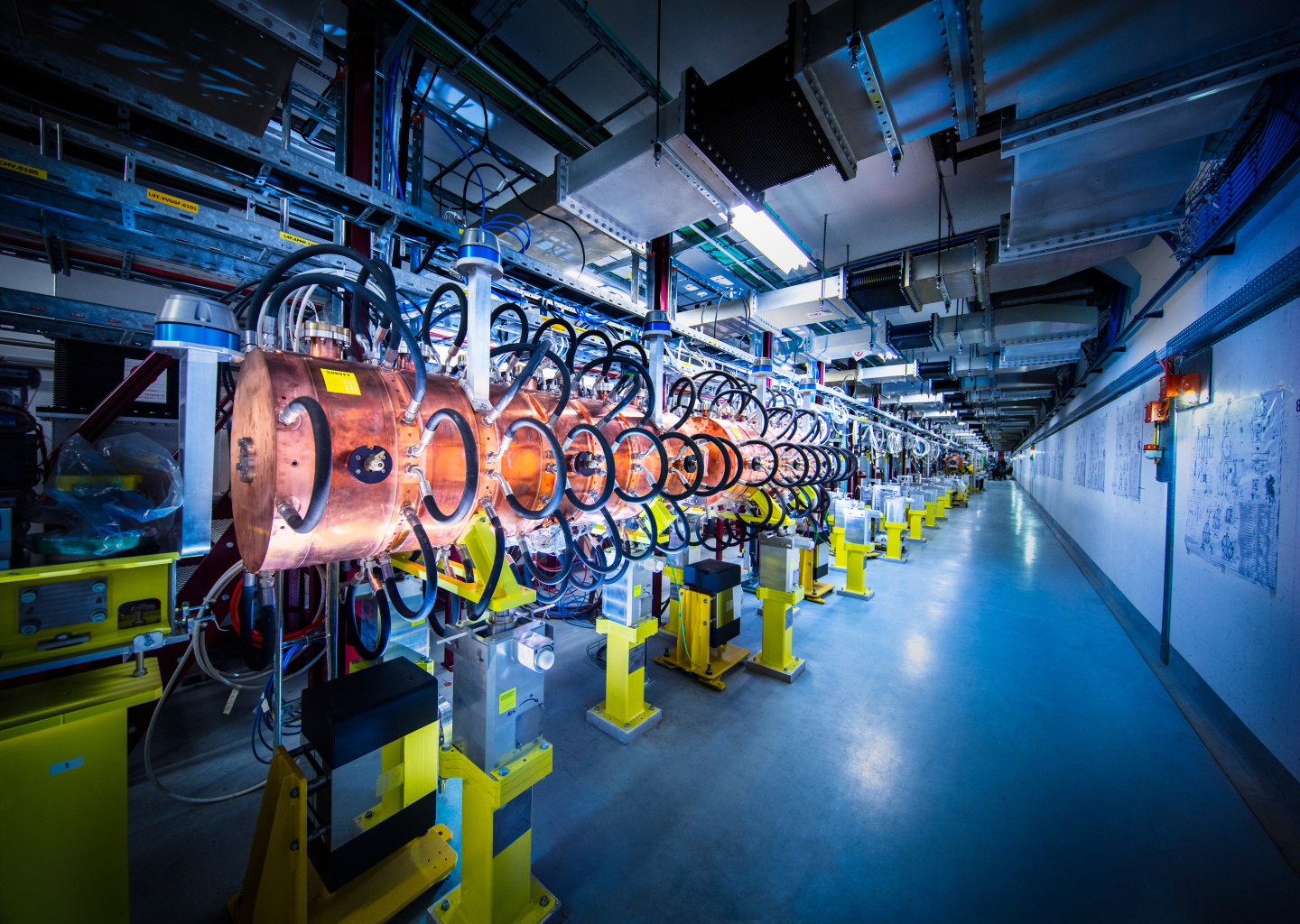
CERN hosts a gigantic complex of particle accelerators.
But what are these machines and how do they work?
What is an accelerator?
An accelerator propels charged particles, such as protons or electrons, at high speeds, close to the speed of light. They are then smashed either onto a target or against other particles circulating in the opposite direction. By studying these collisions, physicists are able to probe the world of the infinitely small.
When the particles are sufficiently energetic, a phenomenon that defies the imagination happens: the energy of the collision is transformed into matter in the form of new particles, the most massive of which existed in the early Universe. This phenomenon is described by Einstein’s famous equation E=mc2, according to which matter is a concentrated form of energy, and the two are interchangeable.
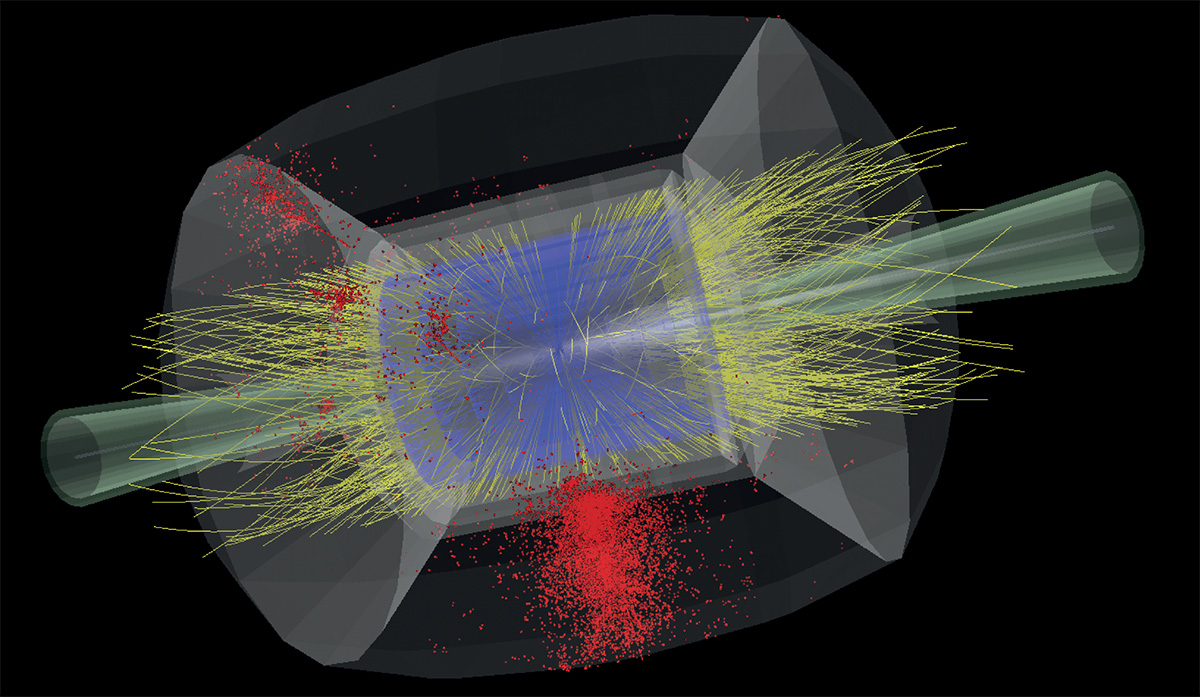
The Large Hadron Collider is the most powerful accelerator in the world. It boosts particles, such as protons, which form all the matter we know. Accelerated to a speed close to that of light, they collide with other protons. These collisions produce massive particles, such as the Higgs boson or the top quark. By measuring their properties, scientists increase our understanding of matter and of the origins of the Universe. These massive particles only last in the blink of an eye, and cannot be observed directly. Almost immediately they transform (or decay) into lighter particles, which in turn also decay. The particles emerging from the successive links in this decay chain are identified in the layers of the detector.
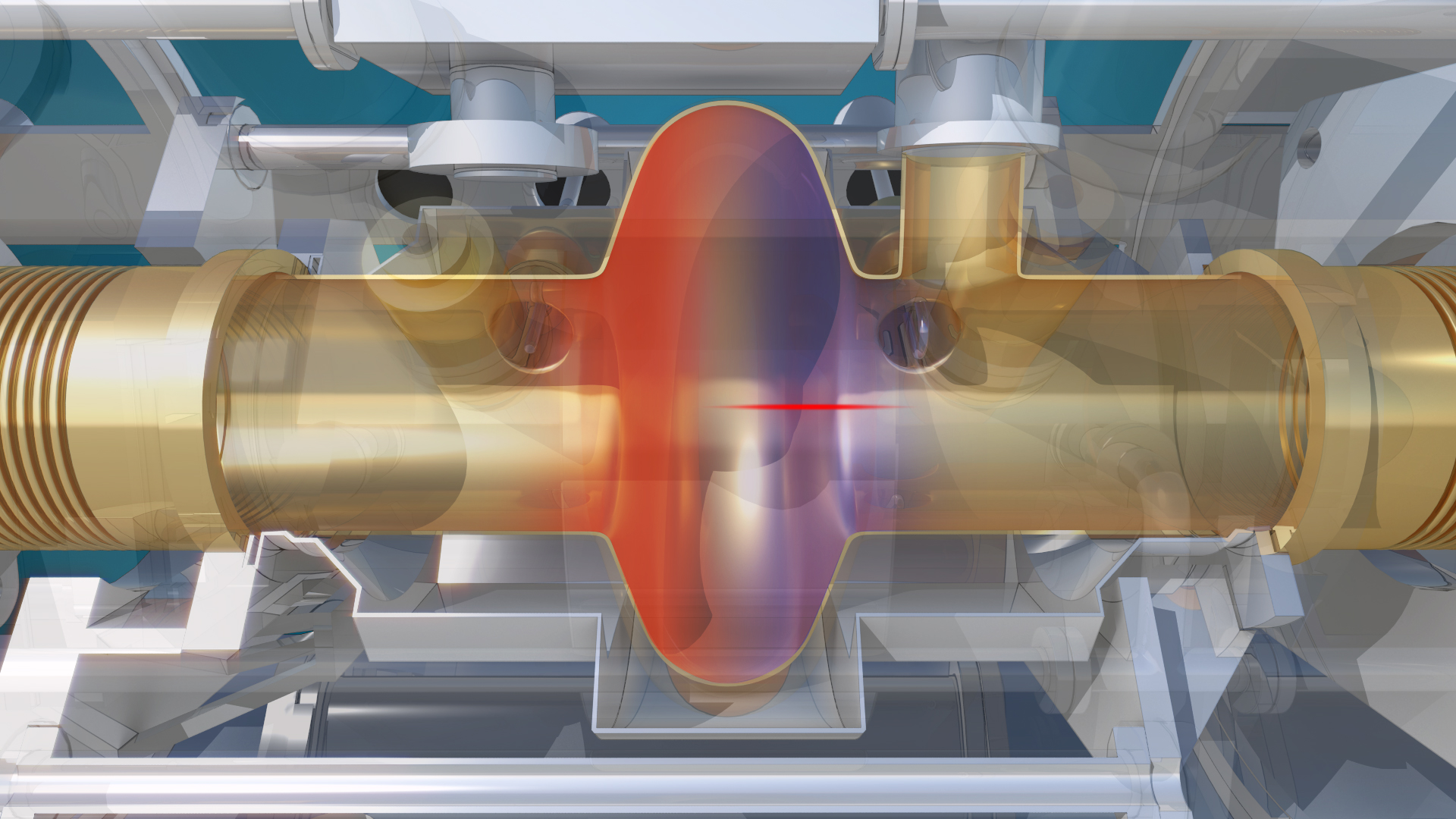
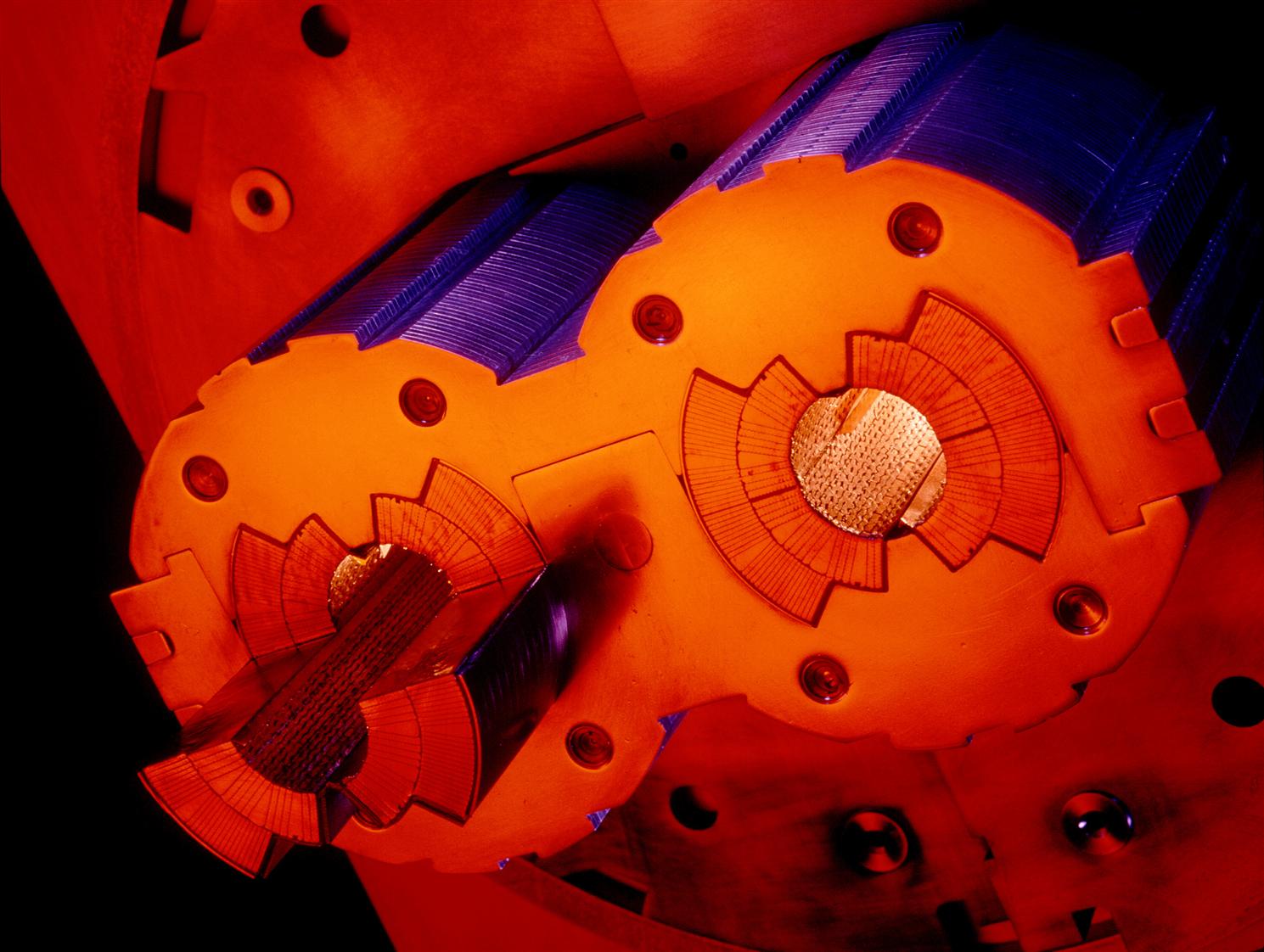
Accelerators use electromagnetic fields to accelerate and steer particles. Radiofrequency cavities boost the particle beams, while magnets focus the beams and bend their trajectory.
In a circular accelerator, the particles repeat the same circuit for as long as necessary, getting an energy boost at each turn. In theory, the energy could be increased over and over again. However, the more energy the particles have, the more powerful the magnetic fields have to be to keep them in their circular orbit.
A linear accelerator, on the contrary, is exclusively formed of accelerating structures since the particles do not need to be deflected, but they only benefit from a single acceleration pass. In this case, increasing the energy means increasing the length of the accelerator.
As physicists have explored higher and higher energies, accelerators have become larger and larger: the size of an accelerator is a compromise between energy, the radius of curvature (if it’s circular), the feasibility and the cost.
Colliders are accelerators that generate head-on collisions between particles. Thanks to this technique, the collision energy is higher because the energy of the two particles is added together.
The Large Hadron Collider is the largest and most powerful collider in the world. It boosts the particles in a loop 27 kilometres in circumference at an energy of 6.5 TeV (teraelectronvolts), generating collisions at an energy of 13 TeV.

The type of particles, the energy of the collisions and the luminosity are among the important characteristics of an accelerator.
An accelerator can circulate a lot of different particles, provided that they have an electric charge so that they can be accelerated with an electromagnetic field. The CERN accelerator complex accelerates protons, but also nuclei of ionized atoms (ions), such as the nuclei of lead, argon or xenon atoms. Some LHC runs are thus dedicated to lead-ion collisions. The ISOLDE facility accelerates beams of exotic nuclei for nuclear physics studies.
The energy of a particle is measured in electronvolts. One electronvolt is the energy gained by an electron that accelerates through a one-volt electrical field. As they race around the LHC, the protons acquire an energy of 6.5 million million electronvolts, known as 6.5 tera-electronvolts or TeV. It is the highest energy reached by an accelerator, but in everyday terms, this is a ridiculously tiny energy; roughly the energy of a safety pin dropped from a height of just two centimetres. But an accelerator concentrates that energy at the infinitesimal scale to obtain very high concentrations of energy close to those that existed just after the Big Bang.
Luminosity is a key indicator of an accelerator’s performance: it indicates the number of potential collisions per surface unit over a given period of time. The instantaneous luminosity is expressed in cm-2s-1 and the integrated luminosity, corresponding to the number of collisions that can occur over a given period, is measured in inverse femtobarn. One inverse femtobarn corresponds to 100 million millions (potential) collisions.
CERN operates a complex of nine accelerators and two decelerators. These accelerators supply experiments or are used as injectors, accelerating particles for larger accelerators. Some, such as the Proton Synchrotron (PS) or Super Proton Synchrotron (SPS) do both at once, preparing particles for experiments that they supply directly and injecting into larger accelerators.
The Large Hadron Collider is supplied with protons by a chain of four accelerators that boost the particles and divide them into bunches.
The accelerators are controlled by operators 24 hours a day from the CERN Control Centre.
Current accelerators


Future accelerators
Imagining, developing and building an accelerator takes several decades. For example, the former LEP electron-positron accelerator had not even begun operation when CERN scientists were already imagining replacing it with a more powerful accelerator. That was in 1984, twenty-four years before the LHC started.
Since 2010, scientists have been working on the LHC’s successor, the High-Luminosity LHC. Approved by the CERN Council in 2016, this second generation LHC is expected to start after 2025. CERN scientists are also working on accelerator studies for beyond 2040, such as the Future Circular Collider (FCC), the Compact Linear Collider (CLIC) and the Muon Collider. Work is also being done on alternative acceleration techniques for example with the AWAKE experiment.



Past accelerators
Many accelerators developed several decades ago are still in operation. The oldest of these is the Proton Synchrotron (PS), commissioned in 1959. Others have been closed down, with some of their components being reused for new machines, at CERN or elsewhere. Travel back into the past of CERN accelerators.