
Tag: Media
-
WWWelcome to CERN!
Geneva, 27 November 1998. CERN1, the laboratory which invented the World Wide Web has re-invented its public web site. The new face of CERN has gone live at http://www.cern.ch/Public . CERN’s new web pages have been designed to give visitors an informative introduction to the fascinating world of particle physics. For those whose whirl around
-
Time’s arrow: Particles cannot go back to the future
Geneva, 6 Novemebr 1998. We have all laughed at those fragments of film run backwards, where broken vases miraculously reassemble themselves, or sprinters reverse at full speed into their starting blocks. In the everyday world these things could never happen - time’s arrow only points forwards. Hitherto, the laws of fundamental physics have seemed to
-
French government gives green light for LHC civil engineering
Geneva, 10 August 1998. Civil engineering for CERN1‘s next major particle accelerator, the Large Hadron Collider (LHC), got the green light from France last week when Prime Minister Lionel Jospin signed the decree allowing work to commence. This important landmark for the laboratory, situated on the Franco-Swiss border, comes after a long and painstaking study
-
LEP to run in 2000
Geneva, 19 June 1998. The CERN1 Council, where the representatives of the 19 Member States of the Organization decide on scientific programmes and financial resources, held its 110th session on 19 June under the chairmanship of Dr. Hans C. Eschelbacher (DE). LEP to continue physics in the year 2000 CERN’s Large Electron-Positron collider got the
-
Japan contributes an additional 5 billion Yen to CERN’s Large Hadron Collider
Geneva, 19 May 1998. Japan’s Ministry of Education, Science, Sports and Culture (Monbusho), has announced, subject to approval by the Diet, a further contribution of 5 billion Yen (approximately 56 million Swiss francs) for the construction of the LHC. This generous gesture reinforces the excellent relations that have been established between CERN1 and Japan. In
-
ESA Director-General visits CERN
Geneva, 7 May 1998. Antonio Rodotà, Director-General of the European Space Agency (ESA) visited CERN, the European Laboratory for Particle Physics on Thursday, 7 May. He was welcomed by CERN Director-General Chris Llewellyn Smith, together with his designated successor, Luciano Maiani. After fruitful discussions the Directors-General agreed on the creation of working groups to study
-
US becomes observer at CERN
Geneva, 19 December 1997. The CERN1 Council, where the representatives of the 19 Member States of the organization decide on scientific programmes and financial resources, held its 109th session on 19 December under the chairmanship of Paul Levaux (BE). Observer status for US Council delegates applauded warmly as representatives of United States of America were
-
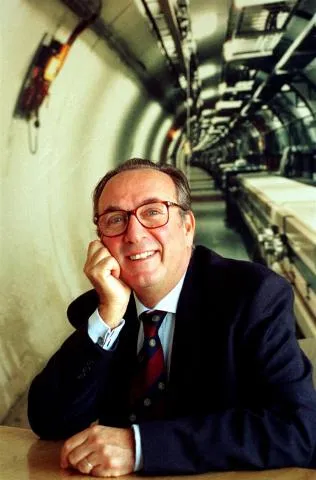
Professor Luciano Maiani chosen as next Director General of CERN
Prof. Luciano Maiani as the next Director General of the Organisation. Geneva, 19 December 1997. CERN1 Council announced at its meeting on 19 December 1997, the election of Prof. Luciano Maiani as the next Director General of the Organisation. Prof. Maiani will take office as from 1 January 1999, replacing Prof. Llewellyn Smith who will
-
U.S. to contribute $531 million to CERN’s Large Hadron Collider project
Geneva, 8 December 1997. U.S. and European officials today signed an agreement for U.S. participation in the Large Hadron Collider (LHC), a particle accelerator under construction near Geneva, Switzerland. When completed in 2005, the 27-kilometre circumference accelerator will be the most powerful in the world. The new accelerator is being built at CERN1, the European
-
CERN holds Workshop on Technology Transfer
Geneva, 25 November 1997. The World-Wide Web, medical imaging, advanced electronic chip design. These are just a few recent results of fundamental research at the World’s leading laboratory for particle physics, CERN1, in Geneva. Although the Laboratory’s mission is pure science, the tools of the trade, particle accelerators and detectors, push the bounds of technology