
Tag: Media
-
Last sprint for LEP
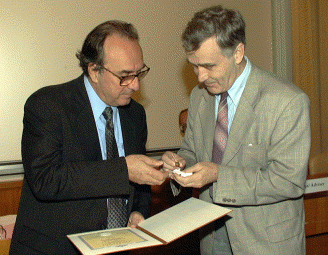
Geneva, 23 June 2000. The CERN1 Council, where the representatives of the 20 Member States of the Organization decide on scientific programmes and financial resources, held its 115th session today under the chairmanship of Dr. Hans C. Eschelbacher (DE). Geneva, 23 June 2000. The CERN1 Council, where the representatives of the 20 Member States of
-
CERN and ESA Examine Future Fundamental Physics Research in Space
Geneva, 4 April 2000. A special workshop on Fundamental Physics in Space and related topics will be held at CERN1 in Geneva from 5 to 7 April 2000. Remarkable advances in technology and progress made in reliability and cost effectiveness of European space missions in recent years have opened up exciting new directions for such
-
CERN, ESA and ESO Launch “Physics On Stage”
Geneva, 1 March 2000. Physics is everywhere. The laws of physics govern the Universe, the Sun, the Earth and even our own lives. In today's rapidly developing society, we are becoming increasingly dependent on high technology – computers, transport, and communication are just some of the key areas that are the result of discoveries by
-
New State of Matter created at CERN
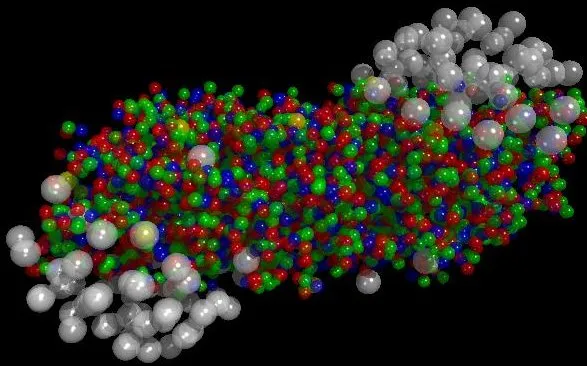
Geneva, 10 February 2000. At a special seminar on 10 February, spokespersons from the experiments on CERN1‘s Heavy Ion programme presented compelling evidence for the existence of a new state of matter in which quarks, instead of being bound up into more complex particles such as protons and neutrons, are liberated to roam freely. Geneva,
-
CERN confronts the New Millennium with Confidence
Geneva, 17 Desember 1999. The CERN1 Council, where the representatives of the 20 Member States of the Organization decide on scientific programmes and financial resources, held its 114th session on 17 December under the chairmanship of Dr. Hans C. Eschelbacher (DE). President's Report Dr Eschelbacher opened the meeting with comments on the state of CERN
-
From Geneva to Gran Sasso in 2.5 milliseconds!
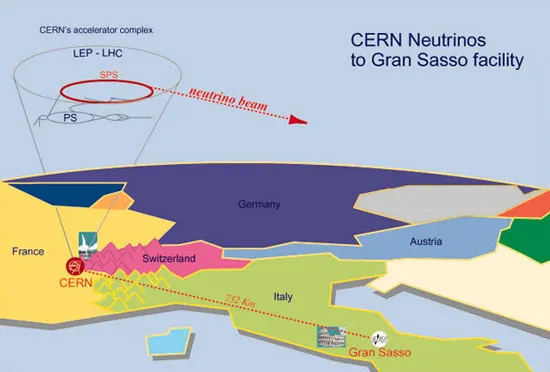
Geneva, 16 December. CERN1 is collaborating with the National Institute of Nuclear Physics (INFN) in Italy to send a beam of neutrinos through the earth, under the mountains from Geneva in Switzerland to the Gran Sasso laboratory in central Italy, 730 km away. The experiments will shed light on the possibility that neutrinos have mass
-
Basic Research Instead of Weapon Technology: CERN Finalizes Contracts with ISTC
Geneva, 22 November 1999. On Monday, 22 November, major collaboration contracts were finalized between CERN1 and the ISTC, the International Science and Technology Centre, which has its headquarters in Moscow. These contracts, worth more than 12 million Swiss Francs, are a large step forward in the cooperation between these two institutions. The agreement, which almost
-
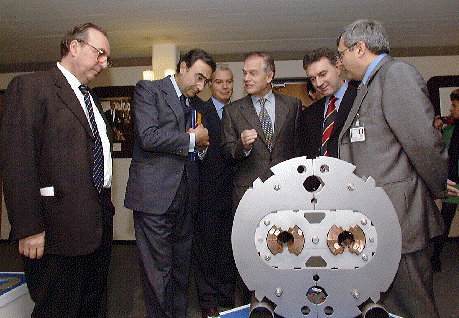
Italy presents new technology at CERN
Geneva, 16 November 1999. Twenty-two Italian companies are presenting their latest technology at the “Italy at CERN1 ” trade fair from 16 to 19 November. The Italian Minister of Research, Ortensio Zecchino, opened the exhibition on Tuesday 16 November together with CERN’s Director General, Professor Luciano Maiani. Geneva, 16 November 1999. Twenty-two Italian companies are
-
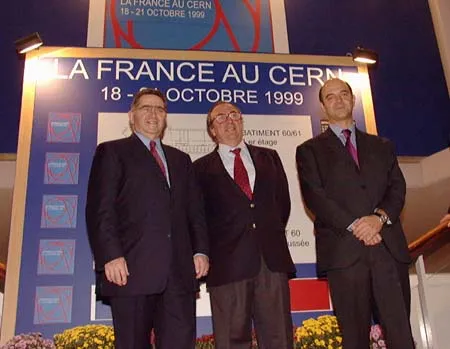
Claude Allègre opens hi-tech trade fair at CERN
Geneva, 19 October 1999. The “France at CERN” trade fair is being held at CERN1 from 19th to 21st October. The event was opened by Claude Allègre, the French Minister for National Education, Research and Technology, and Pierre Moscovici, the Minister for European Affairs. CERN was represented by the Director General, Professor Luciano Maiani. Geneva,
-
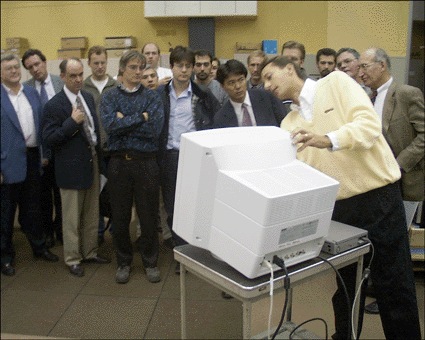
World’s fastest network standard demonstrated at CERN
Geneva, 11 October 1999. A demonstration Gigabyte System Network (GSN) was built during a workshop organised by CERN1, in collaboration with the High Performance Networking Forum (HNF). This was only the second time that GSN has been demonstrated in Europe, and it was the largest GSN to be built anywhere. Geneva, 11 October 1999. A