
Tag: Press release
-
LHC experiments present their latest results at Europhysics Conference on High Energy Physics
Geneva, 21 July 2011. The first of the major summer conferences for particle physics opens today in Grenoble. All of the LHC experiments will be presenting results, and a press conference is scheduled for Monday 25 July. The conference follows an extremely successful start to LHC running in 2011, and results are eagerly awaited. “So
-
CERN launches Open Hardware initiative
Geneva, 7 July 2011. Four months after launching the alpha version, CERN1 has today issued version 1.1 of the Open Hardware Licence (OHL), a legal framework to facilitate knowledge exchange across the electronic design community. In the spirit of knowledge and technology dissemination, the CERN OHL was created to govern the use, copying, modification and
-
CERN Council looks forward to summer conferences and new members
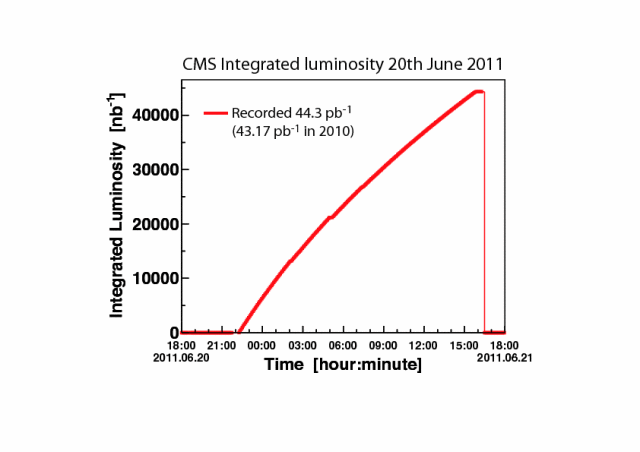
Geneva, 24 June 2011. At its 159th session this week, the CERN1 Council congratulated CERN on the excellent performance of the LHC, and welcomed the news that formal confirmation has been received from the five countries applying for CERN Membership. By 17 June, the LHC had delivered what is known as one inverse femtobarn of
-
LHC achieves 2011 data milestone
Geneva, 17 June 2011. Today at around 10:50 CEST, the amount of data accumulated by LHC experiments ATLAS and CMS clicked over from 0.999 to 1 inverse femtobarn, signalling an important milestone in the experiments’ quest for new physics. The number signifies a quantity physicists call integrated luminosity, which is a measure of the total
-
CERN experiment traps antimatter atoms for 1000 seconds
Geneva, 5 June 2011. In a paper published online by the journal Nature Physics today, the ALPHA experiment at CERN1 reports that it has succeeded in trapping antimatter atoms for over 16 minutes: long enough to begin to study their properties in detail. ALPHA is part of a broad programme at CERN’s antiproton decelerator (AD)2
-
LHC Experiments Present New Results at Quark Matter 2011 Conference
Geneva, 23 May 2011. The three LHC experiments that study lead ion collisions all presented their latest results today at the annual Quark Matter conference, held this year in Annecy, France. The results are based on analysis of data collected during the last two weeks of the 2010 LHC run, when the LHC switched from
-
The AMS detector heads for the International Space Station
Update 16 May 2011: Shuttle Endeavour launched successfully at 14:56 CEST Update 10 May 2011: Shuttle launch delayed – launch now planned 16 May 2011. For further updates follow @astroparticle and @ams_02 Geneva 27 April 2011. The AMS particle detector will take off on 29 April 2011 at 21.47 CEST onboard the very last mission
-
LHC sets world record beam intensity
Geneva, 22 April 2011. Around midnight this night CERN1’s Large Hadron Collider set a new world record for beam intensity at a hadron collider when it collided beams with a luminosity of 4.67 × 1032cm-2s-1. This exceeds the previous world record of 4.024 × 1032cm-2s-1, which was set by the US Fermi National Accelerator Laboratory’s
-
CERN announces LHC to run in 2012
Geneva, 31 January 2011. CERN1 today announced that the LHC will run through to the end of 2012 with a short technical stop at the end of 2011. The beam energy for 2011 will be 3.5 TeV. This decision, taken by CERN management following the annual planning workshop held in Chamonix last week and a
-
CERN Council welcomes new candidates for Membership
Geneva, 17 December 2010. Delegates attending the 157th session of the CERN Council today congratulated the laboratory on the LHC’s successful first year of running, and looked forward to a bright future for basic science at CERN1. Top of the agenda was the opening of CERN to new members. Formal discussions can begin now with