
Tag: Press release
-
Bulgaria is CERN’s 20th Member State
Genava, 18 June 1999. The CERN1 Council, where the representatives of the 19 Member States of the Organization decide on scientific programmes and financial resources, held its 113th session on 18 June under the chairmanship of Dr. Hans C. Eschelbacher (DE). Bulgarian Accession to CERN At a ceremony during the Council meeting the Bulgarian flag
-
Ecuador signs Co-operation Agreement with CERN
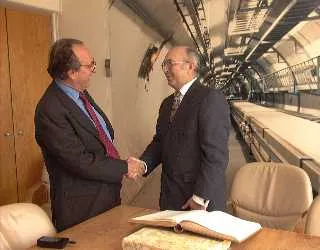
H.E. Ambassador Luis Gallegos Chiriboga of the Permanent Mission of Ecuador in Geneva and Prof. Luciano Maiani, Director General of CERN. Geneva, 15 June 1999. A new Scientific and Technological Co-operation Agreement was formally signed on June 15th 1999 in Geneva by H.E. Ambassador Luis Gallegos Chiriboga of the Permanent Mission of Ecuador in Geneva
-
Science bringing nations Together
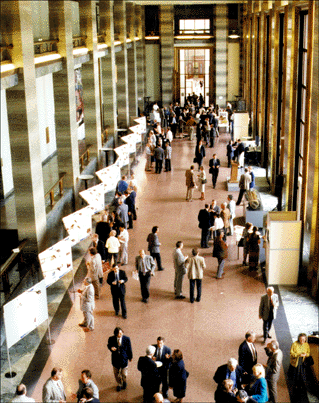
Pas Perdus Hall of the Palais des Nations, Geneva. Geneva, 30 April 1999. On Monday 3 May 1999 at 5 p.m. Ambassador Vassily Sidorov, Permanent Representative of the Russian Federation to the United Nations, together with the Director General of the European Laboratory for Particle Physics (CERN1) Prof. Luciano Maiani, and the Director of the
-
Laying of foundation stone of CERN Building SMA18
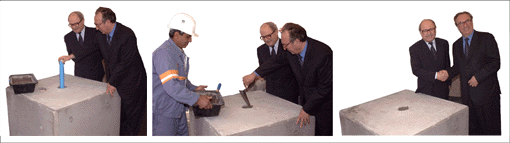
Geneva, 27 April 1999. On 30 April 1999, Jean Pépin, Sénateur for the Department of the Ain and President of the Conseil Général, and Professor Luciano Maiani the Director-General of CERN1 will lay the foundation stone of Building SMA18, financed by the Department of the Ain in the framework of France’s special contribution to CERN’s
-
CERN strengthens its technology transfer policy
Geneva, 16 March 1999. On 10 March 1999, the Finance Committee of CERN1 adopted the policy proposed by the new Management aimed at enhancing technology transfer between CERN and industry. The three main actions taken will be: promoting adequate intellectual property protection rights for new technologies developed at CERN and in collaborating institutes, encouraging the
-
Fire at CERN
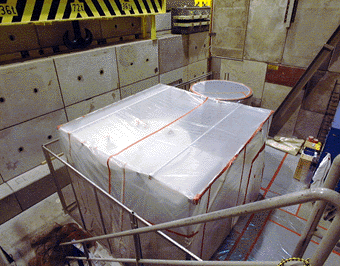
Geneva, 26 January 1999. At 9.15 a.m. on 26 January a fire broke out when part of a particle detector was being dismantled. This apparatus comprised 80 plates of depleted uranium which is used for its strong particle absorption power. Depleted uranium is only very slightly radioactive. The work was being done by two people
-
Professor Llewellyn Smith ends mandate as Director-General
Geneva, 11 December 1998. The CERN1 Council, where the representatives of the 19 Member States of the organization decide on scientific programmes and financial resources, held its 111th session on 11 December under the chairmanship of Dr. Hans C. Eschelbacher (DE). End of Director-General's mandate Speakers representing the world community of particle physics praised the
-
German industry answers the challenge of LHC
Geneva, 1 December 1998. The 7th German technology fair “Germany at CERN 1998” which is being held in CERN1‘s main building from the 1st to 3rd of December, provides the opportunity to extend and deepen the longstanding collaboration between German industry and CERN. This collaboration enables the research community to carry out experiments at an
-
WWWelcome to CERN!
Geneva, 27 November 1998. CERN1, the laboratory which invented the World Wide Web has re-invented its public web site. The new face of CERN has gone live at http://www.cern.ch/Public . CERN’s new web pages have been designed to give visitors an informative introduction to the fascinating world of particle physics. For those whose whirl around
-
Time’s arrow: Particles cannot go back to the future
Geneva, 6 Novemebr 1998. We have all laughed at those fragments of film run backwards, where broken vases miraculously reassemble themselves, or sprinters reverse at full speed into their starting blocks. In the everyday world these things could never happen - time’s arrow only points forwards. Hitherto, the laws of fundamental physics have seemed to