
Shaping the future of non-collider physics at CERN
A dedicated taskforce has been established to design and implement the long-term roadmap for non-collider physics at CERN
Written by:
The Non-Collider Physics Roadmap taskforce team
—
Non-collider activities are a vital component of CERN’s scientific ecosystem, supporting a diverse user community of more than 3000 scientists and enabling a wide range of experiments beyond the high-energy frontier. Through initiatives such as the Physics Beyond Colliders programme, CERN has already fostered innovative proposals for new experiments that leverage its unique accelerator complex and infrastructure, while continuing to develop facilities such as ISOLDE, AD/ELENA and n_TOF, and explore future opportunities.
As part of its vision under CERN’s strategy for 2026–2030 (Pillar 2, Cutting-edge scientific research at the forefront of knowledge), CERN is reaffirming the central role of its non-collider physics programme in delivering scientific excellence and maintaining the Laboratory’s broad appeal to the global research community.
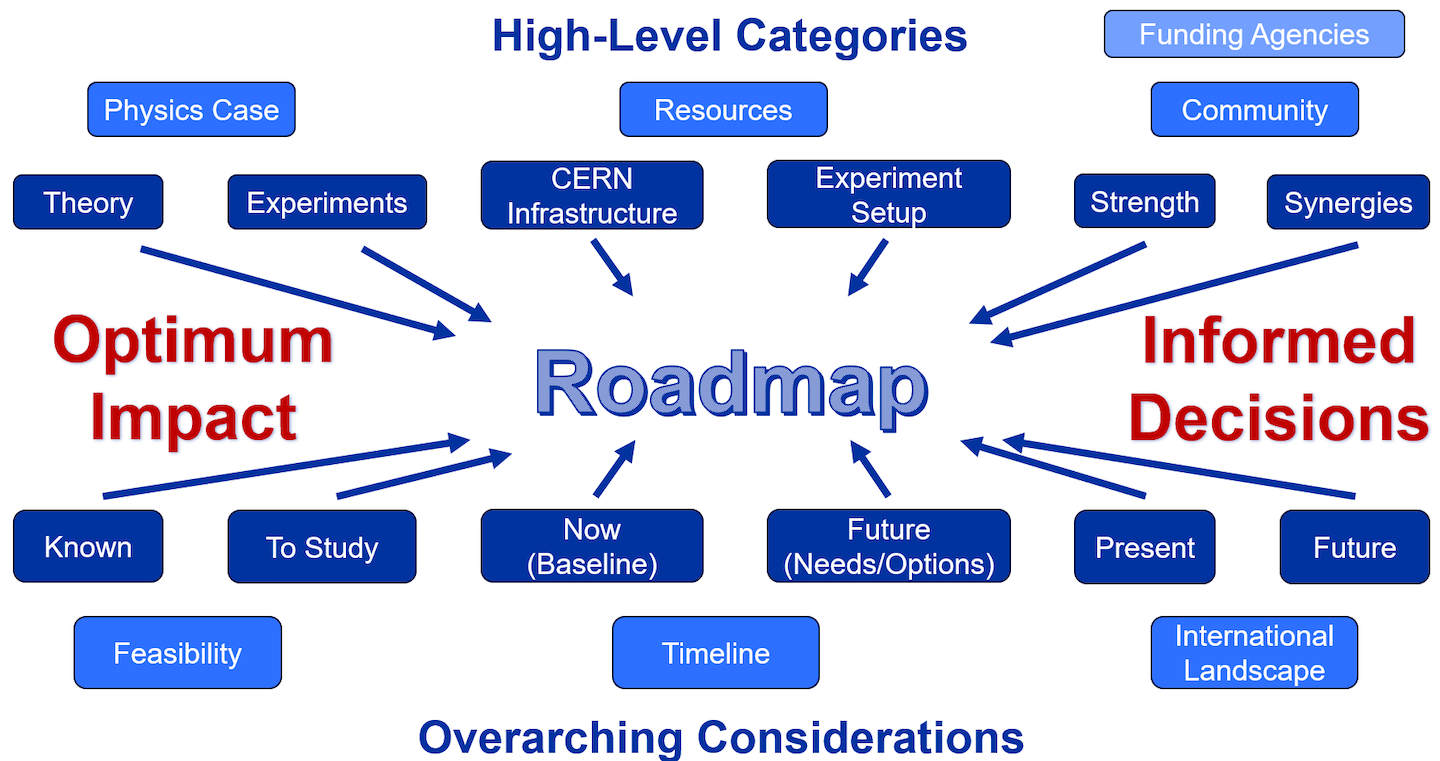
Looking ahead, CERN is placing strong emphasis on defining clear priorities for this domain. Central to this effort is the development of a coherent long-term roadmap for non-collider physics and ensuring that future activities are strategically embedded within CERN’s medium- and long-term plans and aligned with the Laboratory’s overall scientific objectives. This roadmap aims at taking a holistic view of existing and proposed experiments, enabling transparent prioritisation and effective use of resources.
To support this goal, a dedicated taskforce has been established to design and implement the roadmap framework. Its mandate includes delivering, within one year, a baseline plan and scenarios for the evolution of non-collider physics over the next two decades, and outlining – based on the already approved programme – which further options could be pursued and under which conditions. The taskforce will pursue this study based on indicative long-term resource scenarios and propose a transparent, community-inclusive process for evaluating and sequencing future projects. Ensuring coherence with CERN’s broader programme and maximising complementarity across facilities and experiments are key guiding principles.
“Non-collider physics is a fundamental part of CERN’s scientific programme, taking advantage of our unique facilities. This broad programme enriches our research output, extends CERN’s appeal to diverse scientific communities and strengthens the impact of the Laboratory as a whole. Developing a holistic long-term roadmap is essential to ensure that we optimise our future non-collider physics programme in a coherent and sustainable way,” said Mark Thomson.
Building on CERN’s mandate, the roadmap effort will take a structured and phased approach to laying the ground for future decision making. The taskforce will systematically review the current programme and its projected evolution, while assessing future opportunities at different levels of maturity. Close collaboration with CERN’s scientific and technical committees, as well as active engagement with user communities*, will ensure that both scientific excellence and technical feasibility, and the level of community support, are fully integrated into the process. This process will inform the 2027 Medium-Term Plan and thus contribute to the evolution of CERN’s non-collider programme over the coming decades.
By strengthening the strategic planning of non-collider physics, CERN aims to maximise scientific return, sustain its diverse research portfolio and continue offering a unique platform for exploration across multiple frontiers of physics.
__________
* In the context of the roadmap preparation process, an academic training lecture series is launched, with the next seminars taking place on:
17 June 2026 | A Roadmap for Non-Collider Physics at CERN
7 July 2026 | Feebly Interacting Particles I: Physics Motivation and Worldwide Efforts
13 July 2026 | Feebly Interacting Particles II: Searches at the SPS