
n_TOF experiment sheds light on ancient stardust
The first experimental determination of the neutron capture of niobium-94 by n_TOF researchers marks a milestone in efforts to understand the composition of ancient stardust
Written by:
Rory Harris
—
Niobium-94, an isotope of niobium with 41 protons and 53 neutrons, is a critical crossroads in the complex nuclear processes that forge heavy elements under the intense pressures and temperatures of dying stars. Writing in Physical Review Letters, the n_TOF Collaboration reports the first ever measurement of the probability of niobium-94 taking one of the paths at this crossroads, that is to undergo neutron capture.
This new result provides insight into a persistent puzzle over the composition of ancient stardust. This type of stardust, known as presolar grains, survived the formation of the Sun and did not get incorporated into our Solar System. Some of these grains can now be found on Earth, having been brought down by primitive meteorites. And through analysing these presolar grains, researchers can get a snapshot of the nuclear make-up of our Galaxy as the heavy elements were being formed. The puzzle for researchers is that the presolar grains contain more molybdenum-94 than can be explained by theoretical models.
To investigate this problem, researchers looked at niobium-94, which is very similar to molybdenum-94 but with one less proton and one extra neutron. Within a dying star, where the extreme environment allows heavy elements to form, niobium-94 is at a crossroads. It may undergo beta decay to become molybdenum-94 or neutron capture to become niobium-95. Understanding how these two processes compete in this environment is crucial for gaining insight into why there are such mysteriously large amounts of molybdenum-94 in presolar grains.
“The problem was that nobody had ever measured how likely niobium-94 is to capture a neutron,” said Alberto Mengoni, Spokesperson of the n_TOF Collaboration. “Scientists only had rough theoretical guesses.”
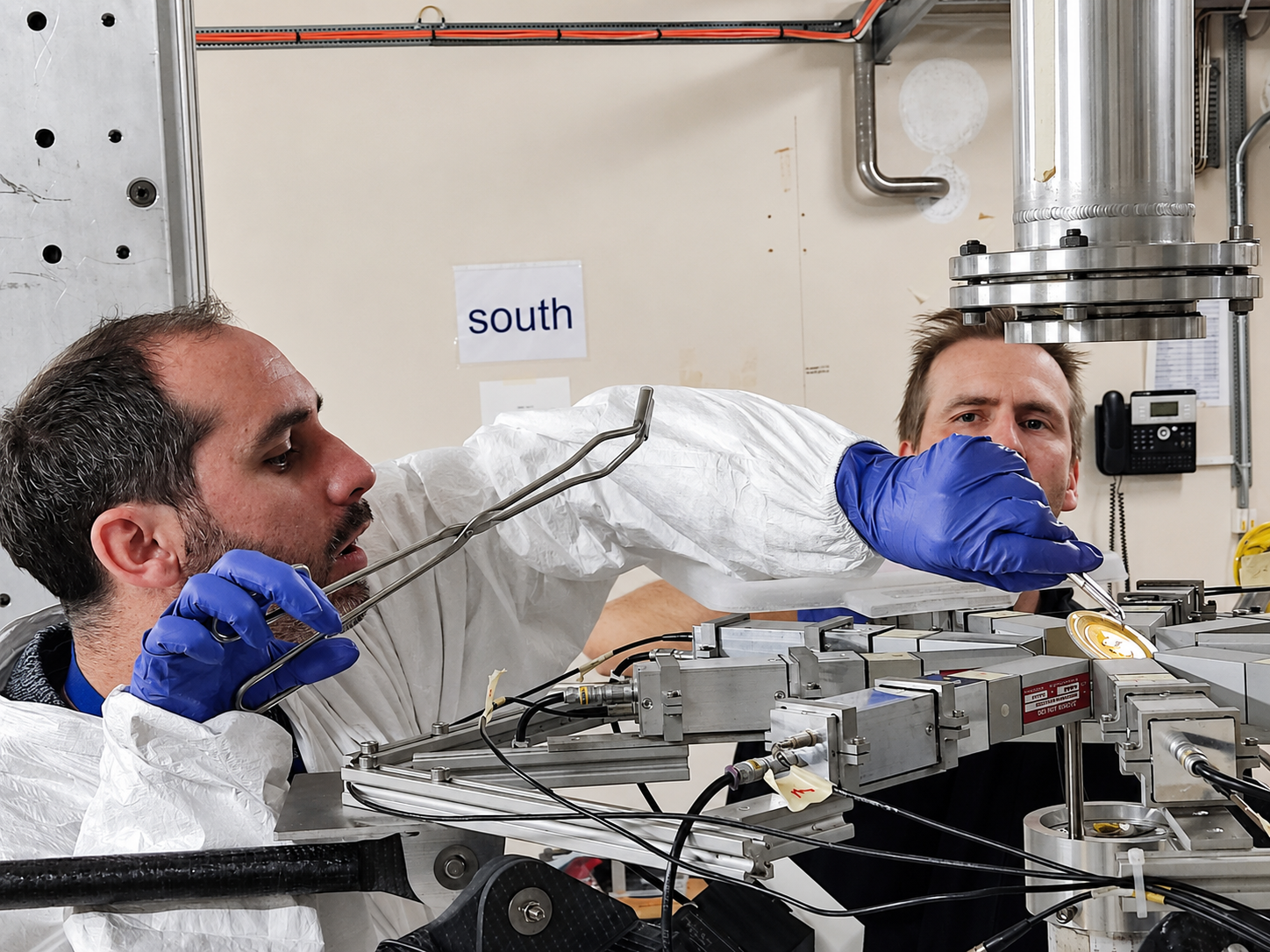
Experimentally measuring the neutron capture of niobium-94 poses many challenges, one of which is to produce and characterise samples of the isotope, which was overcome only though a collaborative effort by multiple institutes. IFW Dresden produced a stable and pure niobium-93 sample, and the Institut Laue-Langevin converted a small amount of this into niobium-94, which was then carefully characterised at the Paul Scherrer Institute. At the EAR2 station at CERN’s n_TOF facility, the researchers could then irradiate the sample with one of the most intense neutron sources in the world in order to simulate the stellar processes that would cause niobium-94 to capture a neutron.
“The unparalleled instantaneous neutron flux of the EAR2 station was pivotal for detecting the faint signal of neutron capture from the niobium-94 sample,” explained Javier Balibrea-Correa, principal investigator of this niobium-94 experiment. “The measurement turned out to be close to some of the previous theoretical estimates, meaning the longstanding discrepancy between models and stardust data was not caused by these estimates but rather by limitations in older stellar models. Indeed, when this new result is incorporated into the most advanced stellar models, they have much less uncertainty and are able to successfully reproduce the molybdenum-94 abundances observed in ancient stardust, marking a milestone in the molybdenum puzzle.”
However, another important piece of the puzzle remains to be understood. Researchers have only theoretical estimates for the other fork in the niobium-94 crossroads, which is to undergo beta decay. Future experiments will now be looking to make precise measurements of this nuclear process in order to better understand where all the molybdenum-94 came from and thus build a clearer picture of how stars create the heavy elements.