
Category: At CERN
-
CERN awarded high-performance computing prize at Supercomputing 2005
Geneva, 16 November 2005. CERN1 has received the High Performance Computing (HPC) Public Awareness Award at a ceremony at Supercomputing 2005 in Seattle this week. Supercomputing 2005 is the foremost international conference for HPC. The award was presented by HPCwire, the leading HPC publication, as one of their 2005 Editors’ Choice Awards, a category where
-
Setting the stage for science in schools
Geneva, 10 November 2005 – How can you weigh the Earth with a straw, a paperclip and a piece of thread? Why don’t we really know what we see? How can a juggling act explain mathematics? These are but a few of the on-stage activities that will be shown at the EIROforum1 Science on Stage
-
Global e-Infrastructure reports landmark results at European conference
Geneva, 28 October 2005. Today marked the completion of a major conference organized by the Enabling Grids for E-sciencE project, which is coordinated by CERN1 and co-funded by the European Commission, where a number of key results were reported on the road to achieving a global Grid infrastructure for science. It was announced at the
-
ICALEPCS 2005: Experts in experimental-physics controls meet in Geneva
Geneva, 7 October 2005. From 10 – 15 October, CERN1, and the Centre de Recherches en Physique des Plasmas (CRPP) of the École Polytechnique Fédérale de Lausanne (EPFL), will be hosting ICALEPCS 2005, the 10th International Conference on Accelerator and Large Experimental Physics Control Systems, at the Geneva International Conference Centre (CICG). The meeting’s scientific
-
CERN receives prestigious Milestone recognition from IEEE
Geneva, 27 September 2005. At a ceremony last night at CERN1, Mr W. Cleon Anderson, President of the Institute of Electrical and Electronics Engineers (IEEE)2 formally dedicated a Milestone plaque in recognition of the invention of electronic particle detectors at CERN. The plaque was unveiled by Mr Anderson and Georges Charpak, the Nobel-prize winning inventor
-
CERN/ITU/UNU help build momentum for African research and education networking
Geneva, 22 September 2005. As part of efforts to implement the outcome of the first World Summit on the Information Society (WSIS), held in Geneva in 2003, the United Nations University (UNU1) in collaboration with the International Telecommunication Union (ITU2) and the European Organization for Nuclear Research (CERN3) will hold an International Workshop on African
-
Magnetic manoeuvres at CERN
Geneva, 25 August 2005. Important milestones have been successfully reached today in the installation of the two largest magnets ever built for experiments at CERN1. At one side of the 27 km ring of the future Large Hadron Collider (LHC), the 230 tonne solenoid magnet for the CMS experiment has been rotated through 90° prior
-
CERN neutrino project on target
Geneva, 15 August 2005. Scientists at CERN1 today announced the completion of the target assembly for the CERN neutrinos to Gran Sasso project, CNGS. On schedule for start-up in May 2006, CNGS will send a beam of neutrinos through the Earth to the Gran Sasso laboratory 730km away in Italy in a bid to unravel
-
CERN Council positioned as Europe’s strategic body for particle physics
Geneva, 17 June 2005. Speaking at the 133rd session of CERN1 Council today, Council Chair, Enzo Iarocci, declared that the Council has agreed to take on the role of defining the future strategy and direction for European particle physics research. Professor Iarocci went on to remind the meeting that this task was originally foreseen for
-
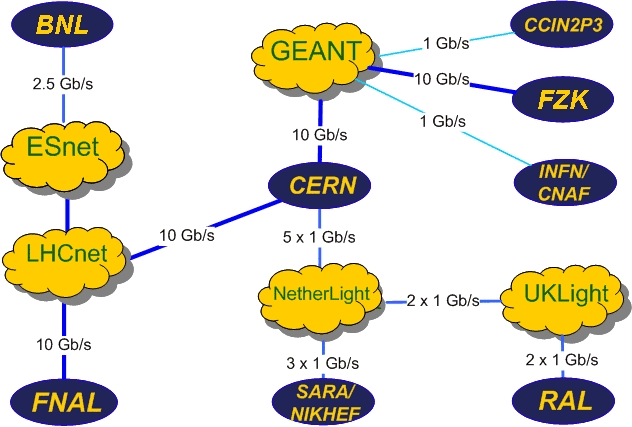
LHC Computing Centres Join Forces for Global Grid Challenge
Geneva, 25 April 2005 – Today, in a significant milestone for scientific grid computing, eight major computing centres successfully completed a challenge to sustain a continuous data flow of 600 megabytes per second (MB/s) on average for 10 days from CERN1 in Geneva, Switzerland to seven sites in Europe and the US. The total amount