
Category: At CERN
-

CHEP ’04: Physicists and Industry Experts Meet in Interlaken to Discuss Future of Scientific Computing
Geneva, 23 September 2004. Next week, CERN1 will be hosting CHEP ’04, a major conference for Computing in High Energy and Nuclear Physics, at the Congress Centre in Interlaken (September 27 – October 1). This edition of CHEP2 will be particularly auspicious, falling in the week where CERN, the European Organisation for Nuclear Research, celebrates
-

CERN’s 50th anniversary in lights
Geneva, 22 September 2004. To mark the 50th anniversary of CERN’s creation, local Swiss and French authorities have clubbed together to offer the Organization a spectacular illumination of the 27-kilometre ring of the Large Hadron Collider accelerator. At 20:00 sharp on 29 September, Micheline Spoerri, Head of Geneva’s Department of Justice, Police and Security, will
-

CERN 50th anniversary celebrations approach their climax
Geneva, 7 September 2004. CERN1‘s 50th anniversary celebrations step up a gear in September, and reach a climax with an official celebration on 19 October. Media are welcome at this event, but accreditation in advance is essential. Geneva, 7 September 2004. CERN1‘s 50th anniversary celebrations step up a gear in September, and reach a climax
-
EnviroInfo 2004: an international conference dedicated to sh@ring
Sh@ring. Sharing is central to EnviroInfo 20041 , which will take place at CERN2 in Geneva on October 21, 22 and 23, 2004. Sharing of technologies. Sharing of data and know-how. Sharing of experiences. For its 18th edition, the International Conference Informatics for Environmental Protection is dedicated to sharing, in accordance with the principles of
-

CERN openlab adds a new dimension to Grid computing
Geneva, 5 July 2004. The CERN openlab for DataGrid applications, a partnership between CERN1, the European Organization for Nuclear Research, and five leading IT companies – Enterasys Networks, HP, IBM, Intel and Oracle – has announced a series of server and storage technical results regarding the first global science Grid – the Large Hadron Collider
-
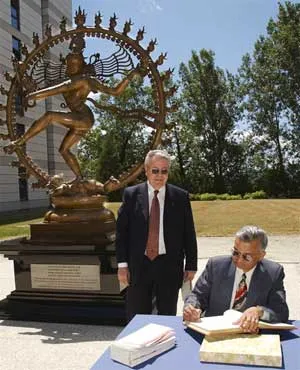
CERN Director General Outlines Seven-point Strategy for European Laboratory
Geneva 18 June 2004. At the 128th session of CERN1 Council, held today under the chairmanship of Professor Enzo Iarocci, CERN Director General, Robert Aymar, outlined a seven-point scientific strategy for the Organization. Top of the list was completion of the Large Hadron Collider (LHC) project with start-up on schedule in 2007. This was followed
-
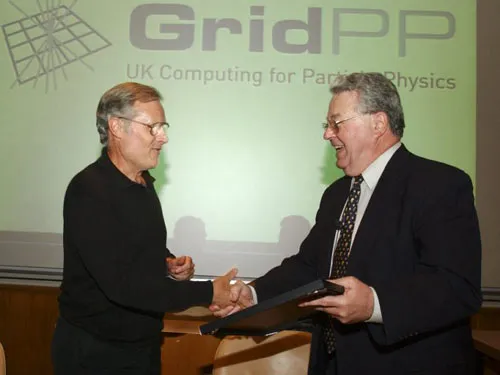
CERN recognizes UK’s outstanding contribution to Grid computing
Geneva, 2 June 2004. CERN1‘s Director General, Dr Robert Aymar, today formally recognized the UK’s exceptional contribution to developing the next generation of computing by presenting awards for outstanding achievement to two British researchers who have been at the forefront of Grid computing at CERN. Dr Aymar also took the opportunity to praise the UK’s
-

CERN Collaborates with Voltaire on Grid Technology Project
Geneva, Switzerland and Bedford, Massachusetts, US, 17 May 2004. The European Particle Physics Laboratory CERN1 and Voltaire, a leading provider of InfiniBand2 solutions for high performance Grid computing, announced today that Voltaire is contributing to the CERN openlab for DataGrid applications. CERN openlab is an industrial partnership which aims to create and test new Grid
-
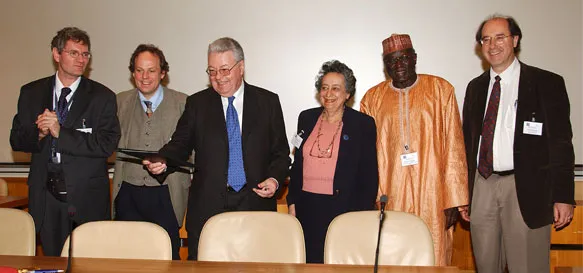
CERN and University of Pavia sign Berlin Declaration at meeting on Open Access to Knowledge in the Sciences and Humanities
Geneva, 13 May 2004. First practical actions toward the realization of open access to knowledge in the sciences and in the humanities have been formulated at a meeting on the implementation of the recommendations in the Berlin Declaration held at CERN1, Geneva, 12 and 13 May 2004, and coordinated by the Max Planck Institute for
-
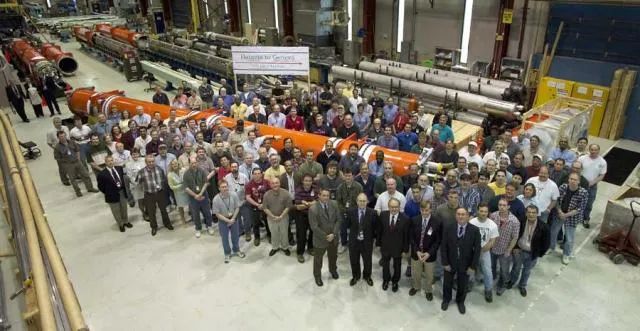
First Fermilab LHC magnet leaves Illinois, bound for CERN
Geneva, 11 May 2004. Officials of the US Department of Energy’s Fermi National Accelerator Laboratory (Fermilab1), near Chicago, and CERN2 announced today the shipment of an advanced superconducting magnet from Fermilab to CERN. The first of a series of such magnets designed and built at Fermilab, the magnet is destined to play a key role