
Category: At CERN
-
New World Record announced for Internet Performance
Geneva, 20 April 2004 – An international team has set a new Internet2(R)2 Land Speed Record by transferring data across nearly 11,000 kilometres at an average rate of 6.25 gigabits per second (Gbps), nearly 10,000 times faster than a typical home broadband connection, from Los Angeles, USA, to Geneva, Switzerland. The Internet2 Land Speed Record
-
European grid computing changes gear
Geneva, 31 March 2004. European plans for Grid technology change gear this week, as the pioneering European DataGrid (EDG) project comes to a successful end and a new project, the Enabling Grids for E-Science in Europe (EGEE) project, begins. The EGEE project will build on the success of the EDG project and take Grid technology
-
New Protocol is 50th anniversary gift to CERN
Geneva, 18 March 2004. Nine of CERN1‘s 20 Member States today signed a new Protocol on privileges and immunities. This brings the Organization into line with other European intergovernmental organizations, such as the European Space Agency and the European Southern Observatory, which already enjoy international status in all of their Member States. CERN already benefits
-
Opening the Big Black Box: European Study Reveals Visitors’ Impressions of Science Laboratories
Geneva, 18th March 2004. On 29 – 30 March the findings of ‘Inside the Big Black Box’- a Europe-wide science and society project – will be revealed during a two-day seminar hosted by CERN1. The principle aim of Inside the Big Black Box (IN3B) is to determine whether a working scientific laboratory can capture the
-
CERN launches 50th anniversary celebrations
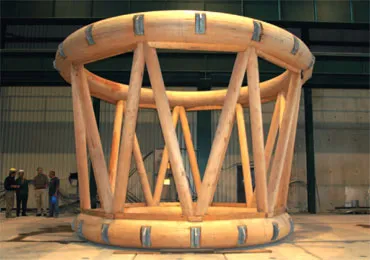
Geneva, 1 March 2004. Celebrations to mark the 50th anniversary of CERN1 officially begin on 8 March with the launch of a Swiss postage stamp dedicated to the Organization. At a press conference in Geneva, the stamp will be presented and details of events to mark the anniversary throughout the Organization's Member States will be
-
CERN Council rings the changes for the upcoming years
Geneva, 19 December 2003. The CERN1 Council, where the representatives of the 20 Member States of the Organization decide on scientific programmes and financial resources, held its 126th session today under the chairmanship of Professor Maurice Bourquin. A review of the year’s activities by outgoing Director General Luciano Maiani, a new structure for CERN, and
-
The Role of Science in the Information Society asserted in CERN conference
Geneva, 9 December 2003. In hosting the Role of Science in the Information Society (RSIS) conference, CERN1 takes a bold step forward into the policy arena. The conference, which was organised jointly by CERN, UNESCO, the International Council for Science, and the Third World Academy of Sciences, was held at CERN on 8-9 December as
-
CERN signs agreement with New Zealand
Geneva, 4 December 2003. New Zealand’s particle physicists have joined the world’s most ambitious scientific undertaking with the signing of a Memorandum of Understanding (MoU) between their government and CERN1. This agreement formalises the participation of New Zealand scientists in the laboratory’s Large Hadron Collider (LHC) project. The MoU, signed recently by New Zealand's Science
-
Oracle joins Cern Openlab to advance Grid Computing
Geneva, 3 December 2003. CERN1 and Oracle Corporation (NASDAQ: ORCL) today announced that Oracle is joining the CERN openlab for DataGrid applications to collaborate in creating new grid computing technologies and exploring new computing and data management solutions far beyond today’s Internet-based computing. The CERN openlab for DataGrid applications will see collaboration between CERN researchers
-
CERN to host conference on the Role of Science in the Information Society
Geneva, 2 December 2003. On 8 and 9 December, CERN1 will host the Role of Science in the Information Society (RSIS) conference, together with UNESCO, the International Council for Science, and the Third World Academy of Sciences. A Summit Event to the first phase of the World Summit on the Information Society (Geneva, 10-12 December),