
From Amazonia to CERN: First Brazilian Teacher Programme held at CERN
From 19 to 24 April 2026, CERN welcomed 24 high-school teachers from across Brazil for its very first Brazilian Teacher Programme
Written by:
Jeff Wiener
—
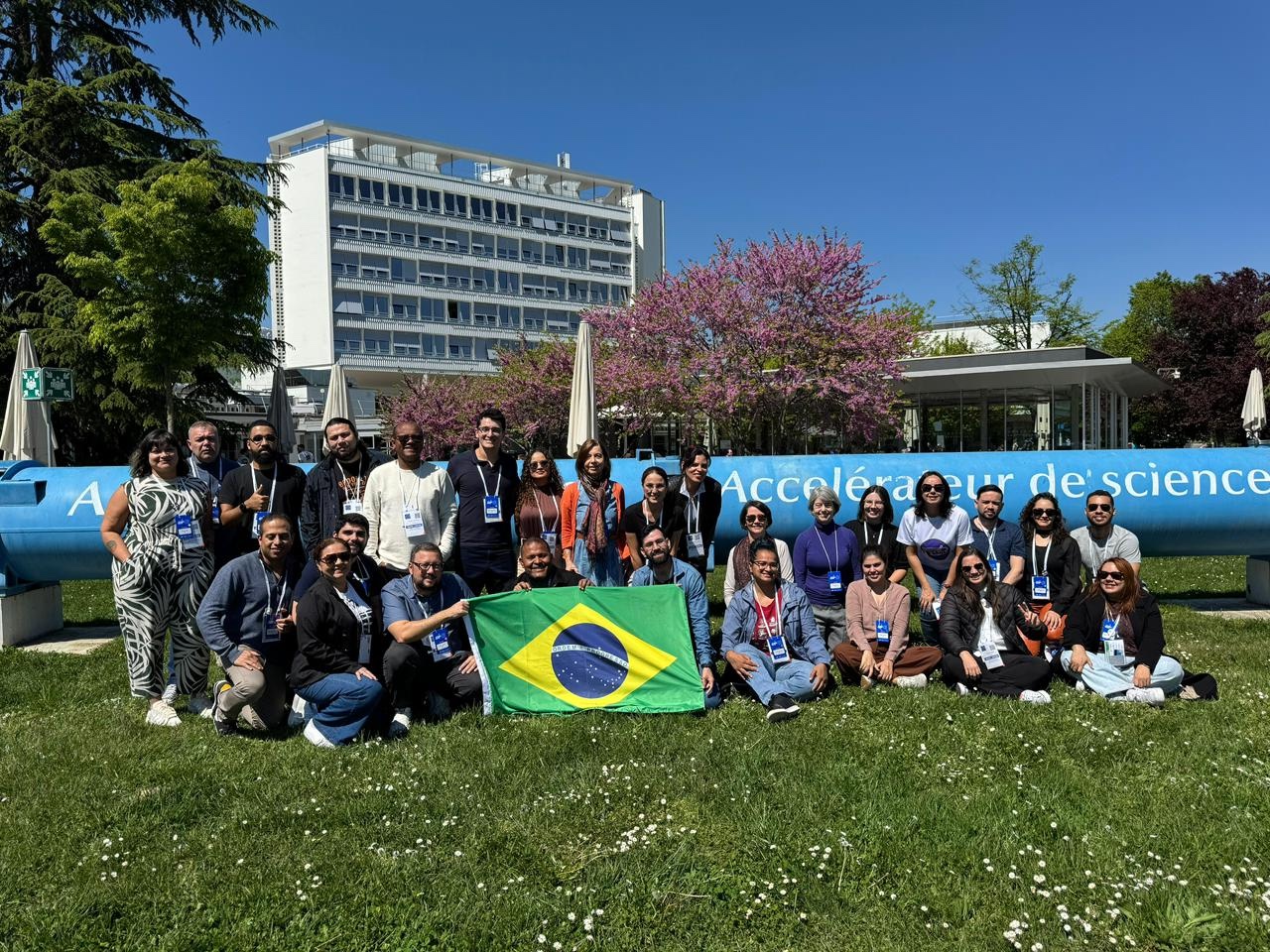
From 19 to 24 April 2026, CERN welcomed 24 high-school teachers from across Brazil for its very first Brazilian Teacher Programme. Representing all regions of the country, the participants travelled both from major state capitals and remote areas in Amazonia, reflecting the geographical and cultural diversity of Brazil.
Launched in 1998, CERN’s Teacher Programmes are professional development programmes dedicated to in-service high-school physics teachers across the world. They introduce them to CERN’s scientific and technological activities, help them keep up to date with the latest developments in particle physics and related areas, and teach them how modern physics can be brought into the classroom. Every year, CERN welcomes around 1000 teachers as part of these programmes.
The programmes, which last between one and two weeks and are facilitated by experts in the fields of physics, engineering and computing, include an extensive lecture and visit itinerary at CERN. They are delivered in English or in one of the national languages of CERN’s Member and Associate Member States.
The Portuguese Language Teacher Programme, which brings together teachers from all Portuguese-speaking countries, has existed since 2009. To date, more than 350 teachers from Brazil have already joined this programme.
Now, with Brazil officially becoming a CERN Associate Member State in 2024, the Brazilian Physical Society (SBF) took the initiative to organise, in collaboration with CERN’s Education Section and supported by the Brazilian Federal Agency for Support and Evaluation of Graduate Education (CAPES) and the Brazilian National Council for Scientific and Technological Development (CNPq), the first-ever Brazilian Teacher Programme.
Alongside lectures by Brazilian physicists and engineers covering topics ranging from particle physics, detectors and accelerators to astrophysics and gravitational waves, the programme included site visits and hands-on workshops. A key focus of the week was pedagogy: participants explored innovative teaching approaches and worked in small groups to develop outreach and classroom activities. The programme concluded with presentations of these projects, designed to be implemented in schools across Brazil.