
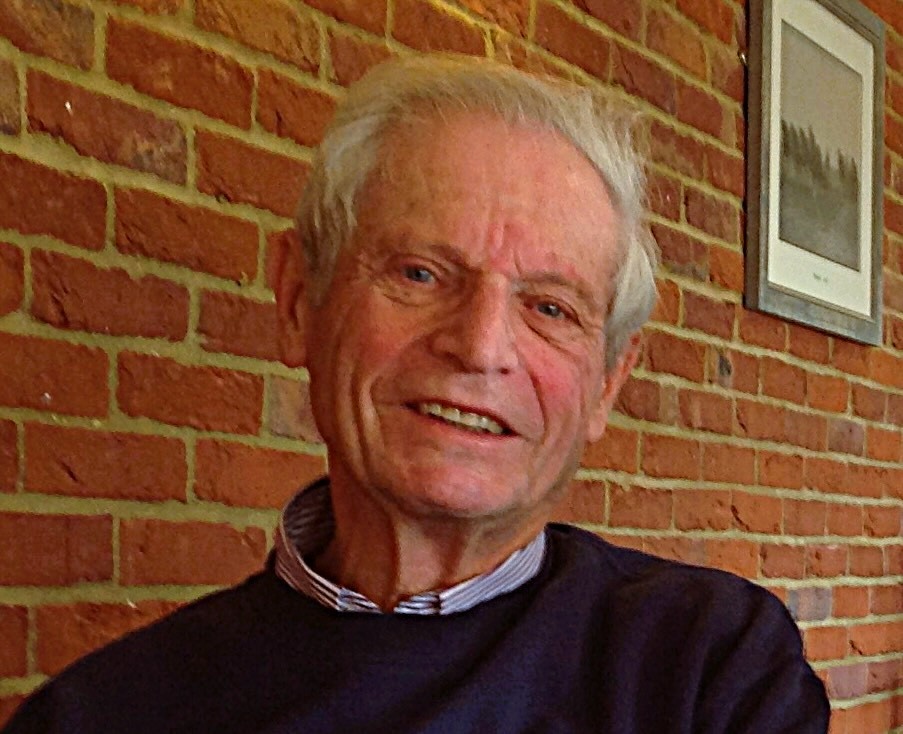
George Kalmus (1935–2026)
—
It is with great sadness that we learned that George Kalmus passed away on 27 May at the age of 91. George had a long and distinguished career in experimental particle physics, not only at CERN, where he played a leading role in many experiments, but also at the Rutherford Appleton Laboratory (RAL) in the UK and at the Lawrence Berkeley Laboratory (LBL) and SLAC in the US.
George was born in Yugoslavia, and moved to London with his family in 1939. He went on to obtain his physics degrees at University College London (UCL), gaining a PhD with a thesis entitled Physical properties of bubble chambers in 1959. This was the start of a long involvement with this well-known technique for visualising the tracks of charged particles.
Following research and teaching positions at UCL, in 1964 George moved to what is now LBL, becoming a senior physicist there in 1967. During this time he worked on many aspects of the decay of positive kaons, and designed a negative kaon beam at the Bevatron, the laboratory’s proton synchrotron.
In 1972, George left LBL to become head of the bubble chamber group at what is now RAL, where he was to spend the rest of his career. Just before this, in 1970–1971, he had worked at CERN for a year as a visiting scientist. At RAL, his involvement with CERN continued as he proposed and led a major experiment using a Track-Sensitive Target in the Big European Bubble Chamber (BEBC). He was a member of the CERN Track Chamber Committee, the first Chair of the BEBC User Group, and in 1979–1982 a member of the CERN Super Proton Synchrotron Committee. After the discovery of particles with ‘open charm’ in 1976, he led an experiment making important measurements of the decays of short-lived D mesons in a bubble chamber, this time at SLAC.
In the 1980s, as bubble chambers were increasingly replaced by electronic detectors, George went on to lead the Rutherford group working on the DELPHI experiment at CERN’s LEP collider, where he contributed to the design, realisation and analysis of the experiment. He led RAL’s involvement in the construction of the DELPHI solenoid – at the time the world’s largest superconducting magnet – and later pushed for the addition of a silicon microvertex detector, the first at LEP.
George became director of RAL’s Particle Physics Department in 1986, a post he held until 1997. He then joined the NA48 experiment at CERN to study ultra-rare kaon decays, thus continuing a long interest in these particles. At the same time, he was appointed as Chair of CERN’s Scientific Policy Committee from 1999 to 2001, having been a member of the Committee from 1990 to 1997. He retired from RAL in 2000, but not from physics, joining the ZEPLIN-III experiment to search for dark matter in the Boulby Underground Laboratory in Yorkshire, UK.
George had a special combination of scientific ability, integrity and human skills, all greatly appreciated by those who knew and worked with him. He is survived by his brother, Peter, who is also a particle physicist, three daughters and his grandchildren. Our deepest sympathy goes to his family.
His former colleagues and friends
________
An obituary will also appear in the CERN Courier.