
The puzzle of neutrinos, seventy years on
Theorised in 1930 and discovered in 1956, the elusive neutrino still keeps many of its secrets, inspiring research efforts at CERN and around the world
Written by:
Davide De Biasio
—
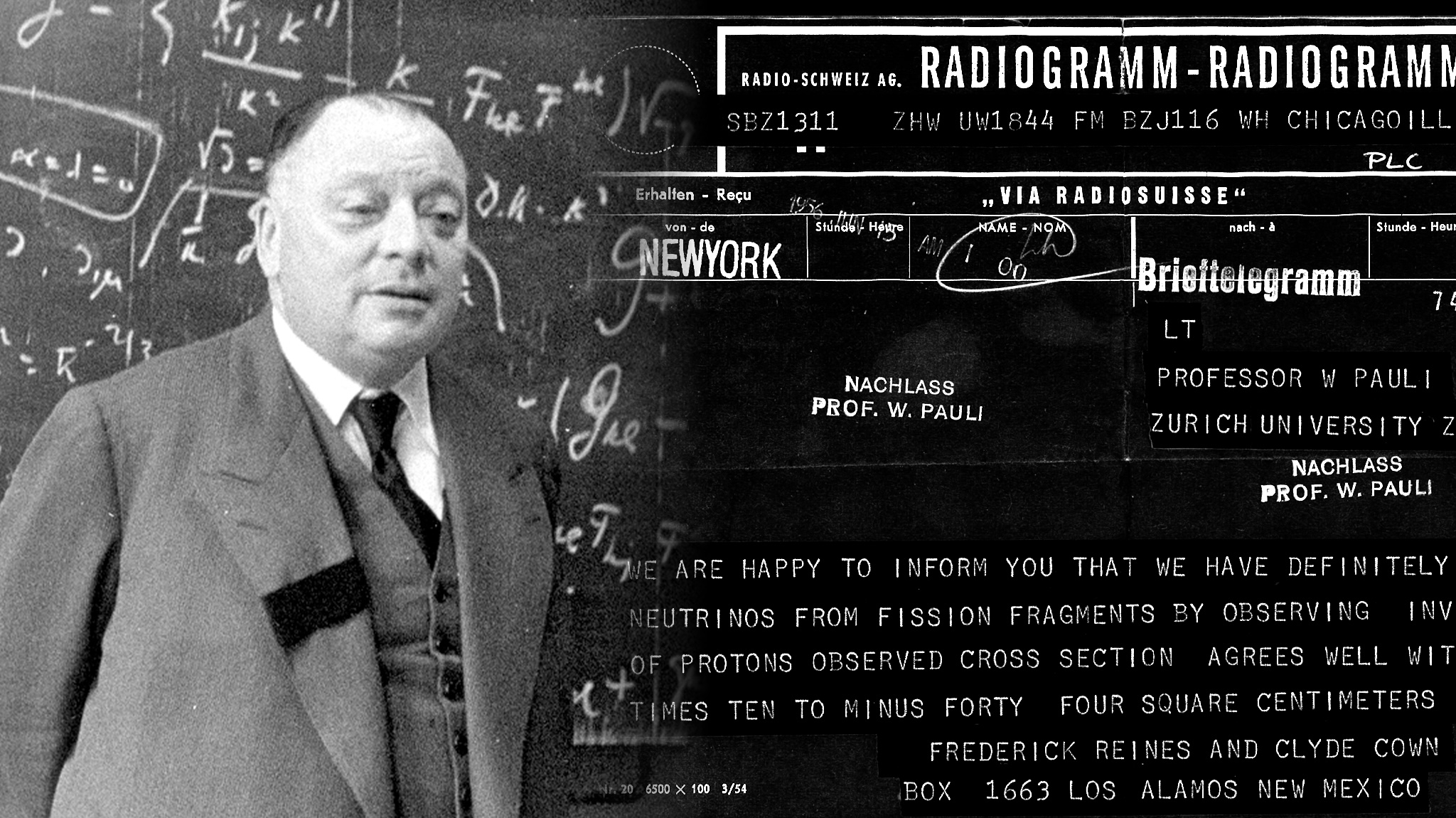
Seventy years ago today, Clyde Cowan, Frederick Reines and their colleagues closed a quarter-century hunt with a paper in Science, having caught neutrinos streaming out of a nuclear reactor in South Carolina. The search had begun in December 1930, when Wolfgang Pauli, in a letter to the “radioactive ladies and gentlemen” gathered at a meeting in Tübingen, proposed a desperate remedy for the energy that seemed to vanish in beta decays: a light, neutral particle that carried it away undetected. A few years later, Enrico Fermi and Edoardo Amaldi named it the neutrino.
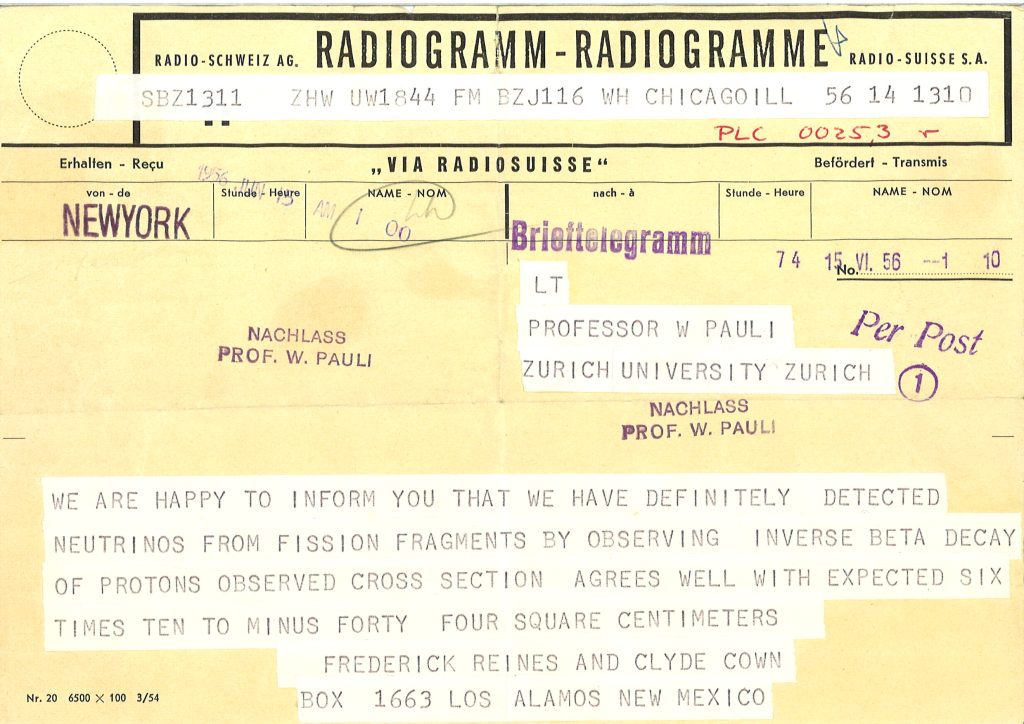
Five weeks before the paper was published, Wolfgang Pauli received a telegram during a meeting at CERN. “We are happy to inform you that we have definitely detected neutrinos”, wrote Reines and Cowan. Pauli’s reply never reached them, and Reines discovered it decades later. “Thanks for the message. Everything comes to him who knows how to wait.”

The lightest and most elusive of the known matter particles, neutrinos carry no electric charge, and a typical one could cross a light-year of solid lead before interacting. The Sun alone sends a hundred trillion of them through our bodies every second. More peculiar still, they come in three types, and a neutrino born as one can arrive as another. Decisive evidence of this shape-shifting, known as “oscillation”, came in 1998 from the Super-Kamiokande experiment in Japan. Oscillation is only possible if neutrinos have mass, something the Standard Model of particle physics had not anticipated.
Yet much about them remains unknown. What is the order of their three masses? Do neutrinos and antineutrinos oscillate differently? Are there additional, as yet undetected, neutrino states? The answers reach well beyond the laboratory. For instance, neutrinos left over from the Big Bang still fill the cosmos, and their tiny masses influenced how matter gathered into galaxies.
Experiments around the world are chasing these questions. One of the newest is the JUNO (Jiangmen Underground Neutrino Observatory) experiment in Kaiping, China, which monitors antineutrinos from reactors just as Cowan and Reines did 70 years ago. Other experiments use particle accelerators to fire neutrinos towards detectors several hundred kilometres away, catching them in the act of changing type as they cross the Earth’s crust.
CERN’s Neutrino Platform helps build and test hardware for the next generation of these “long-baseline” experiments, including prototypes and cryostats for DUNE (Deep Underground Neutrino Experiment), which will send neutrinos 1300 km across the US, and detector upgrades serving Hyper-Kamiokande, fed by a beam travelling 295 km across Japan.
To make the most of these experiments, however, physicists will need to understand their beams as precisely as possible. Neutrino beams are usually produced by protons striking a target, which releases a spray of short-lived particles that decay to generate neutrinos. Since the details of those decays go unobserved, the properties of the resulting beams are hard to pin down.
Bruno Pontecorvo proposed a solution in 1979. Each decay yields a neutrino and a charged particle, typically a muon. By measuring the parent in flight and the muon that emerges, and applying nothing more than conservation laws, physicists can deduce the energy and momentum of the neutrino and pair it with an interaction seen further along the beam. This technique is known as “neutrino tagging”.
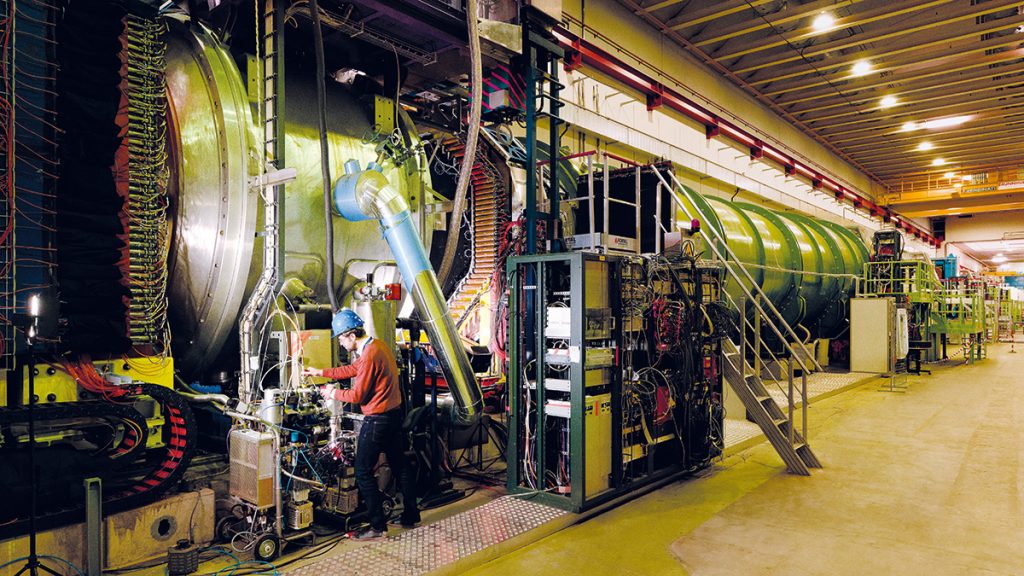
In practice, that means tracking particles by the billion every second. CERN’s NA62 experiment, built to study some of the rarest kaon decays, sifted data collected in 2022 and matched a neutrino to its parent decay, determining its energy to a record 0.3%. Physicists are now studying whether entire tagged beams could contribute to the next leap in precision for long-baseline experiments.
Read the full article “Neutrinos on the clock”in the May/June issue of CERN Courier.
Explore the Wolfgang Pauli Archive.