
ALICE’s upgraded detector showcases its beauty
The ALICE Collaboration has performed the first LHC measurement of beauty-quark production in a previously unexplored momentum range
Written by:
ALICE Collaboration
—
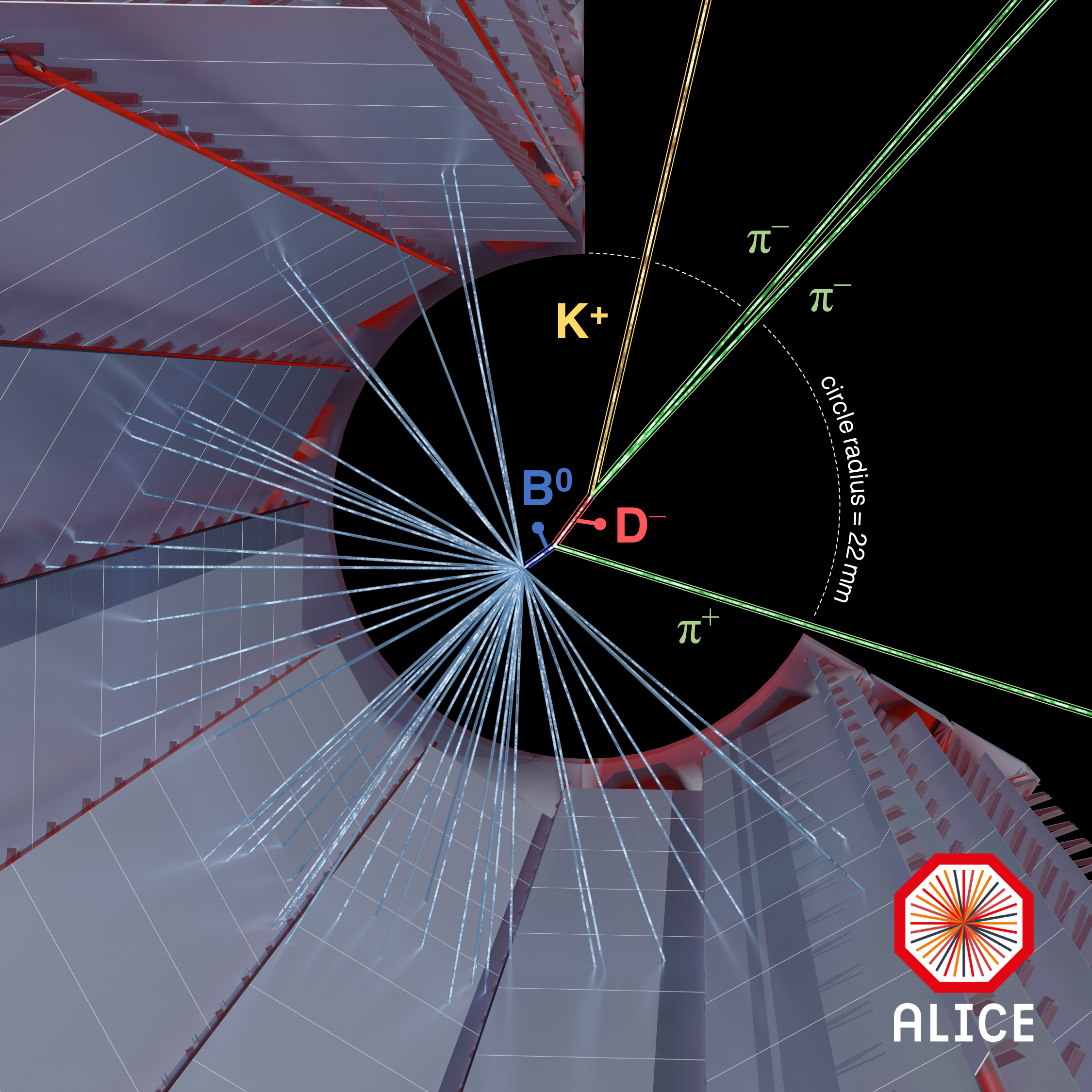
At the Large Hadron Collider (LHC), protons travel around the ring at almost the speed of light before colliding to release energy that transforms into many particles, including those containing beauty quarks. As reported in a recent paper, the ALICE Collaboration has made a new measurement of the production of neutral beauty mesons, particles made of a beauty antiquark and a down quark. For the first time at LHC energies, the probability that this particle is produced in a region perpendicular to the particle beam was measured down to a transverse momentum of 1 GeV/c. This previously unexplored particle-motion range covers the bulk of beauty-quark production. The research, which complements the coverage of the other LHC experiments, is therefore essential for the measurement of the total production probability at the LHC.
This new result was based on data from proton–proton collisions at an energy of 13.6 TeV, which took place during the third run of the LHC. It was only possible due to major improvements made to the ALICE detector during the second long shutdown. These improvements included the installation of a new innermost detector, the Inner Tracking System 2, which improved the level of detail at which particles can be tracked.
Additionally, upgrades to the Time Projection Chamber and the Time-of-Flight detector significantly increased the collision recording rate, by a factor of 500 for proton–proton collisions and 50–100 for lead–lead collisions, compared to previous runs. To efficiently inspect the enormous amount of data and to isolate collisions such as those producing neutral beauty mesons, ALICE now also employs a software-based filtering procedure. This is part of its new Online-Offline (O2) computing framework, a high-performance redesign of ALICE computing capabilities specifically tailored to Run 3 of the LHC and beyond.
The likelihood that beauty particles – particles containing beauty quarks – are produced can be precisely predicted using calculations based on quantum chromodynamics (QCD), the theory of the strong force that binds the proton together. Comparing these calculations with measurements of beauty-particle production allows physicists to test models of this important theory.
Lastly, this new measurement will serve as a key baseline for the analysis of the large heavy-ion datasets collected during LHC Run 3. By analysing the data from these collisions, which recreate the extreme conditions present in the first microseconds of the Universe, ALICE aims to study how beauty quarks interact with the primordial phase of matter known as quark–gluon plasma.