
CERN congratulates Nobel Prize winner Francis Halzen
The detection of high-energy neutrinos from space has been awarded the 2026 Nobel Prize in Physics
Written by:
Rory Harris
—
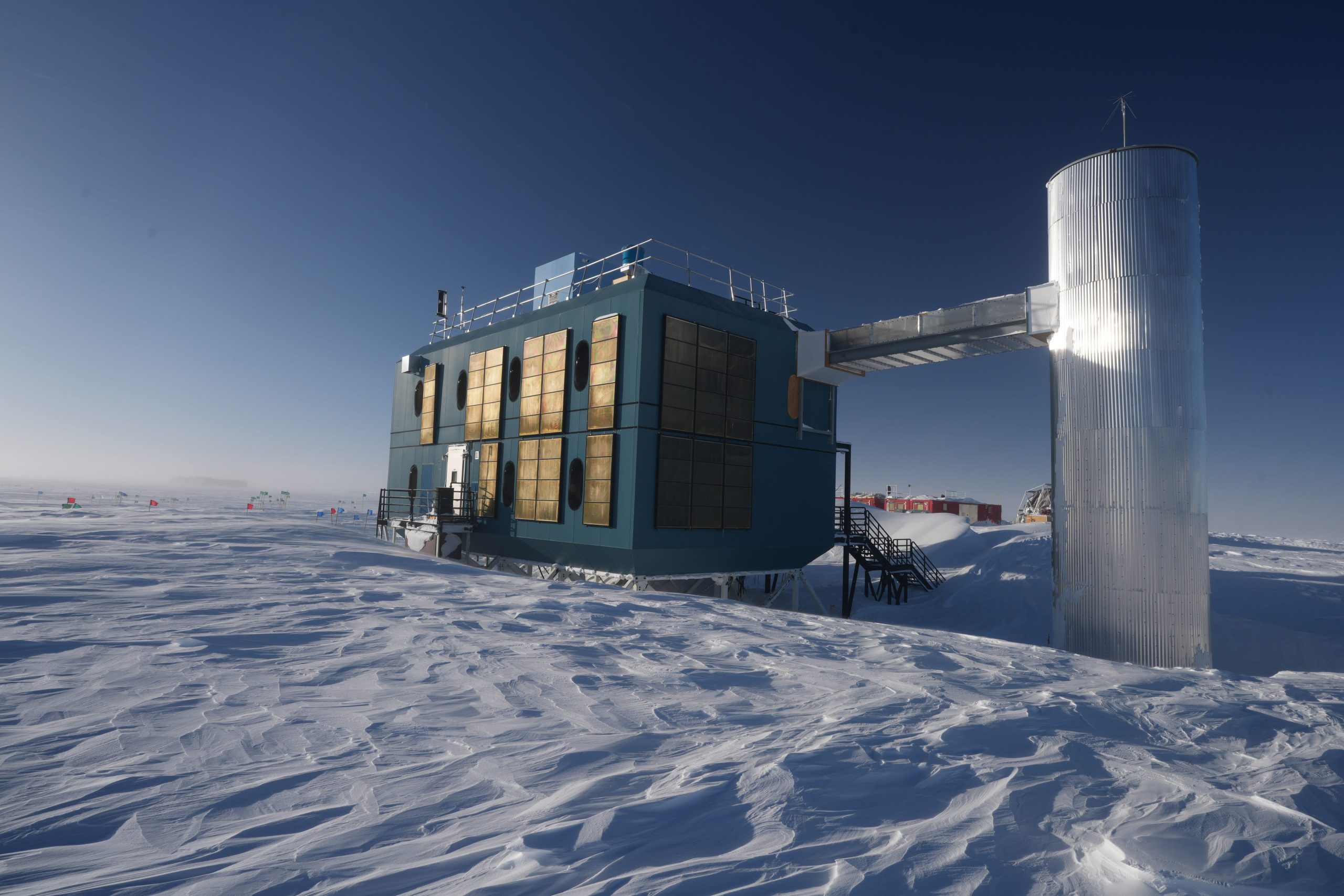
The 2026 Nobel Prize in Physics has been awarded to Francis Halzen for his contributions to the IceCube Neutrino Observatory, which discovered high-energy neutrinos coming from far beyond our Solar System. This work is paving the way for a new generation of observatories to exploit neutrinos as a unique messenger of extreme environments in the distant cosmos.
Around 100 trillion neutrinos pass through your body every second. But these particles are notoriously hard to detect as they very rarely interact with matter. This elusiveness calls for extremely sensitive experiments to investigate them. One of these is IceCube, which operates in Antarctica and is a CERN Recognized Experiment.
The IceCube detector consists of over 5000 light sensors spread across a cubic kilometre of ice about two kilometres below the surface at the South Pole. Using such a large volume increases the chances of a neutrino collision with the ice, which would produce a flash of light that can be picked up by the sensors.
From Gargamelle to the Large Hadron Collider (LHC) today, neutrinos have always been a vital part of CERN’s research. Currently, CERN contributes to research into neutrino physics through the Neutrino Platform, developing and testing instruments for leading neutrino experiments such as DUNE, and through experiments such as NA61 and NA65. CERN is also able to directly detect neutrinos produced at the LHC with FASER and SND@LHC, which has ushered in a new era of neutrino physics at colliders. Although the neutrinos detected by FASER and SND@LHC are not as high energy as those detected by IceCube, studying collider neutrinos complements the work of IceCube to understand these elusive particles.
“It’s fantastic to see astroparticle physics recognised by the Nobel Committee,” said Mark Thomson, CERN Director-General. “Francis Halzen’s vision and leadership have been fundamental to the success of IceCube – a CERN Recognized Experiment that has transformed our understanding of astrophysical high-energy neutrinos.”