
Accelerator Report: Beyond the LHC – CERN’s Beams Keep Science Moving
While the LHC is in Long Shutdown 3, the injector chain remains fully operational, serving the experiments of today and preparing the beams of tomorrow
Written by:
Nikolaos Charitonidis, Matthew Fraser, Kevin Li and Bettina Mikulec
—
The Large Hadron Collider (LHC) may have entered Long Shutdown 3 (LS3), but across the rest of CERN’s accelerator complex operations remain as busy as ever. The LHC injector chain continues to provide proton beams for a broad range of users, including the ELENA antiproton community, the East and North Area experiments and the n_TOF facility.
This continuing operation is a reminder of the wealth of physics that can be performed with CERN’s accelerator complex. Even as the LHC is being prepared for its next chapter, the injectors are still supporting today’s physics programme, delivering beams to experiments that study antimatter, nuclear reactions, detector technologies, neutrino and astroparticle physics and many other areas of research at the frontiers of science.
HiRadMat rounds off its beam year
Alongside the standard operation of the LHC injectors, this week marks the final run of the year for the High Radiation to Materials facility (HiRadMat). This facility provides teams to test materials and equipment using intense beam pulses delivered by the SPS, reproducing the demanding conditions that accelerator components may face during operation.
This final run includes a particularly important experiment for the CERN accelerator complex: a systematic study of a wide range of materials, including both well-established materials and others never before used as beam monitors. By determining their failure thresholds and characterising their behaviour under intense beam exposure, researchers aim to improve the reliability and robustness of beam monitoring throughout the accelerator chain.
The study addresses a significant gap in the existing scientific literature and will provide valuable knowledge for the operation and design of present and future high-intensity accelerators. It is also a unique experiment that can only be performed using the SPS and the exceptional capabilities of the HiRadMat facility.
Machine development: fine-tuning today, preparing for tomorrow
A busy machine development (MD) programme will also be running throughout the year. During MD periods, accelerator experts step away from routine beam delivery to optimise machine processes, perform special measurements, explore new beams and test new operational methods. These studies are where many future capabilities first take shape before becoming part of standard operation.
One recent focus has been the future SPS Beam Dump Facility (BDF) which is being prepared within the HI-ECN3 project to serve a new general-purpose experiment, the Search for Hidden Particles, or SHiP. SHiP is designed to search for feebly interacting, long-lived particles predicted by many hidden sector models. Such particles could help explain open questions including dark matter, neutrino oscillations and the origin of the matter-antimatter asymmetry in the Universe.
To maximise SHiP’s physics reach and to make comprehensive searches at the MeV to GeV scale across many orders of magnitude in coupling, the SPS will need to operate at its intensity limit. The goal is to produce as many high-energy proton interactions as possible in the beam dump, which serves as the BDF production target.
During recent weeks, SPS MD studies have tested prototypes of the future BDF production target installed in the TCC2 target cavern of the North Area. The most recent tests demonstrated the successful cooling of a tungsten target with gaseous helium while it was exposed to the impact of the 400 GeV/c proton beam.
The intensity limit of the SHiP beam has also been explored further. A new cycle was commissioned at a new working point to stabilise the machine tune below the half-integer. This mode inherently stabilises the rigid bunch motion induced by resistive-wall wake fields, relaxing the stability requirements and allowing the maximum intensity to be pushed to a record 5.4 x 10^13 protons per cycle at 400 GeV/c (see Figure 1). The achieved transmission from SPS injection to flat-top was around 90%. The increased intensity could provide additional flexibility in future proton-sharing scenarios with SHiP operation.
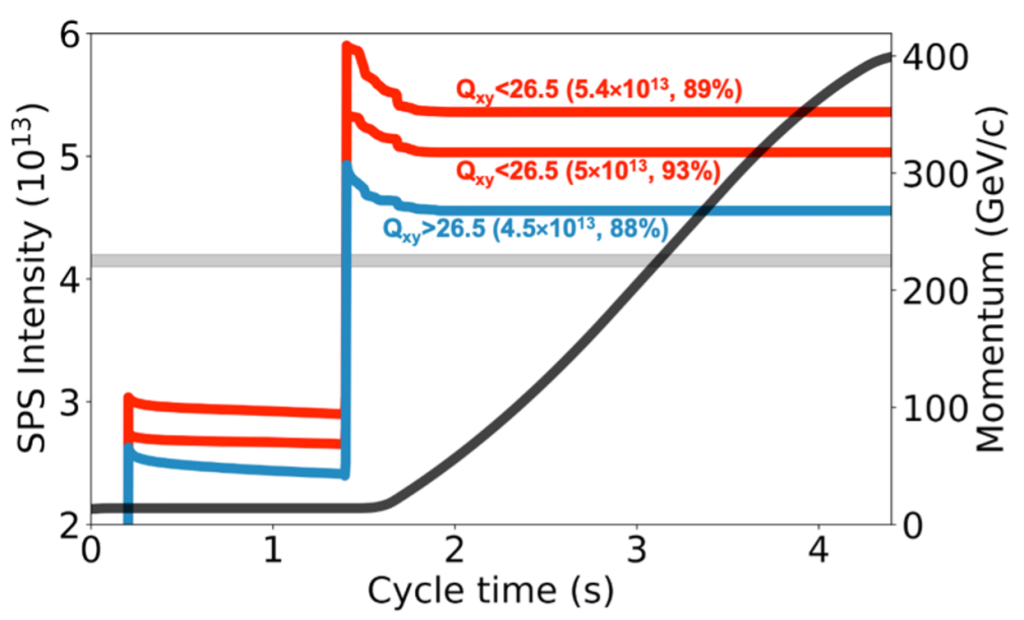
The 2026 MD programme has also investigated the future SHiP production supercycle in the SPS. In parallel, it demonstrated the use of new crystal technology to reduce beam loss on the SPS slow-extraction septa by more than a factor of four for future high-intensity operation of the North Area.
This approach uses a specially designed goniometer that supports several crystals aligned with one another. The array repeatedly exploits the volume-reflection process in each crystal, an arrangement known as a multi-crystal volume-reflection array, or MVRA. The MVRA provides coherent and efficient deflection of protons that would otherwise hit the blade of the electrostatic septum and activate equipment in the SPS extraction straight section LSS2. Instead, these protons are steered towards the production targets of the North Area.
Next up: ions for the North Area
The next major operational milestone is already close. In the middle of next week, the North Area is scheduled to begin its ion-physics programme, bringing lead beams to experiment users and opening another important chapter in this year’s accelerator schedule.
So, while the LHC is in shutdown, CERN’s accelerator complex continues to do what it does best: deliver beams for today’s science, test the technologies needed for tomorrow and prepare new ways to explore the fundamental structure of the Universe.