
NA64, a decade of hunting dark matter
The NA64 experiment at CERN has searched for dark matter since 2016 by looking for energy that goes missing when particles strike its detector
Written by:
Davide De Biasio
—
In particle physics, energy is never lost. When particles collide or decay, all the initial energy they carry must be conserved in the resulting products, and a shortfall signals that something has escaped unseen. It was the energy missing from radioactive decays that led Wolfgang Pauli to propose the neutrino in 1930, a particle so elusive that it evaded detection for a quarter of a century.
Similar approaches are now employed in searches for physics beyond the Standard Model. Evidence ranging from the afterglow of the Big Bang to the way galaxies formed and clustered, for instance, indicates that around 85% of the matter in the Universe emits no light, revealing itself only through gravity. For decades, the leading candidate for this dark matter was a new heavy particle, roughly a hundred times more massive than the proton. Increasingly sensitive experiments have searched for it. So far, without success.
However, the absence of a signal may simply suggest that dark matter is lighter and interacts more weakly than first assumed. A particle of this kind could naturally fit into a broader dark sector – a hidden family of new particles and forces, in contact with known matter only through a handful of feeble interactions. These interactions would, on rare occasions, allow collisions of ordinary particles to produce dark matter particles.
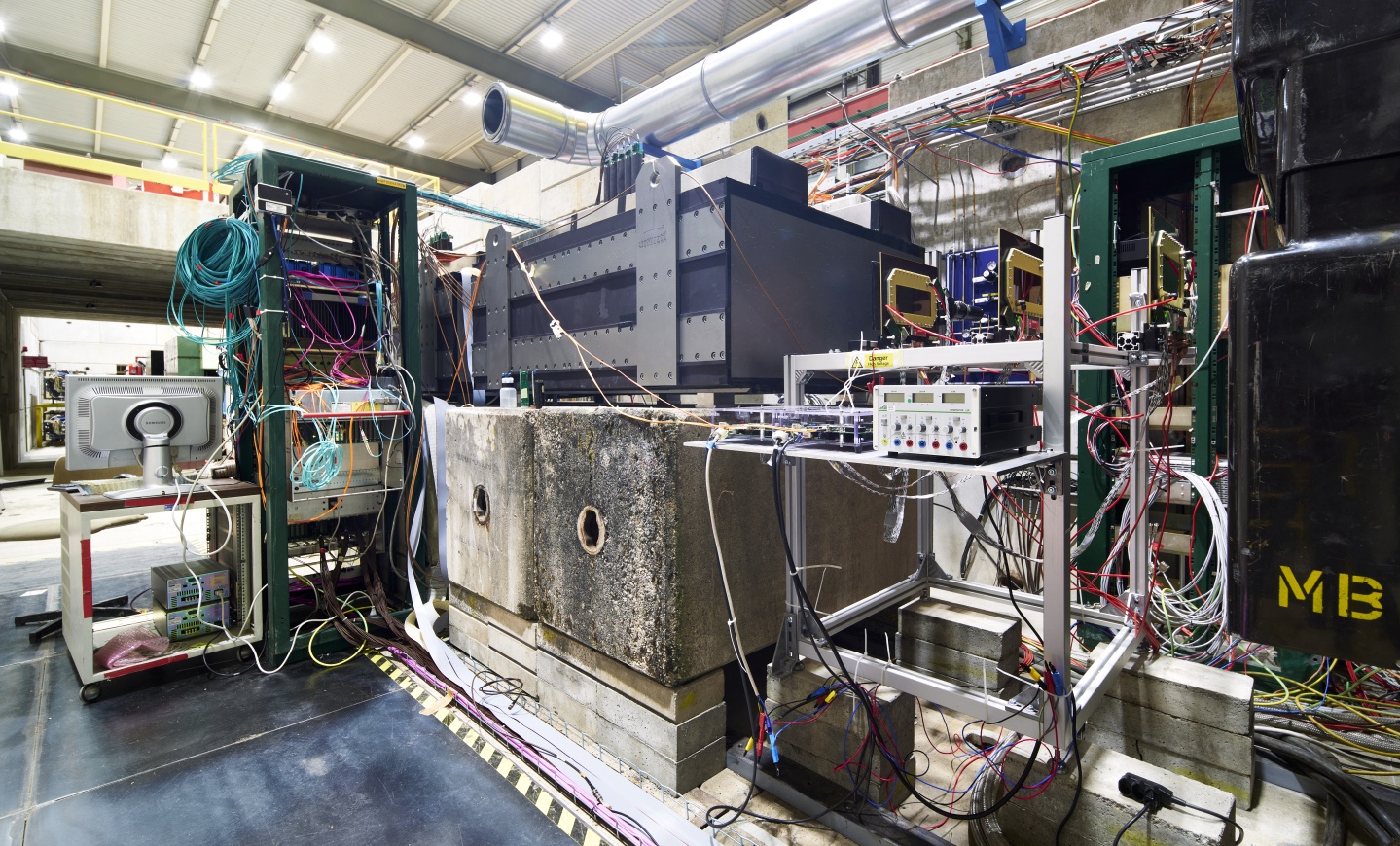
Dark matter particles of this kind are what NA64 has spent the past ten years looking for. The experiment sits in CERN’s North Area, where 400 GeV protons from the Super Proton Synchrotron hit a beryllium target, producing a spray of secondary particles that are sorted into different beams. The required type of beam is then selected and guided to NA64. On the way in, each particle’s energy is precisely measured before it strikes the detector. If the energy recorded after the interaction falls short of that of the incoming particle, the difference must have been carried off by something the detector cannot see. Perhaps by a dark matter particle.
For most of the experiment’s operation, the probes have been electrons, and their collisions have revealed no missing energy beyond what known processes can account for. However, the measurements have placed an upper limit on the strength of the coupling between the dark sector and ordinary matter, which sets how often dark matter particles should have been produced. For some of the lightest candidates, no other experiment has pushed this boundary further. The programme has since grown beyond electrons, taking in positrons (the electrons’ antimatter partners), muons (their heavier cousins) and hadrons, to test different dark matter models.
Since dark matter particles would be produced only rarely, the next step in this endeavour is to increase the number of collisions. During the third long shutdown of CERN’s accelerator complex, the NA64 Collaboration will upgrade its apparatus to run with more intense beams, while making sure that no ordinary energy slips through unmeasured and mimics a signal. The dataset is then expected to grow by up to two orders of magnitude, enough to test a wide range of scenarios for light dark matter.
Find out more in the article “Ten years at the missing-energy frontier” in the July/August issue of the CERN Courier.