
Tag: Media
-
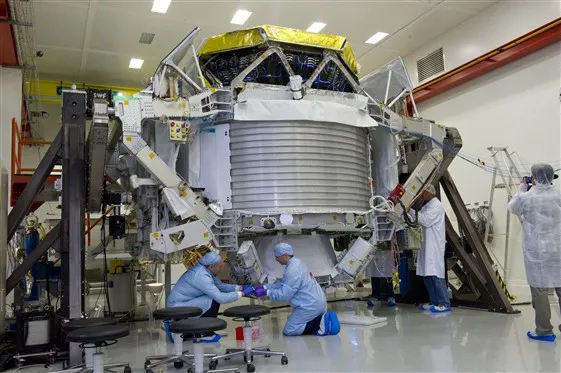
AMS experiment takes off for Kennedy Space Center
Geneva, 18 August 2010. The Alpha Magnetic Spectrometer (AMS), an experiment that will search for antimatter and dark matter in space, leaves CERN1 next Tuesday on the next leg of its journey to the International Space Station. The AMS detector2 is being transported from CERN to Geneva International Airport in preparation for its planned departure
-
ICHEP 2010 conference highlights first results from the LHC
Geneva, 26 July 2010. First results from the LHC at CERN1 are being revealed at ICHEP, the world’s largest international conference on particle physics, which has attracted more than 1000 participants to its venue in Paris. The spokespersons of the four major experiments at the LHC – ALICE, ATLAS, CMS and LHCb – are today
-
World’s particle physics labs take amateur photographers behind the scenes
Geneva, 8 July 2010. Picture this: For the first time, amateur photographers around the world collide with the past, present and future of particle physics. Five of the world’s leading particle physics laboratories will make the image a reality when they join together to host a Particle Physics Photowalk on 7 August. More than 200
-
CERN Council opens the door to greater integration
Geneva, 18 June 2010. At its 155th session today, the CERN1 Council strongly congratulated the Laboratory on the excellent performance of the LHC since its start-up for physics on 30 March this year. Council also opened the door to greater integration in particle physics when it unanimously adopted the recommendations of a working group set
-
CERN inaugurates its new permanent “Universe of Particles” exhibition
Geneva, 15 June 2010. CERN1 has recently started operating the LHC, one of the most sophisticated scientific tools ever built to explore new territories of knowledge. To share this exciting adventure with the general public, CERN is opening a visitor centre that is as high-tech and futuristic as its accelerator. The "Universe of Particles" exhibition,
-
Physicists and medics set out strategy on physics for health
Geneva 3 June 2010. Following a workshop hosted by the CERN1 European particle physics laboratory in February, doctors and physicists today published a strategy for harnessing physics for health. Techniques developed for physics research have a long history of application in medicine. Today’s news recognises that synergy, and sets out a programme of strengthened collaboration.
-
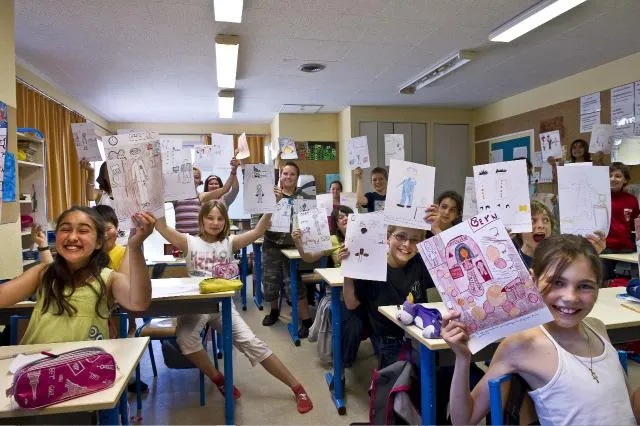
Children put science in the picture with the exhibition “Draw me a physicist”
Geneva 3 June 2010. From 12 to 23 June 2010, CERN1 ’s Globe of Science and Innovation will be hosting the exhibition “Draw me a physicist”, featuring over 160 drawings and definitions by children on the subject of scientific research. Geneva 3 June 2010. From 12 to 23 June 2010, CERN1 ’s Globe of Science
-
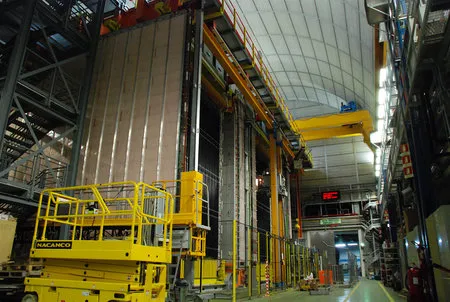
Particle chameleon caught in the act of changing
Geneva 31 May 2010. Researchers on the OPERA experiment at the INFN1’s Gran Sasso laboratory in Italy today announced the first direct observation of a tau particle in a muon neutrino beam sent through the Earth from CERN2, 730km away. This is a significant result, providing the final missing piece of a puzzle that has
-
LHC research programme gets underway
Geneva, 30 March 2010. Beams collided at 7 TeV in the LHC at 13:06 CEST, marking the start of the LHC research programme. Particle physicists around the world are looking forward to a potentially rich harvest of new physics as the LHC begins its first long run at an energy three and a half times
-
CERN sets date for first attempt at 7 TeV collisions in the LHC
Geneva, 23 March 2010. With beams routinely circulating in the Large Hadron Collider at 3.5 TeV, the highest energy yet achieved in a particle accelerator, CERN has set the date for the start of the LHC research programme. The first attempt for collisions at 7 TeV (3.5 TeV per beam) is scheduled for 30 March.