
ATLAS moves into top gear for Run 3
In their first Run 3 results, the ATLAS collaboration measured two Standard Model processes: the production of Z bosons and top-quark pairs
Written by:
ATLAS collaboration
—
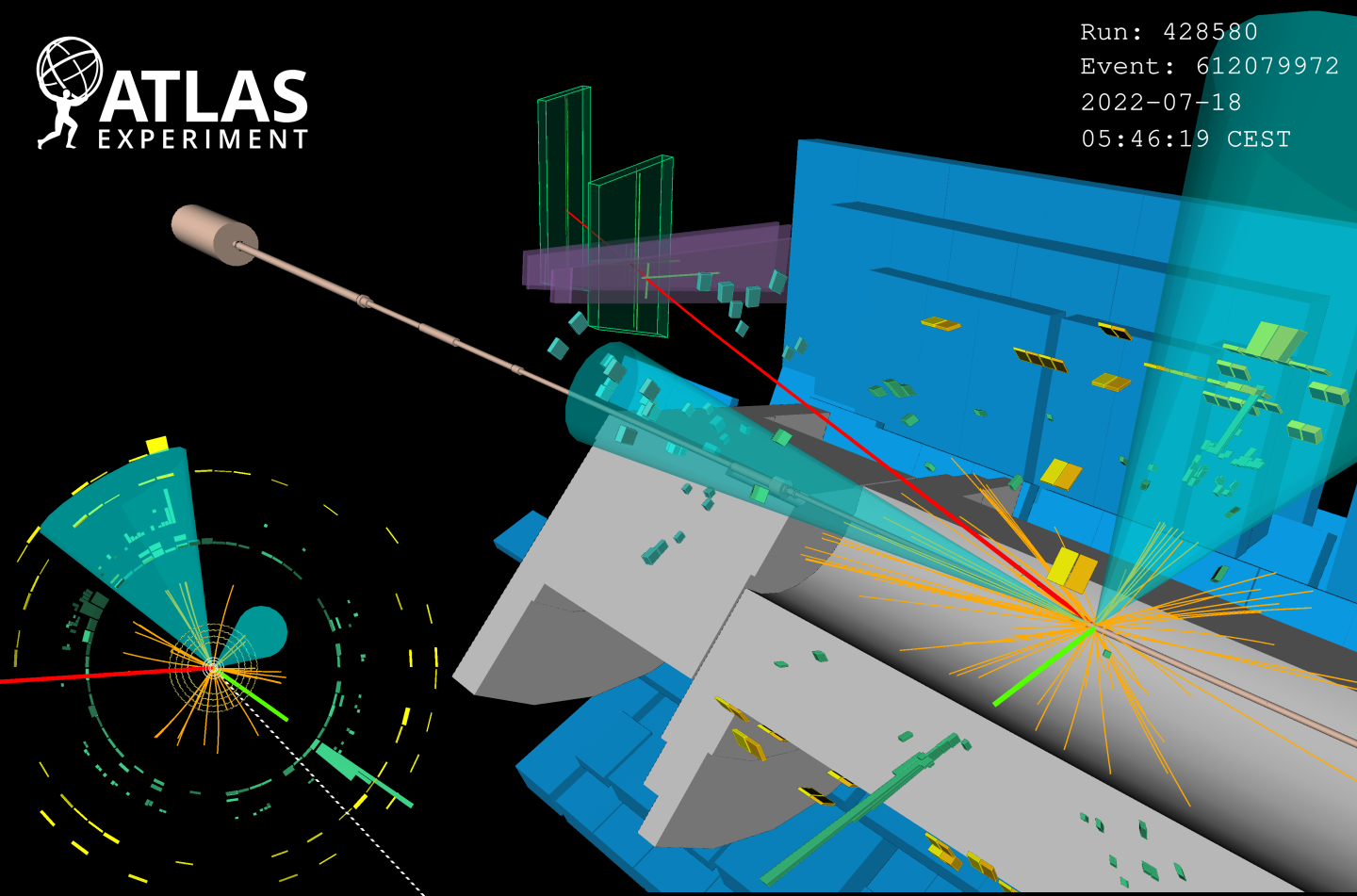
After over three years of upgrade and maintenance work, the Large Hadron Collider began its third period of operation (Run 3) in July 2022. Since then, the world’s most powerful particle accelerator has been colliding protons at a record-breaking energy of 13.6 TeV. The ATLAS collaboration has just released its first measurements of these record collisions, studying data collected in the first half of August 2022.
The researchers measured the rates of two well-known processes: the production of top-quark pairs and the production of a Z boson, which proceed through strong and electroweak interactions, respectively. The ratio of their cross sections is sensitive to the inner structure of the proton, and their measurement sets constraints on the relative probabilities that reactions are initiated by quarks and gluons.
These early measurements also validate the functionality of the ATLAS detector and its reconstruction software, which underwent many improvements in preparation for Run 3.
Physicists focused on Z-boson decays to electron and muon pairs, and on top-quark decays to a W boson and a jet – collimated sprays of particles – originating from a bottom quark. The W boson subsequently decays into one electron or muon and an invisible neutrino. As the analysis uses very early Run 3 data, physicists relied on preliminary calibrations of the leptons, jets and luminosity. These were derived promptly after the first data became available.
ATLAS measured a top-quark pair to Z boson production ratio that is consistent with the Standard Model prediction within the current experimental uncertainty of 4.7%.
The calibration and corresponding uncertainties will be improved as more data is processed. Future updates of the calibration will allow researchers to measure the cross sections with greater precision.
To validate their results, physicists performed a series of cross-checks. These included measuring the ratio of the cross section each time the LHC was injected with a new fill of protons for a data-taking run.
More analyses using the Run 3 data will follow, exploiting the unprecedented energies and the increased LHC data set.
Read more on the ATLAS website.