LHCb explores new territory during a special low-energy run
On 29 and 30 April 2026, the LHC briefly departed from its standard high-energy operation to perform a special low-energy run at a beam energy of 1.2 TeV, compared with the usual 6.8 TeV used during Run 3
Written by:
LHCb Collaboration
—
While the heavy-ion run season is in full swing at the LHC, let’s look back at the low-energy run that took place on 29 and 30 April. In yet another demonstration of the versatility of CERN’s accelerator complex, the LHC briefly departed from its standard high-energy operation to perform a special low-energy run dedicated primarily to the needs of the LHCb experiment. Conducted at a beam energy of 1.2 TeV, compared with the usual 6.8 TeV used during Run 3 proton–proton operation, the run opened a unique window onto physics processes that are relevant not only to particle physics, but also to astrophysics and the study of cosmic rays.
Unlike standard LHC operation, which focuses on maximising collision energy to probe rare processes and search for new particles, low-energy runs allow physicists to study particle production in a kinematic regime closer to that encountered in cosmic-ray interactions in space. In particular, the 1.2 TeV run provides essential input for interpreting measurements of antimatter in cosmic rays by space-based experiments such as the Alpha Magnetic Spectrometer (AMS) and Payload for Antimatter Matter Exploration and Light-nuclei Astrophysics (PAMELA). Precise measurements of antiproton production are crucial for distinguishing possible dark matter signatures from conventional astrophysical processes.
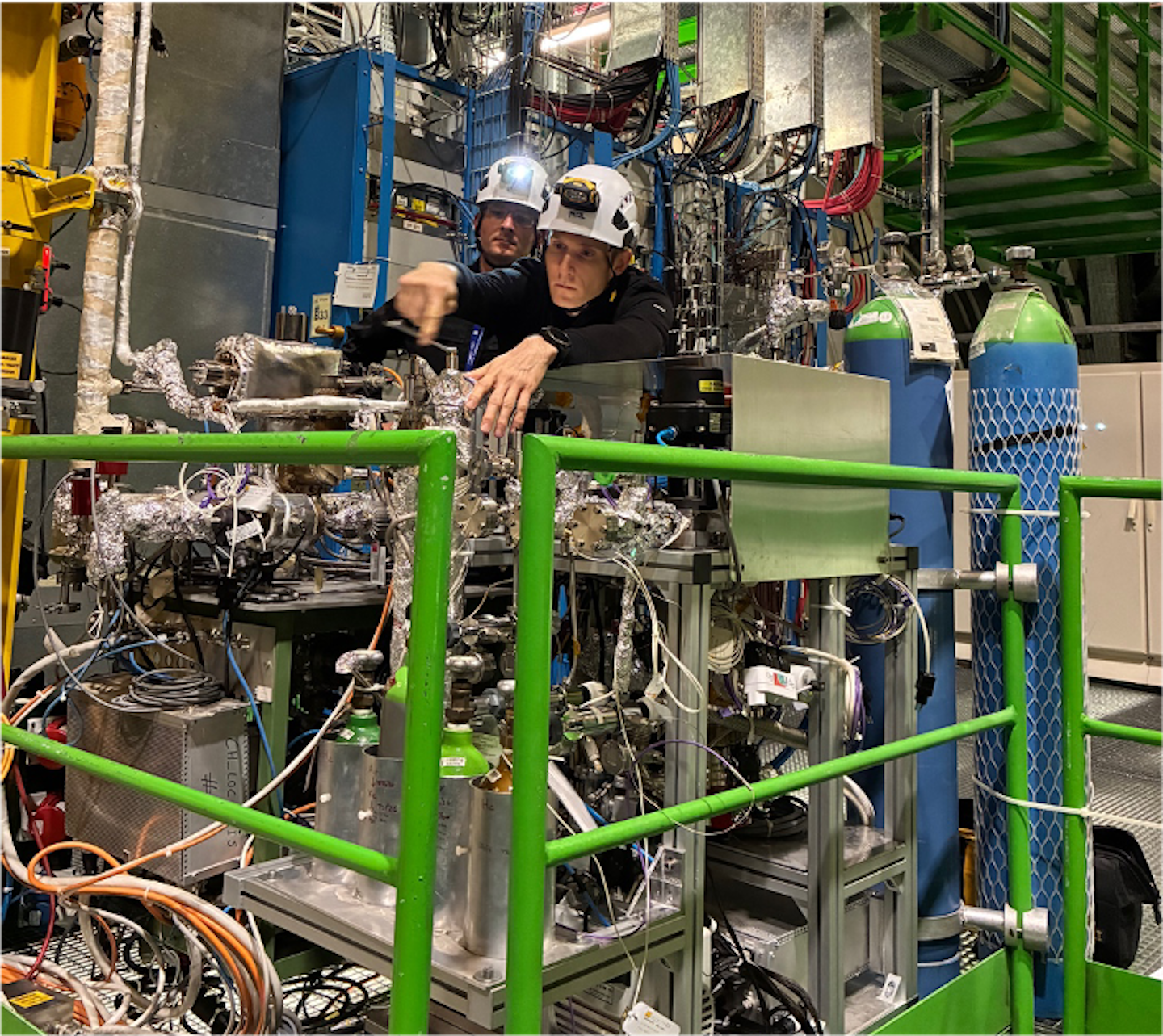
To carry out these studies, LHCb used its SMOG2 system, a gas storage cell installed directly upstream of the vertex locator (VELO) detector. By injecting gases into the beam pipe, SMOG2 enables proton beams circulating in the LHC to collide not only with each other, but also with gas targets. During the low-energy run, data was collected using hydrogen, deuterium and helium targets, allowing LHCb to study antiproton production in several collision systems.
The programme also relied heavily on the flexibility of the upgraded LHCb detector. The new VELO pixel detector, the upgraded SMOG2 system and the fully software-based trigger proved particularly well suited to the rapidly changing conditions of the run. At the same time, the operation required close coordination between accelerator and experiment teams. In just two days, the machine had to perform a compressed version of a standard commissioning period, including luminosity calibration scans, beam optimisation and intensity ramp-up.
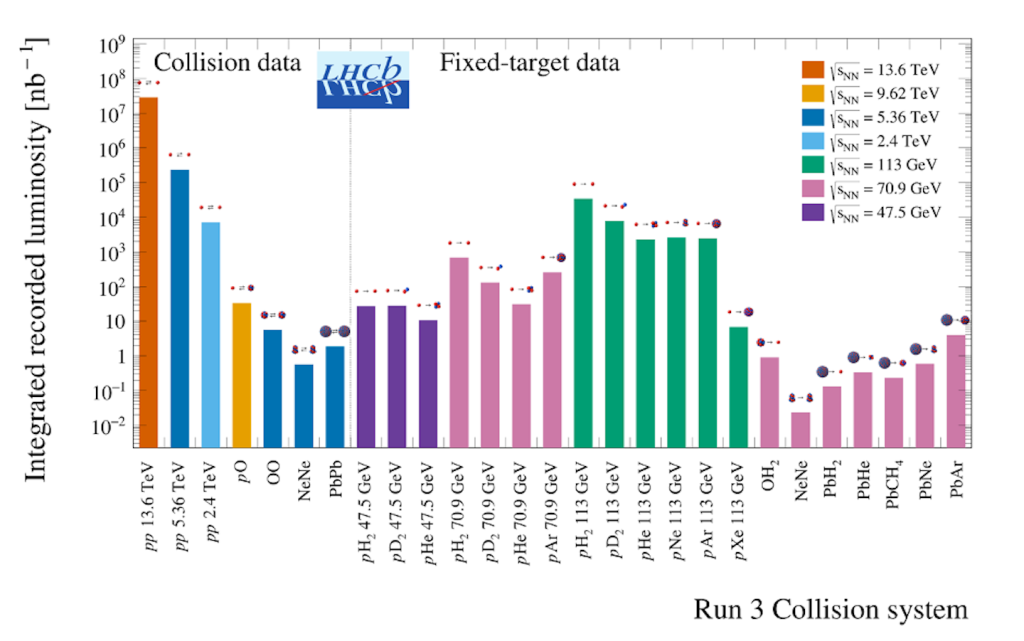
Despite the challenges, the run was highly successful. Over the course of five physics fills, all luminosity targets were achieved, more than one billion fixed-target events were recorded for each injected gas and approximately 7 pb-1 of proton–proton collision data were collected. The campaign further expanded LHCb’s already remarkably diverse Run 3 physics programme. As of today, a total of 27 different systems has been collected by the experiment since the start of Run 3. Analysis of the new datasets is in progress and promises to provide long-awaited new insights into cosmic-ray interactions that were not accessible before.