
CLOUD experiment uncovers a major new source of marine aerosol particles
The marine biosphere may be better able to compensate for future reductions of anthropogenic aerosols than previously thought, according to a new study from the CLOUD experiment
—
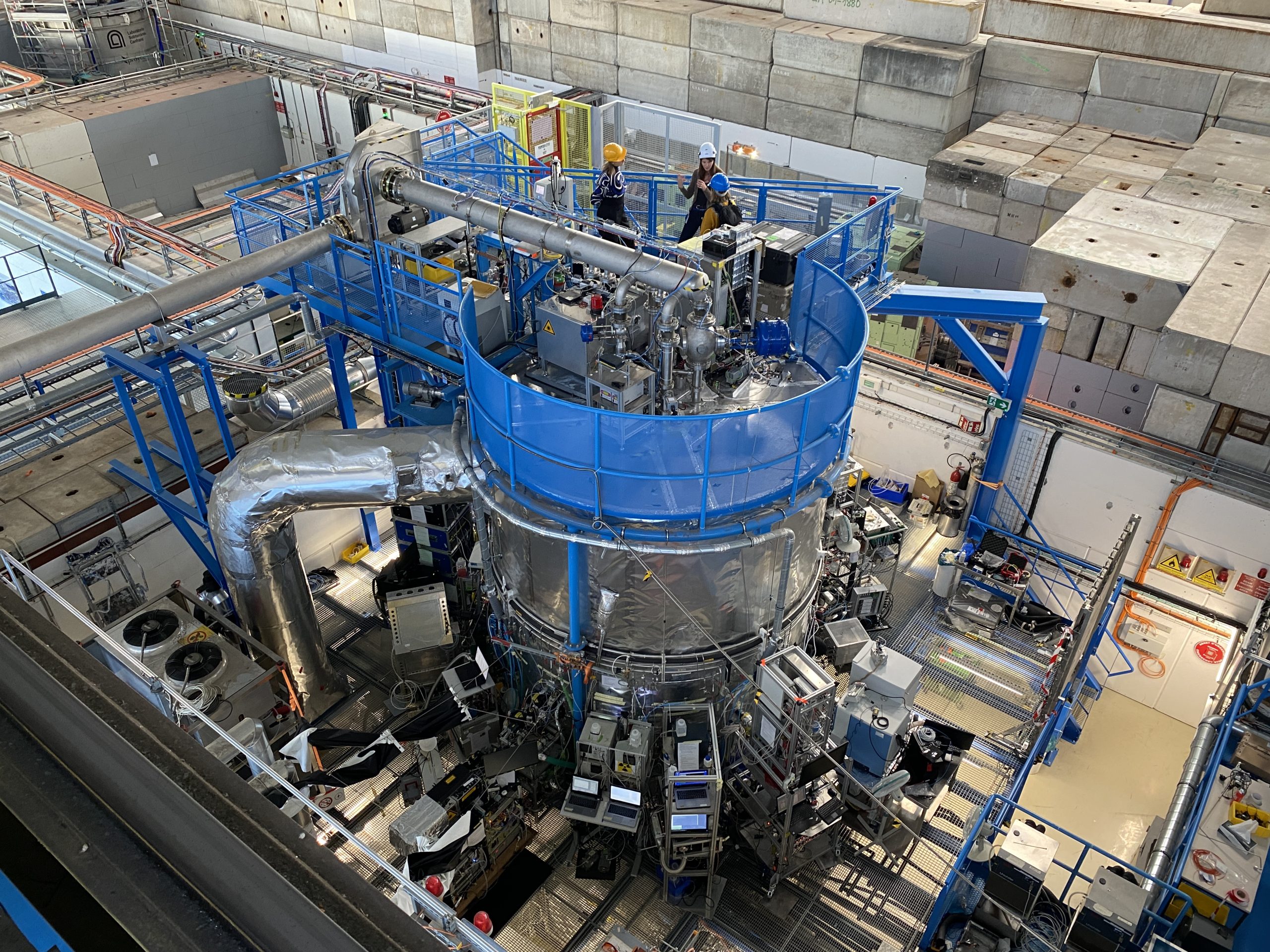
In a paper published today in the journal Nature, the CLOUD Collaboration at CERN reports that natural emissions from phytoplankton are producing far more aerosol particles than previously thought, changing our understanding of aerosols and clouds in pristine climates from before the industrial era and after the fossil fuel era.
Cloud droplets form on aerosol particles – tiny solid or liquid particles suspended in the atmosphere – larger than about 50 nm, known as cloud condensation nuclei (CCN). Increased aerosol particles cool the climate by reflecting sunlight and by forming smaller but more numerous cloud droplets, which makes clouds brighter and increases their coverage. Increased aerosols from human activities are thought to have offset a substantial fraction of the warming caused by greenhouse gases.
More than half of the CCN in the atmosphere originate from the spontaneous condensation of trace vapours – a process known as nucleation or new particle formation. The most important nucleating vapour is thought to be sulphuric acid, which largely originates from sulphur dioxide from fossil fuels. Atmospheric sulfur dioxide and, in turn, anthropogenic aerosol particles are now declining in response to emission controls. Although this benefits human health, the falling CCN levels are expected to drive additional warming of the climate later this century as aerosol concentrations in the atmosphere, sustained by biogenic sources alone, return near to pre-industrial levels.
“Most climate models currently consider only sulphuric acid-driven nucleation”, explains Jasper Kirkby, spokesperson of the CLOUD Collaboration. “However, it is vital to understand and properly account for biogenic sources to reliably predict the Earth’s future climate and air quality. Observations over the Southern Ocean and in the upper troposphere over the Atlantic and Pacific Oceans indicate that a major source of marine aerosol particles is unaccounted for by current models.”
Although this source has so far remained a mystery, the new results from CLOUD may provide the answer. Marine phytoplankton emit dimethyl sulphide, accounting for around 20% of atmospheric sulphur. The oxidation products of dimethyl sulphide in the atmosphere include both sulphuric acid (SA) and methanesulphonic acid (MSA), at comparable concentrations. Whereas SA is known to drive new particle formation, the role of MSA has remained unclear until now.
Combining fundamental experiments and modelling, the international team of researchers of the CLOUD Collaboration have studied new particle formation from MSA and from SA-MSA mixtures, in the presence of ammonia and at temperatures of between +10 oC and -50 oC. They have found that, below -10 oC, MSA is equally effective as SA at driving particle nucleation in the presence of ammonia and that the two acid vapours readily mix and nucleate synergistically. In addition, MSA drives rapid particle growth at all temperatures below +10 oC, even in the near absence of ammonia, increasing the likelihood that newly formed particles survive scavenging to become CCN.
“Since MSA and SA generally coexist at similar concentrations in cool marine regions, our findings indicate that particle nucleation rates might be accelerated up to tenfold and growth rates up to twofold compared with sulphuric acid and ammonia alone”, adds Jasper Kirkby. “Our model simulations indicate that MSA-driven new particle formation may account for the major missing source of marine aerosol particles in current models.”
Together with previous CLOUD findings of abundant isoprene-driven new particle formation in the upper troposphere over tropical rainforests, the new role of MSA in marine CCN formation suggests that the biosphere may be more effective than previously thought at partially compensating for the reduction of anthropogenic aerosols and the associated warming expected to occur later this century as sulphur dioxide levels fall with emission controls.
“The CLOUD Collaboration has made an important advance in our understanding of climate”, says Gautier Hamel de Monchenault, CERN Director for Research and Computing. “It is crucial to deepen our understanding of aerosols: in this case, increased biogenic CCN will affect estimates of the Earth’s climate sensitivity as well as projections of climate warming.”