
Beam tests boost FCC detector technologies
Teams worldwide tested advanced detector technologies for the Future Circular Collider before CERN’s accelerator complex paused for major upgrades
Written by:
Hector Garcia Morales
—
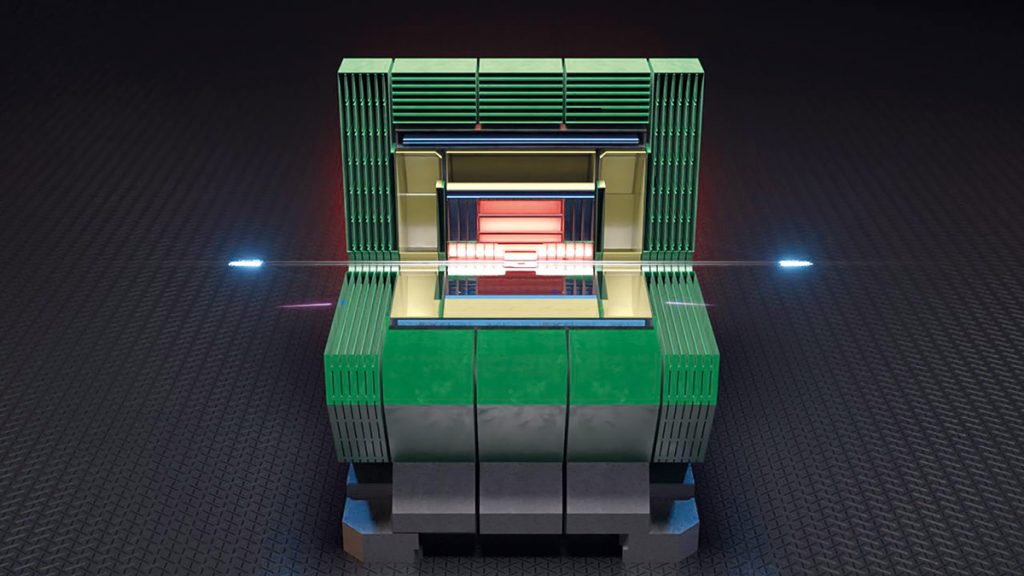
The proposed Future Circular Collider (FCC) at CERN would put the Universe under a microscope like never before. By colliding electrons and positrons at four points around a 91 km ring, it would enable scientists to pin down the properties of the Higgs boson and other fundamental particles with a precision beyond the reach of the Large Hadron Collider (LHC).
The success of the FCC-ee physics programme rests on the capabilities of the detectors surrounding the collision points. In order to meet the demanding requirements of the FCC-ee design, physicists and engineers are pushing the boundaries of current detector technologies. Six different concepts for the FCC-ee detectors are currently being explored at institutes across the world. Much like the LHC detectors, for which the first beam tests took place 16 years before they saw their first proton collisions, detector development for the FCC-ee started many years ago.
Between May and August this year, proponents of the IDEA (International Detector for Electron Accelerator) detector concept tested several prototypes of detector components using secondary beams from the Super Proton Synchrotron (SPS) and the Proton Synchrotron (PS). It was one of the last opportunities to perform such tests before the CERN accelerator complex entered Long Shutdown 3 to make way for the HiLumi LHC in 2030.
The first beam tests explored the potential of an innovative muon detector prototype that offers greater precision than the existing detectors at the LHC. Tracking the position of muons in the outermost layers of the FCC-ee detectors is essential, and the IDEA muon detector concept offers a spatial resolution as high as 50 micrometres. In parallel, a team working on the IDEA drift chamber, which would track and identify particles in the central part of the detector, analysed the performance of a technique called cluster counting. The goal is to achieve the optimal particle identification performance required by the FCC-ee design specifications.
The FCC-ee physics programme also requires the energy of particle “jets” to be determined with unprecedented precision. This is driving the development of new dual-readout calorimeters that incorporate additional information from particles’ transit through the detector, enabling significantly greater accuracy than conventional approaches. The recent beam tests at CERN offered the first opportunity to evaluate two new calorimeter technologies under study for IDEA, both of which showed promise for future large-scale developments.
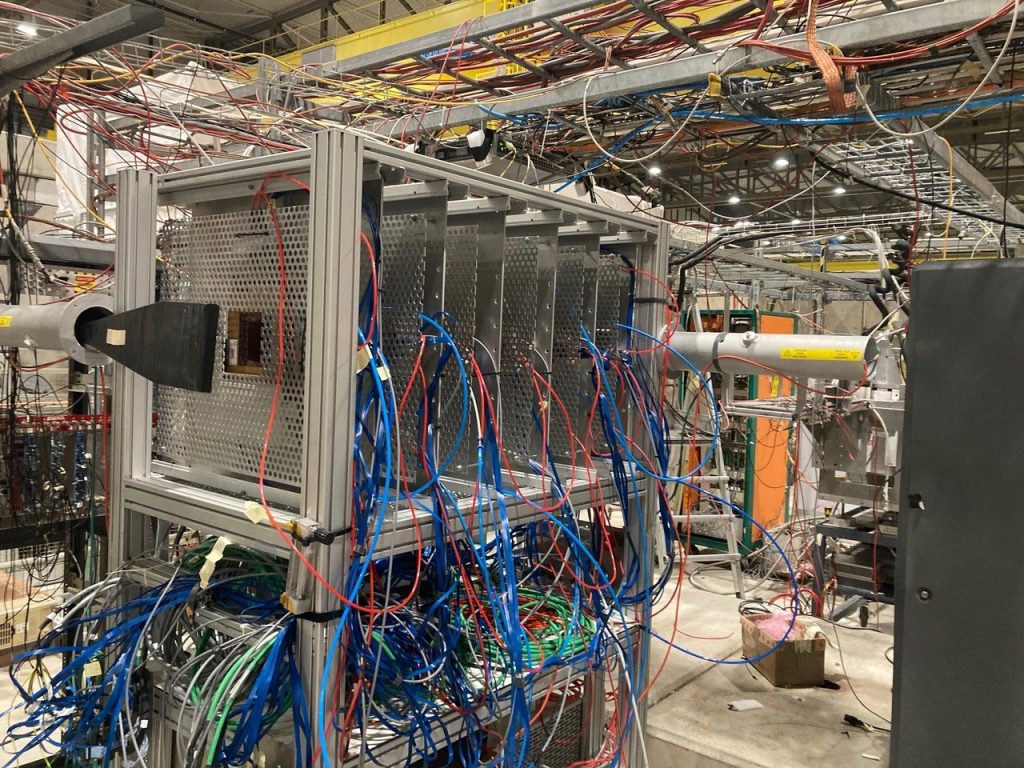
“These beam tests were the culmination of decades of detector research and development and show that progress in the FCC does not only happen through simulations or concept schemes, but it has also taken the shape of real prototypes for many years,” explains Paolo Giacomelli (INFN Bologna), who is in charge of the IDEA detector concept.
The teams working on detector concepts for the FCC-ee have years of intense research and development ahead.
The CERN Council is expected to be in a position to take a decision on the FCC-ee in 2028, taking into account elements such as the scientific, technical and financial feasibility of the project, as well as results from public consultation exercises in CERN’s Host States, France and Switzerland.
Read the full article in the latest EP Newsletter.