
CERN bids farewell to the LHC and enters Long Shutdown 3
The Large Hadron Collider is embarking on its most ambitious upgrade yet
—
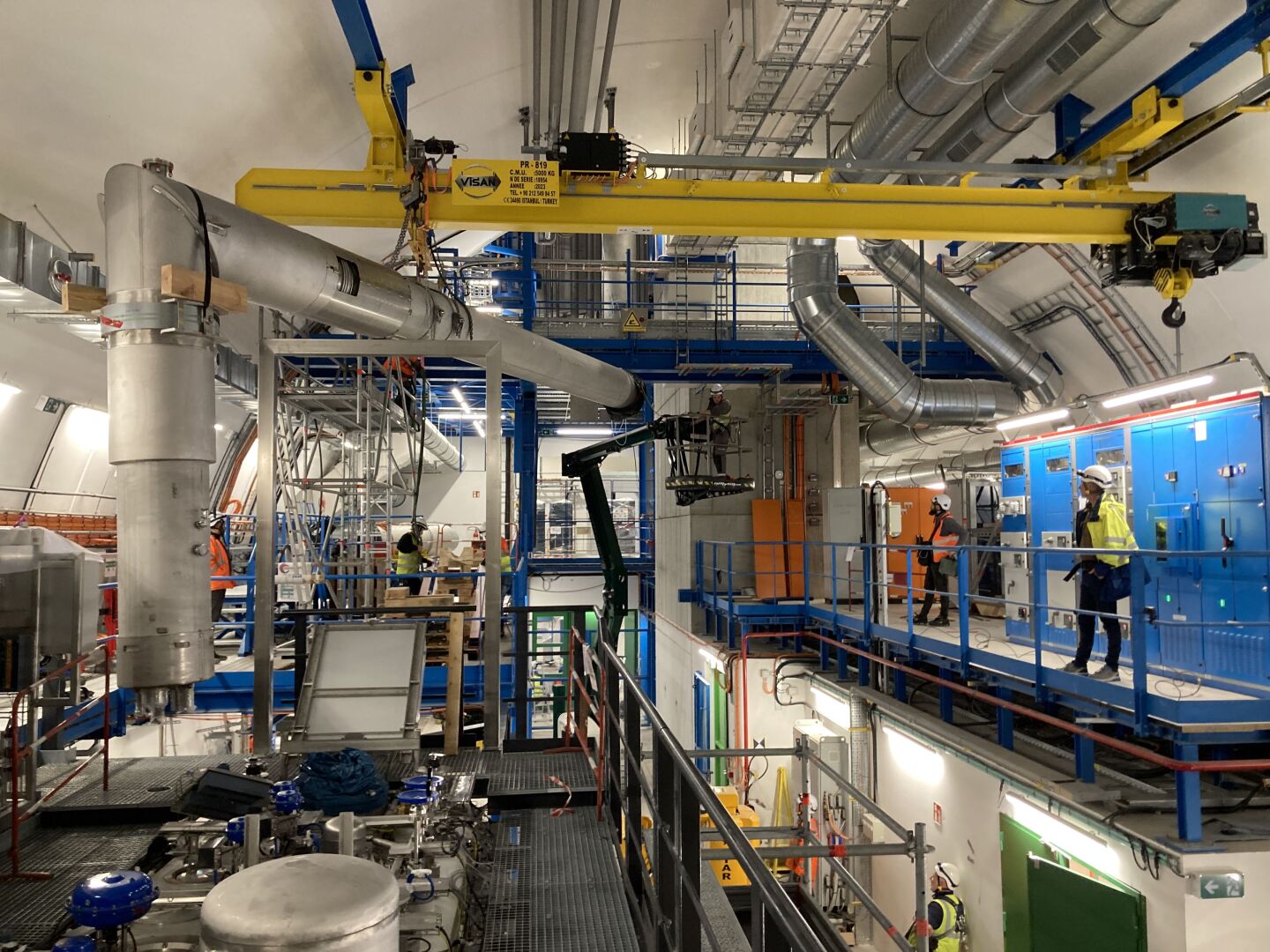
Today, the Large Hadron Collider (LHC), the world’s most powerful particle accelerator, comes to the end of an extraordinary chapter in its scientific journey. Following its final physics run, the accelerator has been switched off to begin CERN’s Long Shutdown 3 (LS3), a major programme of maintenance, consolidation, upgrades and installation work that will prepare the Laboratory for the High-Luminosity LHC (HiLumi LHC), the next phase in the exploration of the fundamental laws of nature.
Since circulating its first beams in September 2008, the LHC has pushed the frontiers of science and technology, becoming one of the most ambitious scientific instruments ever built. The accelerator delivered its first proton collisions in 2009 and rapidly established itself as a unique discovery machine – across three operational periods (Runs 1–3), the LHC delivered unprecedented quantities of data to its experiments.
The LHC’s most celebrated achievement came on 4 July 2012, when the ATLAS and CMS Collaborations announced the discovery of the Higgs boson, confirming a mechanism proposed nearly half a century earlier. In the years that followed, the LHC enabled hundreds of major advances, including the discovery of more than 85 hadrons, the setting of exclusion limits on the discovery of new particles, searches into the imbalance between matter and antimatter, exploration of the nature of the quark–gluon plasma, and measurements with important implications for astrophysics. Beyond its scientific output, the LHC drove innovation in accelerator science, superconducting technologies, computing and international collaboration.
As the accelerator enters a new phase, CERN celebrates not only the discoveries made, but also the global community that made them possible.
“The LHC has exceeded every expectation,” said Oliver Brüning, CERN Director for Accelerators and Technology. “For nearly two decades, it has transformed our understanding of the Universe and inspired generations of scientists, engineers and citizens around the world. Today we say goodbye to the LHC as we have known it, while preparing to welcome its successor: the HiLumi LHC, which will extend this scientific adventure far into the future.”
The HiLumi LHC, scheduled to begin operation in 2030, will increase the collider’s luminosity by a factor of up to ten beyond its original design. This will allow researchers to collect vastly larger datasets, enabling precision studies of the Higgs boson and enhancing the potential to uncover phenomena beyond the Standard Model.
LS3 marks the most extensive intervention on CERN’s accelerator complex since the construction of the LHC itself. Between now and 2030, the shutdown will involve thousands of specialists from CERN and partner institutes worldwide, who will transform the LHC, the injectors and their experiments into their HiLumi versions, and carry out essential renovation projects across the entire accelerator complex and experimental facilities: from the consolidation of the Super Proton Synchrotron (SPS) North Area, the dismantling of the CERN Neutrinos to Gran Sasso (CNGS) target area and the transformation of the Experimental Cavern North 3 (ECN3) into a high-intensity fixed-target facility, to the renovation of the ISOLDE facility and the consolidation of the personnel safety systems, electrical network and technical galleries.
“The LS3 represents a huge and complex logistical and engineering undertaking,” says Jean-Philippe Tock, Head of the LS3 Coordination Team. “In the LHC alone, 1.2 km of magnets and components will be removed and replaced with new equipment, and across the whole complex, dozens of projects are planned, involving thousands of engineers, physicists, technicians and support personnel.”
In the LHC caverns, the ATLAS and CMS experiments will undergo extensive upgrades, effectively becoming renewed detectors. To fully exploit the unprecedented performance of the HiLumi LHC, they will need to cope with between 140 and 200 proton–proton collisions in every bunch crossing, compared to around 60 during the last LHC run. This means identifying and selecting the most interesting collisions from more than five billion interactions every second. To meet this challenge, both experiments will completely replace their trigger systems, which are responsible for selecting the most promising events for further analysis. These events will be recorded using advanced new detector technologies, including all-silicon tracking systems with billions of readout channels (far more than in the current detectors), high-precision timing detectors with resolutions of a few tens of picoseconds, and new calorimeter systems capable of operating at megahertz rates.
While no particle beams will circulate during this period, CERN’s scientific activity will remain intense. Thousands of researchers will continue analysing the vast datasets accumulated during the LHC era, extracting new physics results while simultaneously preparing the experiments for the challenges ahead.
When the accelerator complex gradually restarts, from 2028, it will inaugurate a new era for high-energy physics. Building on the legacy of the LHC, the HiLumi LHC will provide unprecedented opportunities to deepen our understanding of the Universe and explore some of the most fundamental questions in science.