
LHCb finds evidence of one-in-ten-billion particle decay
If confirmed, this beauty-particle decay would be the rarest ever observed
—
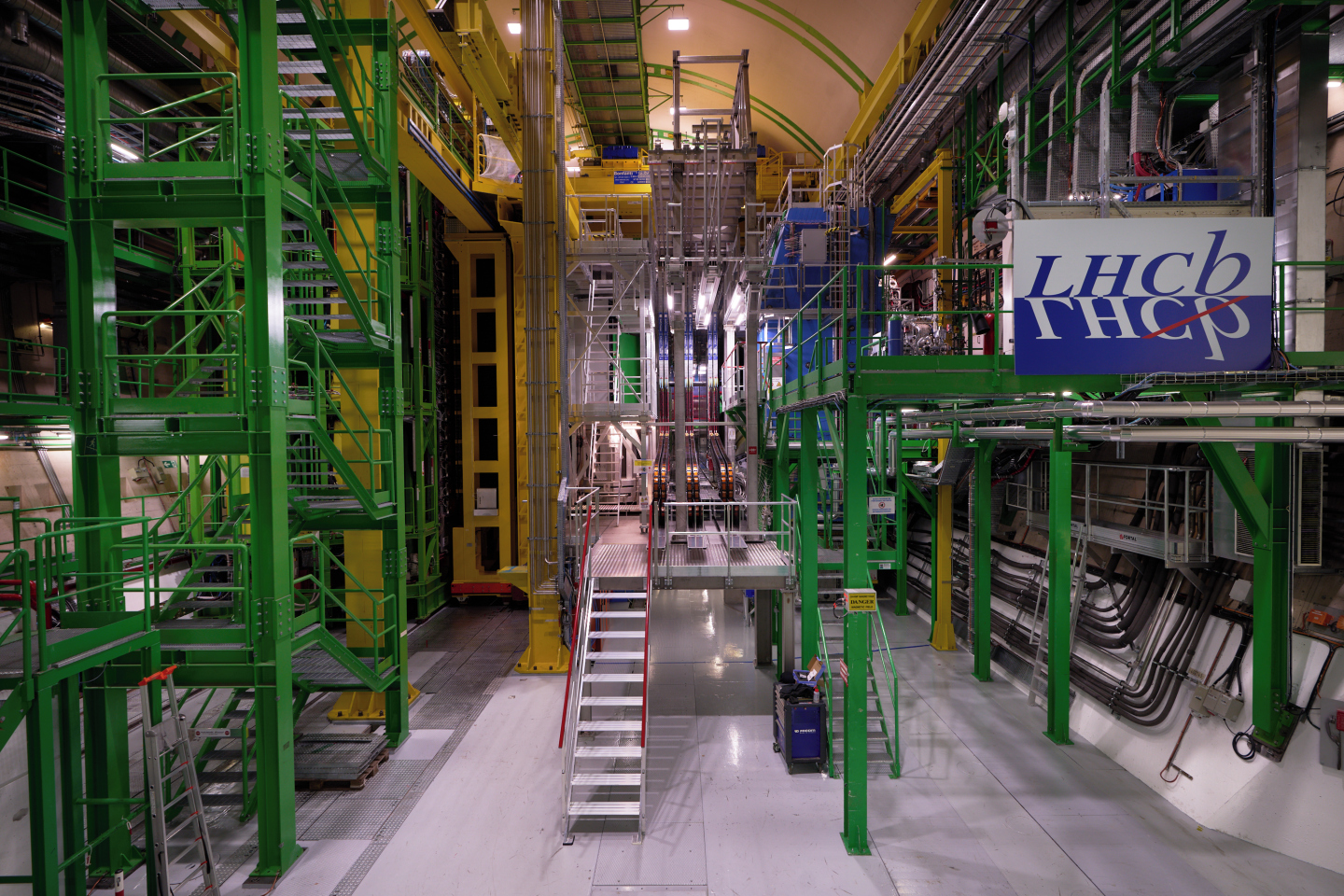
They say good things come to those who wait, and the LHCb Collaboration’s latest result marks a major milestone in a decades-long search. As announced in a seminar held at CERN today, the Collaboration has found evidence of a one-in-ten-billion decay of a beauty particle, becoming the first to do so using data from a single experiment.
The decay is that of a particle containing a beauty quark and a down antiquark, known as Bd, into a pair of muons (μ+μ–). Consistent with theoretical predictions, the new result places limits on possible new particles beyond the Standard Model.
Quantum physics describes how particle decays are influenced by other particles. Measuring this beauty-quark decay precisely could therefore reveal signs of new particles that are too heavy to be directly produced in LHC collisions. In general, the more unlikely a decay, the more sensitive it is to the influence of new particles.
Bd → μ+μ– is part of a subset of decays that are so rare they have long been regarded as ‘golden channels’ in the search for new physics. In these decays a beauty quark and an oppositely charged antiquark annihilate, releasing energy that becomes a muon – a particle similar to an electron, but heavier – and its antiparticle. In 2015, a joint analysis by the LHCb and CMS Collaborations resulted in the first observation of Bs → μ+μ– and a claim for the first evidence of Bd → μ+μ–. However, in subsequent updates using data collected up until 2018, the evidence for Bd → μ+μ– was not confirmed. The Bs → μ+μ– decay occurs only around three times in every billion beauty-particle decays, but Bd → μ+μ– is even rarer, with a predicted rate about thirty times lower.
In 2024, a major upgrade of the LHCb experiment allowed data to be collected at five times the rate achieved between 2010 and 2018. This upgrade also enhanced the ability of the detector to distinguish between different types of particle. These improvements, in combination with the application of machine-learning techniques, allowed the LHCb team to suppress the vast background of processes that would have otherwise swamped the signals from these rare beauty-particle decays.
“Physicists have been chasing this decay for more than forty years,” said Marco Santimaria, who co-led the 19-person international analysis team. “Extreme precision is required to pick the muons out of the overwhelming background.”
To claim evidence of a new phenomenon, a result needs a significance level of 3 ‘standard deviations’, corresponding to just a 0.3 % chance that the signal occurred randomly. Data taken by the LHCb experiment from 2024 to 2025 revealed evidence of the Bd → μ+μ– decay at a level of 3.0 standard deviations. By combining this data with that collected between 2011 and 2018, the significance level rose to 3.2 standard deviations, comfortably beyond the commonly accepted threshold. In the same analysis, the team also made the most precise ever measurements of the previously observed Bs → μ+μ– decay.
Further research will seek to confirm the occurrence of the Bd → μ+μ– decay by achieving a significance level of 5 standard deviations. This would make it the rarest decay of a beauty particle observed to date.
The start-up of the HiLumi LHC in 2030 and the planned upgrade of LHCb in the middle of the next decade could increase the rate of data collection by another order of magnitude. “Seeing evidence of this rare decay is incredibly exciting, opening up new possibilities to probe beyond the direct reach of the LHC,” explained Harry Cliff, LHCb’s Rare Decays Convener and Analysis Co-lead. “The future LHCb upgrade will allow us to observe many more of these decays, providing even greater sensitivity to undiscovered particles.”
Further information:
LHCb news: https://lhcb-outreach.web.cern.ch