
AMS releases new cosmic-ray measurements
The new data from the precision particle-physics detector on the International Space Station provides fresh insights into the nature of cosmic rays
Written by:
Emma Hattersley
—
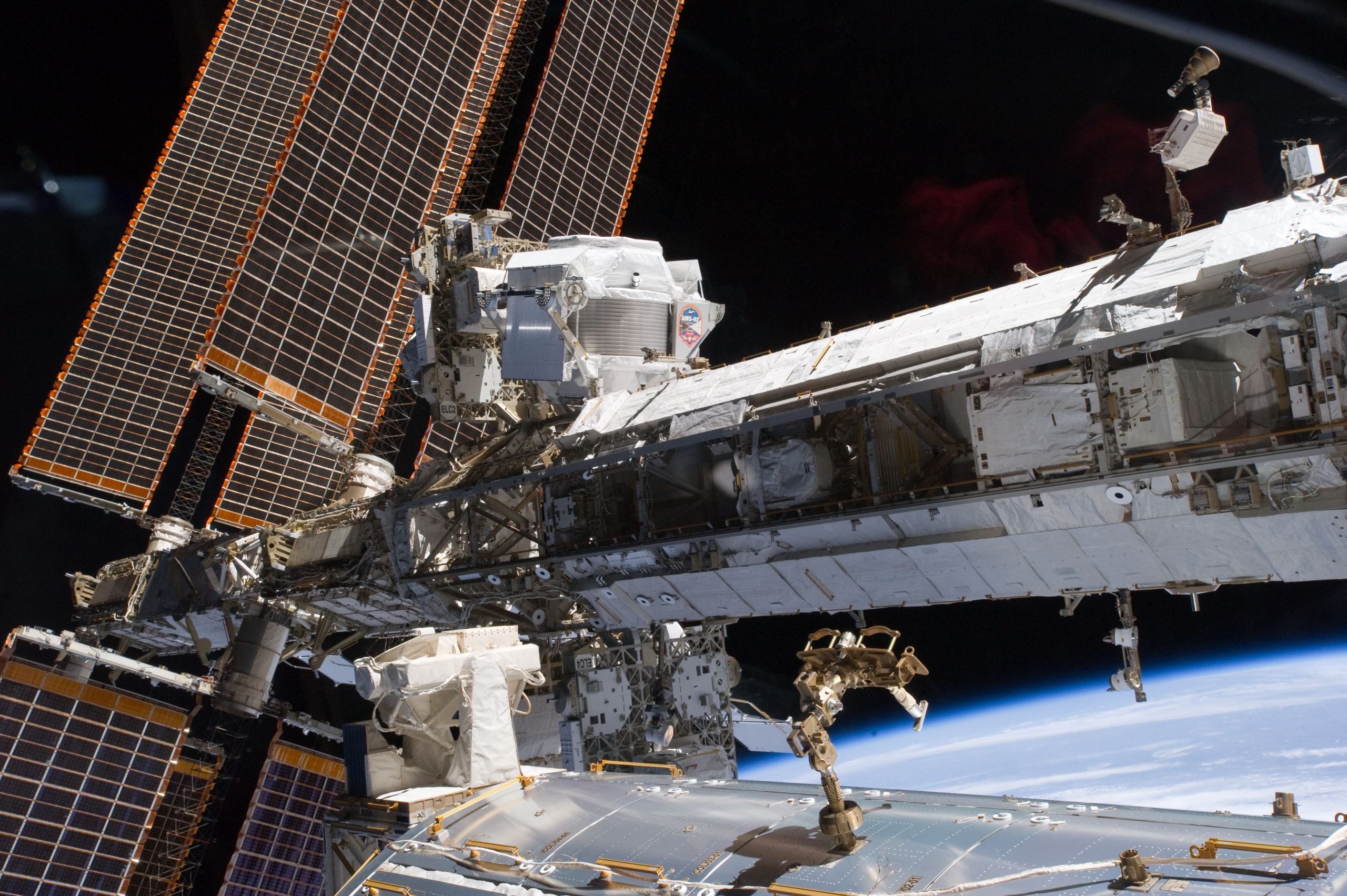
Fixed to the International Space Station (ISS) as it speeds around Earth, the Alpha Magnetic Spectrometer (AMS) is constantly measuring high-energy particles that stream from across the Universe, known as cosmic rays. In a recent paper published in Physical Review Letters, the AMS Collaboration reports its first measurements of five heavy elements found amongst these particles.
Since it was installed on the ISS in 2011, AMS has collected data from over 200 billion cosmic rays using technology adapted from the much larger particle detectors found at CERN. This unique dataset helps researchers build a clearer picture of how cosmic rays are produced, accelerate, and travel through space.
The recent paper from the AMS Collaboration describes precise measurements of the heavy elements phosphorous, chlorine, argon, potassium and calcium, bringing the total number of elements studied by AMS to twenty.
Traditionally, cosmic rays have been divided into two main categories. Primary cosmic rays mostly come from exploding stars, while secondary cosmic rays are produced by interactions between primary cosmic rays and the gas and radiation of space.
Previous results from AMS revealed that, unexpectedly, primary cosmic rays could be divided into two distinct classes. Elements were sorted into these classes based on how their flux, which is proportional to the number of particles, varied with their rigidity – the extent to which that element is deflected by magnetic fields.
The recent paper describes flux measurements taken of the additional five heavy elements over 13.5 years from approximately one million cosmic rays, in the gigavolt to teravolt rigidity range. Taken together with previous AMS results, this data allowed researchers to also divide secondary cosmic rays into two categories, bringing the total number of distinct classes to four.
Some elements are found in both primary and secondary cosmic rays, so belong to two categories. Researchers therefore also studied what fraction of different elements were found in primary and secondary rays. Of the elements covered in the recent paper, those with an even number of protons were found to have a larger proportion of particles from a primary cosmic ray than elements with an odd number of protons.
“AMS provides orders of magnitude improvement in precision over previous detectors. None of its results agree with current theory, necessitating the development of new models of cosmic rays,” explained AMS spokesperson Samuel Ting.
“This disagreement arises because models were developed when flux uncertainties were as large as 100%. AMS improving precision to 1% means commensurate improvement in theoretical predictions are needed to explain AMS measurements,” said Sunil Gupta, President-Designate of the International Union of Pure and Applied Physics, who was not involved in this research. “The presence of secondary components in primary cosmic rays hints that a sizable production of elements that are important for life on Earth could have occurred in cosmic-ray interactions in our Galaxy, rather than only during nucleosynthesis inside stars, as is commonly accepted.”
With an additional silicon tracking layer due to be placed on top of the nine existing detecting layers this year, AMS should soon increase its cosmic-ray acceptance by approximately 300%. In the next five years, it will collect as much data from cosmic rays as in the previous fifteen, helping reveal further secrets of these mysterious streams of high-energy particles.