
CERN leads project to make EU scientific data more accessible
The EU-funded HORIZON-ZEN+ project is developing AI tools to improve the increasingly popular EU Open Research Repository
Written by:
Thomas Brent
—
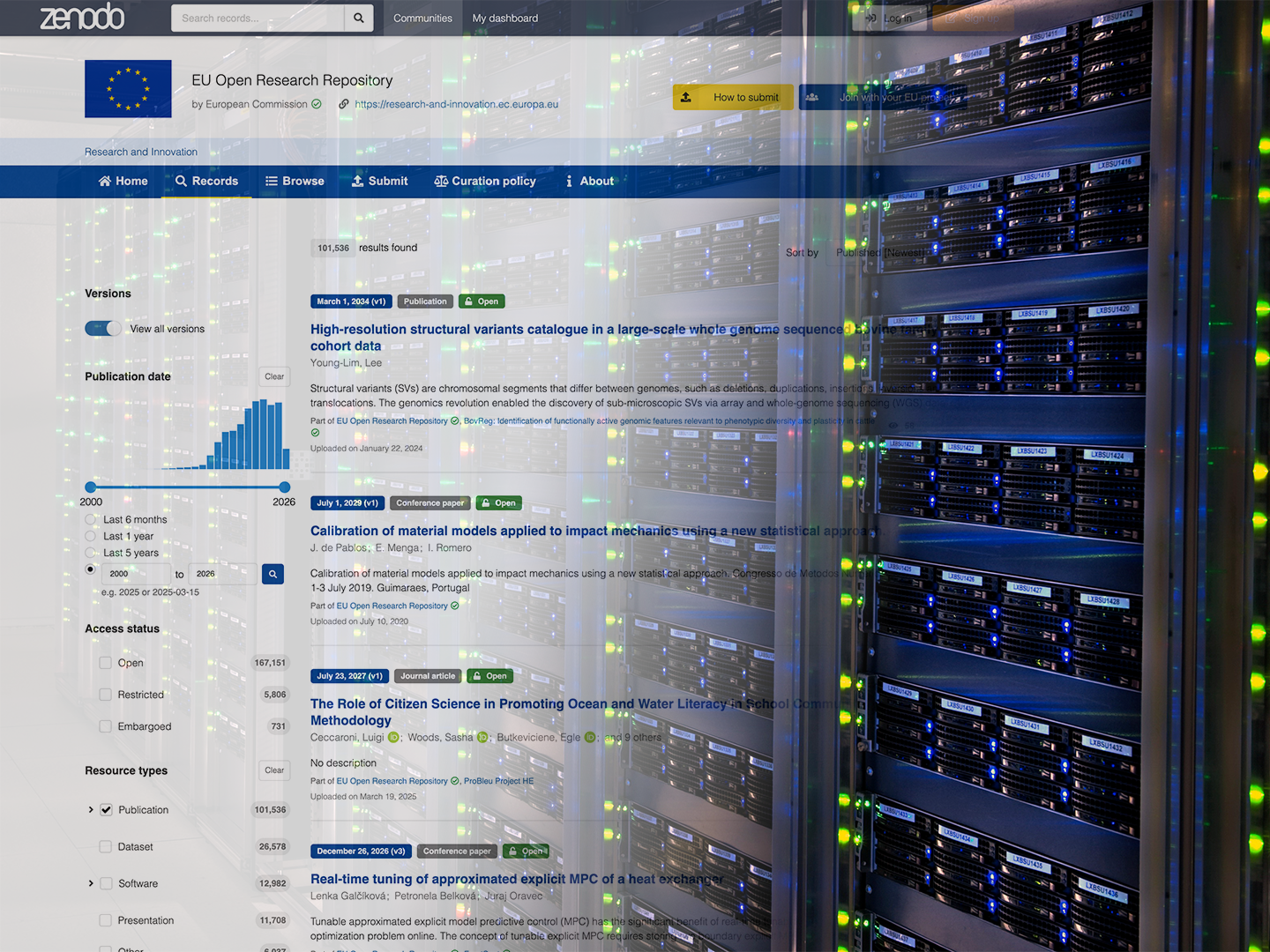
Sharing research data openly is transforming science, but it comes with challenges. Since 2021, EU-funded projects have been required to make their data FAIR: findable, accessible, interoperable and reusable. The EU Open Research Repository (EOR Repository) was created through the HORIZON-ZEN project with this in mind and provides a dedicated space on Zenodo for data from EU-funded projects. This makes it easier for researchers to both disseminate their data and find project results in an efficient way. To date, over 2700 EU-funded projects have joined the repository, with over 150 000 records uploaded.
But the repository is a victim of its own success, requiring more human capital to describe and prepare data for upload and keep records findable as it grows. To help manage this, the two-year HORIZON-ZEN+ project was launched in October 2025, building on its predecessor with the aim of drawing on artificial intelligence (AI) to improve data curation tools, automate workflows and improve interfaces for depositing and finding information.
“Researchers carry a wide range of responsibilities, from running studies to writing papers, sharing results and securing funding. Few have the time or expertise to do all of them well, and their work often suffers as a result – shared poorly or in ways that fall short of FAIR principles,” said Alex Ioannidis, CERN’s Zenodo Service Manager. “The role of Zenodo, with its EOR Repository, is to provide the easiest way for researchers to preserve their data FAIRly, without burden,” he added.
The HORIZON-ZEN+ project will build more automated processes to assist the Zenodo team in curating entries. Uploading scientific data correctly – so that it can be easily retrieved – can be time‑consuming, and without a proper framework, researchers often mislabel work. To address this, the new project will harness AI to simplify the process for researchers and make the repository’s search functionality smarter.
The EOR Repository, and the wider Zenodo platform, are part of the way in which CERN is supporting the EU’s ongoing efforts to improve open science tools.
From autumn this year, the Open Research Europe (ORE) open access publishing platform will be hosted at CERN. ORE and the EOR Repository are complementary. Researchers can use the EOR Repository to share all their project results, datasets, posters, etc., and then submit final papers to ORE to be peer-reviewed.
These two initiatives also support the EU’s European Open Science Cloud (EOSC), which is the broader framework that makes scientific data FAIR across Europe. Essentially, EOSC ensures that more specific repositories, such as the EOR Repository, are well linked.
For more information, consult the project website and the news on the CERN EU Projects Office website.