
About
The Future Circular Collider (FCC) could be Europe’s next-generation particle collider: a unique tool to explore the deepest mysteries of the Universe and to drive technology, innovation and skills for decades to come. The FCC would be housed in a 91-kilometre tunnel at an average depth of 200 metres underneath CERN and the surrounding regions of France and Switzerland, including a section passing beneath Lake Geneva. It would collide electrons with their antiparticles, delivering collision results with unprecedented detail.
This new collider would help answer many questions about nature’s rulebook that go beyond the reach of current colliders, including CERN’s flagship accelerator, the Large Hadron Collider (LHC), and its high-luminosity upgrade. The LHC is currently the most powerful particle accelerator in the world and is set to run until the 2040s. But scientists around the world are already thinking beyond the LHC. A decision on whether the FCC will be built is expected around 2028.

Feasibility study
Over the past few years, an international team of scientists and engineers worked on the Future Circular Collider (FCC) Feasibility Study. Their task was to find out whether the FCC as envisaged by physicists from around the world could be implemented, balancing scientific goals with technical feasibility and the geological and territorial conditions of the region. The results were published in spring 2025.
The Feasibility Study was one of the key recommendations of the European Strategy for Particle Physics, an exercise under the mandate of the CERN Council. In this Strategy, scientists from Europe, in collaboration with the worldwide particle physics community, draw the roadmap for the future of particle physics research, setting scientific priorities and identifying the next major accelerator projects. It is updated every five to seven years.
For the Feasibility Study, every aspect of the proposed collider was scrutinised, spanning administrative and financial issues, geological studies of the local area, infrastructure and civil engineering considerations and the collider’s environmental impact. Working hand in hand with French and Swiss authorities and engaging local communities, teams studied the conditions with the help of sample collections, geodesy, vibratory trucks and exploratory drilling.
Many requirements had to be met: the tunnel should avoid geologically complex areas and must be connectable to CERN’s existing accelerator infrastructure and the location of the surface sites must respect social and environmental constraints, following the principles of “avoid, reduce, compensate” to ensure a sustainable design for future generations.
Following four years of study, a preferred tunnel configuration was identified out of some 100 variants.
Future Circular Collider Feasibility Study Report Volume 1: Physics and Experiments
Future Circular Collider Feasibility Study Report Volume 2: Accelerators, technical infrastructure and safety
Future Circular Collider Feasibility Study Report Volume 3: Civil Engineering, Implementation and Sustainability
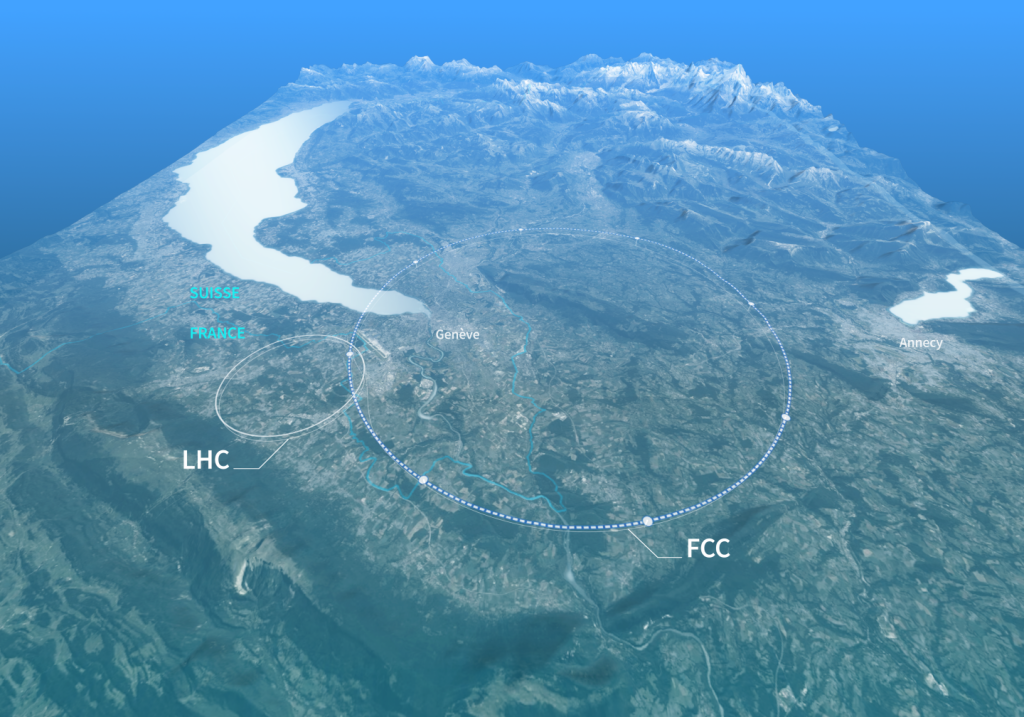
The future collider would be built in a circular underground tunnel some 91 kilometres in circumference located at a depth of between 180 and 400 metres beneath the French departments of Haute-Savoie and Ain and the Swiss canton of Geneva.
90.7 kilometres
The circumference of the accelerator ring is a key parameter for determining the energies at which particles can be collided. Its proposed location was chosen after careful consideration to minimise the impact on the surrounding countryside and villages.
200 metres average depth
The FCC tunnel would be primarily embedded in the molasse of the Geneva Basin, spanning parts of France and Switzerland and including a section beneath Lake Geneva. The tunnel would be accessible from eight surface points, one in Switzerland and seven in France.
4 detectors
Using different detector technologies would ensure a broad scientific harvest as well as systematic cross-checks of results. International collaborations would build on CERN’s existing technical and organisational infrastructure, while expanding it to meet the specific requirements of the FCC programme.
Decades of scientific research
An infrastructure designed to support decades of scientific research, reinforcing Europe’s leadership in particle physics throughout the 21st century and beyond.
Timeline
2021-2025
2026-2027
2028
Early 2030s
2038-2046
Late 2040s
Feasibility Study
Update of the European Strategy for Particle Physics
Expected decision whether or not to build the FCC
Construction start
Installation phase
Start-up of FCC
International Collaboration
CERN has a long history of international collaboration. Founded as a truly international endeavour in 1954, it unites people from all over the world to push back the frontiers of science and technology for the benefit of all. The FCC will raise this global mission to the next level by making this new project sustainable from the very start.
The team working on the FCC forms an open, international collaboration, aiming at an inclusive, geographically well-balanced and topically complementary network of contributions for the realisation of this next-generation, frontier research infrastructure.
The FCC Global Collaboration Working Group is developing a globally coordinated strategy for converging activities. Organisations from around the world are invited to participate in laying the foundations for subsequent development actions in the framework of the FCC project that will strengthen the European Research Area as a focal point of global research cooperation.
Frequently asked questions
Here are some of the questions most often raised about the FCC.
This collider is the scientific instrument that the global particle physics community considers the most promising in terms of research prospects and variety of study topics. It would, in particular, make it possible to fully exploit the discovery of the Higgs boson and to study the Standard Model of particle physics in greater depth.
The discovery by CERN in 2012 of the fundamental particle called the Higgs boson completed the theory that describes the behaviour of the visible matter in the Universe (the Standard Model) and opened a new chapter of research. The Higgs boson is a powerful tool for the search for physics beyond the Standard Model.
The LHC has continued to produce Higgs bosons and the LHC experiments will continue their research until 2040; after that date, more powerful and more precise particle accelerators will be needed to advance research.
Indeed, many questions remain open: we know from the observation of phenomena in the Universe that the Standard Model is not complete. For example, although the observation of galaxies has provided compelling evidence for the existence of dark matter, the fundamental nature of dark matter remains unknown. The dominance of matter over antimatter in the Universe remains unexplained.
These questions, together with experimental observations such as the fact that neutrinos have mass, indicate that the Standard Model is incomplete. Addressing them requires measurements of unprecedented precision, which the FCC would make possible.
Its main goal is to study in detail the Higgs boson and its interactions with other known fundamental particles – it will be a “Higgs factory.” It will also study other aspects of nature at the infinitely small scale to search for the slightest deviations from the underlying theory and explore rare phenomena.
The objectives include:
- Measure the Higgs boson and other key particles with unmatched precision.
- Search for new particles, new forces and potential dark-matter candidates.
- Understand why matter dominates over antimatter in today’s Universe.
- Explore entirely new phenomena through gains in precision and sensitivity.
The FCC would be installed in an underground tunnel roughly the shape of a ring with a circumference of 91 km, located deep underground with shafts averaging 200 metres in depth. The FCC would be deeper than the current LHC and three times longer.
The tunnel alignment was selected, among other considerations, to allow the existing CERN accelerator complex to serve as a chain of pre-accelerators.
Below is a map of the route, which crosses the French departments of Ain and Haute-Savoie and the Swiss Canton of Geneva and passes under Lake Geneva.
There would be eight access points: one in Switzerland and seven in France.
The surface areas of the access points (called surface sites) would vary between 4 and 6 hectares, depending on their purpose.
The Future Circular Collider (FCC) is the approach that has been judged the most effective in terms of research for studying in depth the widest variety of promising topics in particle physics.
This choice follows a conceptual design report for the FCC that was submitted in 2020 as a contribution to the update of the European Strategy for Particle Physics. Following this, CERN was mandated by its Member States to carry out a technical and financial feasibility study of the FCC that would be ready for presentation during the next Strategy update in May 2026.
The current Strategy was adopted after the Higgs boson, the last undetected particle predicted by the Standard Model – which describes all known fundamental forces except gravitation – was discovered at the LHC.
To build on these achievements, the FCC would be an electron-positron collider that would serve as a “Higgs factory”, a facility specially designed to study Higgs bosons. This facility might later be converted into a proton–proton collider capable of reaching collision energies of up to 100 teraelectronvolts.
The main objective of CERN is fundamental research in particle physics. This type of research expands the limits of human knowledge to understand the fundamental building blocks and their interactions, which lets us draw conclusions about the history and the fate of the Universe.
Major advances come from new knowledge generated by fundamental research; without fundamental science, there is no applied science. For example, without Albert Einstein’s fundamental equation of general relativity there would be no such concrete everyday applications as GPS. Applications like lasers, integrated circuits and transistors are all based on discoveries from quantum research.
The tools and technologies developed to carry out this research can have many direct applications for humankind, such as medical imaging and hadron therapy used for the treatment of certain cancers.
These technologies are transferred to society by the universities and institutes that participate in the collaborations and by CERN itself, in fields ranging from aerospace to security, environmental protection and cultural heritage. Read more here.
If approved, the FCC would come online around 2045.
2026
Citizen participation process
2028
Decision by the CERN Member States, including France and Switzerland, meeting in the CERN Council, on whether to carry out the project
2026–2032
Preparatory phase
Further, more in‑depth studies commissioned by the CERN Member States
2033 to 2040
Civil engineering phase
After 2038
FCC installation phase
After 2045
FCC commissioning and operation
In 2021, CERN’s Member and Associate Member States, including France and Switzerland, mandated the Feasibility Study. This followed a recommendation by the particle physics community in the 2020 update of the European Strategy for Particle Physics.
CERN, together with academic and industrial partners, is currently conducting research programmes on reuse of the material excavated during the tunnel construction. The aim is to make the best possible use of the material extracted from the subsoil, preferably locally.
A strategy for managing the material is being developed with stakeholders from the Host States (France and Switzerland), universities and companies with expertise in this field.
The current objective is to reuse most of the excavated material (around 70%)
locally to limit disturbance and storage. In addition, an estimated 15 % of the material will be undergo treatment at the extraction sites to make it suitable for reuse. The remaining material that cannot be used will be transported to specialised treatment and disposal centres.
Of the 85 % of material that can be recovered, the plan is to reuse it for the following purposes (numbers are estimates):
- 10% to 20 % for the production of cement and concrete
- 40 % for use as quarry fill
- 30 % for use in agriculture, forestry and land and brownfield development; this figure may increase depending on the results of the OpenSkyLab project.
- 10 % for other recovery channels (construction materials, rural roads, creation of covered trenches).
This approach is in line with the European Union’s action plan for the circular economy and complies with the best practices adopted by CERN’s two Host States (France and Switzerland).
The total quantity of material that would be excavated for the FCC is estimated at 6.3 million m³ in volume, or approximately 16.4 million tonnes over the construction period.
| Comparative construction projects | Million tonnes of excavated material |
| FCC | 16.4 |
| Gotthard | 28.2 |
| Grand Paris | 43 |
| Lyon Turin | 37 |
| High Speed 2 (UK) | 130 |
| Crossrail | 8 |
| Stuttgart 21 | 40 |
Per year, the FCC construction works would involve managing less than 2% of all material extracted annually in France and 0.1 of the material extracted annually in Switzerland.
CERN aims to be a model environmentally responsible scientific laboratory, acting with transparency, accountability and sustainability. All activities linked to the FCC will follow these commitments and will comply with environmental rules in France and Switzerland and with EU legislation. These include wildlife, plants, soil quality, air quality, water resources, biodiversity, noise, dust and light pollution. Existing and planned local infrastructure will also be taken into account. The project will systematically apply the “avoid–reduce–offset” principle.
Read more here.
The cost of the FCC with four interaction points is estimated to be 15 billion CHF, spread over a period of about 12 years, with the civil engineering for the tunnel representing about one third. This investment would be firstly based on CERN’s recurrent budget, spread over many years and shared among CERN’s Member States and international partners. Additional funding may come from other institutional and private contributions. Private donors have already pledged 860 million euros and the FCC is ranked first among 11 possible ‘moonshot projects’ for Europe in the European Commission’s Multiannual Financial Framework (2028-2034).