
Local area
A project rooted in the local area
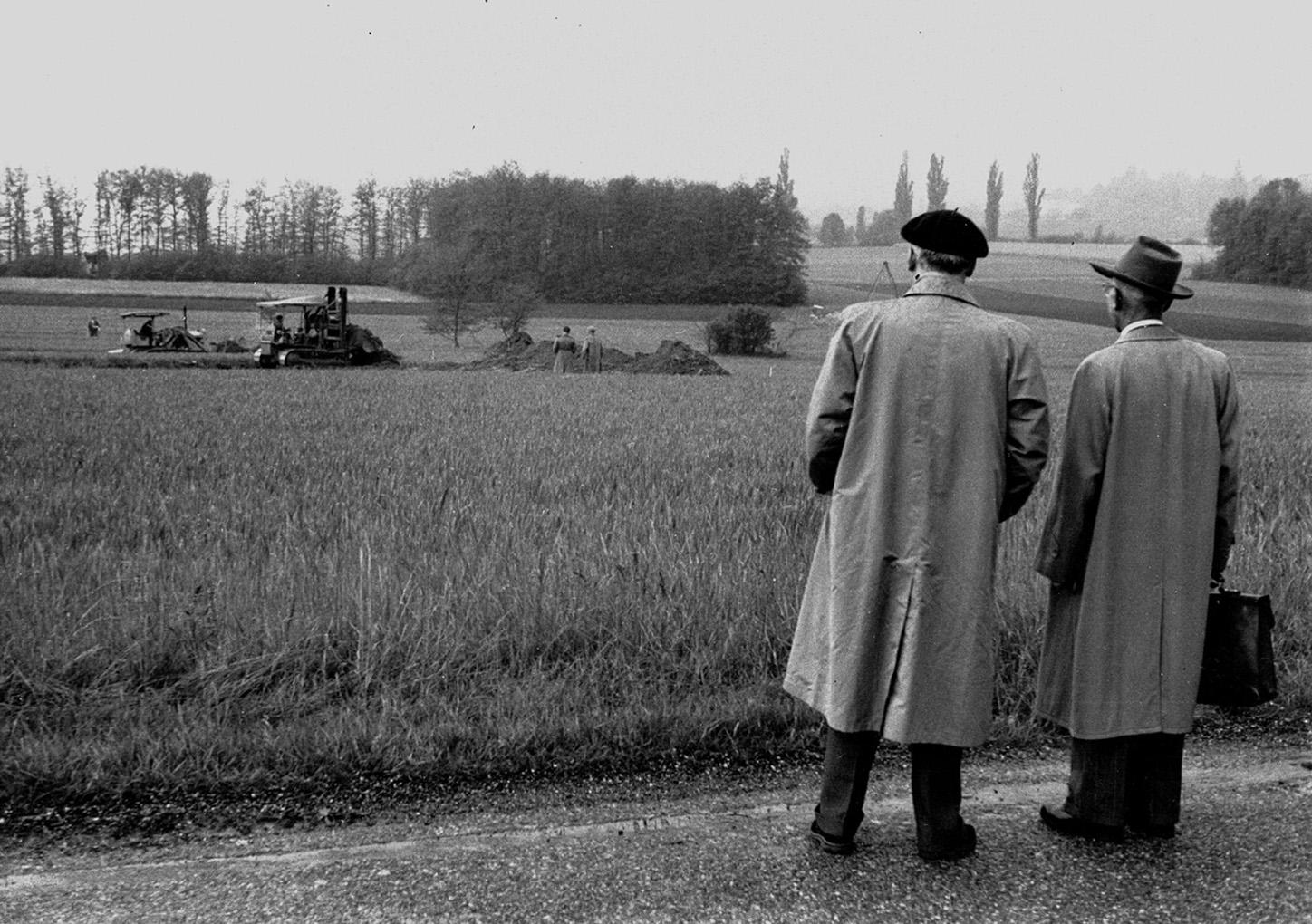
CERN’s history in the region and its deep-rooted relationship with its Host States, France and Switzerland, date back to the 1950s. For the FCC Feasibility Study, CERN invited local officials and residents to public meetings both at CERN and in their local communities to answer their questions and concerns as well as introduce the investigations carried out underground, the general context and objectives. This dialogue will continue both on an individual and an administrative level throughout the decision-making, construction and operation phases.
The May 2025 information meeting was recorded and is available to watch.
Public debate
Citizen participation process
Information and dialogue on such a large project are essential, and CERN is committed to engaging with local audiences in both Switzerland and France.
France
The “Commission nationale du débat public” (CNDP), France’s independent national authority for public participation in major projects and policies, has decided to organise a public debate on the FCC project following a referral from CERN and RTE, the French Transmission System Operator for electricity.
The public debate organised under the auspices of the CNDP is the most important form of public participation in France. It takes place over several months in a range of formats, including large public meetings, workshops, round tables and online participation tools. This makes it possible to examine and question the FCC project before any decision is taken on its funding. It will open up discussions on how the project may develop. Further information (in French).
Timetable for the French public debate
From Tuesday, 2 June to Thursday, 1 October 2026
Switzerland
A public participation exercise will take place in Switzerland over the same period. While respecting established practices in participatory democracy and public consultation, CERN has appointed an agency specialising in supporting project consultations, “Opinion publique”, to set up a consultation and information mechanism in the region. The Canton of Geneva and the Swiss Confederation are monitoring this mechanism from its preparation phase through to its implementation and reporting phases.
An independent and trusted third party, responsible for overseeing the proper procedural conduct of the consultation mechanism, has also been appointed; among other things, it will be in charge of producing the final report on the consultation. Further information (in French).
Timetable for the Swiss consultation
From Monday, 18 May to Friday, 2 October 2026
Meetings with local residents
France
In June 2024, CERN called on the “Commission nationale du débat public” (CNDP), France’s independent national authority for public participation in major projects and policies, to provide advice during the preliminary phase of the FCC, even before formally requesting it to organise the public debate. The CNDP appointed Ms Brigitte Fargevieille and Mr Jonas Frossard to carry out this advisory mission on 3 July 2024. Mr Jonas Frossard was replaced by Mr David Chevalier in September 2025.
In this context, the CNDP advised CERN on the local information campaign and dialogue regarding the geophysical and geotechnical measurement campaigns carried out as part of the preliminary studies for the FCC accelerator project.
The CNDP recommended that CERN put in place a territorial action plan with a view to maintaining continuous dialogue.
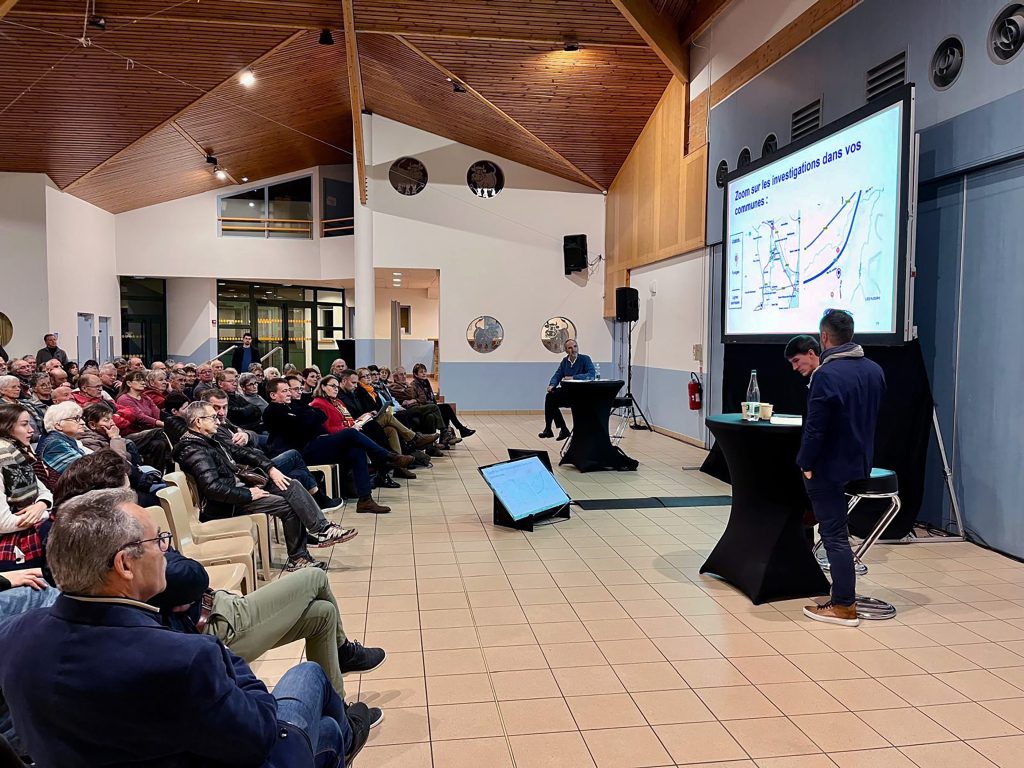
In 2024, a CERN team, in the presence of national and local officials and the CNDP, organised seven public meetings in Haute-Savoie and Ain to present the initial project outline, in particular for the communes of Pougny, Challex, Ferney-Voltaire, Prévessin-Moëns, Nangy, Contamines-sur-Arves, Groisy, Charvonnex, Marlioz, Cercier, Allonzier-la-Caille, Choisy, Amancy, Cornier, Arenthon, Scientrier, La Roche-sur-Foron, Éteaux, Vulbens, Dingy-en-Vuache, Savigny and Minzier.
A large public meeting was also held at CERN on 24 April 2024 to present the progress with the FCC Feasibility Study, and another took place on 27 May 2025 following the publication of the Feasibility Study. In this way, CERN engaged in dialogue with more than 1500 people in the local area in 2024.In autumn 2025, CERN embarked on a more personalised dialogue by organising five outreach events in France. These allowed the public to interact directly with the FCC Study teams during five-hour time slots, in the communes of Nangy, Groisy/Charvonnex, Challex, Ferney-Voltaire and Marlioz/Cercier.
Switzerland
CERN works closely with the Canton of Geneva and the Swiss Confederation.
A large public meeting was held at CERN on 24 April 2024 to present the progress with the FCC Feasibility Study, and another took place on 27 May 2025 following the publication of the Feasibility Study. In this way, CERN engaged in dialogue with more than 1500 people in the local area in 2024.
In addition, two public information meetings were held in Switzerland with the support of the communes concerned: one at CERN on 18 February 2025 for the communes of Dardagny, Satigny, Russin and Meyrin, and the other in the commune of Lullier on 1 April 2025 for the communes of Presinge, Choulex, Puplinge, Jussy and Meinier. The meetings, which were attended by some 200 people, were an opportunity to present the progress with the FCC Feasibility Study, in particular the geotechnical investigations carried out in the region, and to answer the many questions from the public. In autumn 2025, CERN embarked on a more personalised dialogue by organising an outreach event in the Canton of Geneva. This allowed local residents to interact directly with the FCC Study teams during a five-hour time slot, in the commune of Presinge.
A neighbour unlike any other
Not many people find themselves living next to a large circular collider.
Beyond training and hosting an impressively diverse community of people, CERN brings many economic and industrial benefits to the region. Business incubation centres run by CERN in its Member States – including in the Pays de Gex and the Geneva region – are hives of technological creativity. Educational programmes benefit thousands of students and hundreds of teachers every year, with many activities taking place at CERN itself and others offered as classroom resources from primary level upwards.
CERN is a major tourist destination in the region, welcoming around 400 000 visitors each year. CERN also organises open days that give local people the chance to learn more about their neighbour, the LHC. The benefits of having such a neighbour beneath your feet often outweigh the drawbacks. Nevertheless, building a 91‑kilometre‑circumference tunnel is no easy task and, like any major civil engineering project, will require the cooperation of the local population.
The construction of the FCC would expand CERN’s research facilities and extend the geographical reach of the benefits already enjoyed by the two Host States throughout the twenty‑first century.
Frequently asked questions
Here are some of the questions most often raised about the FCC, for example in meetings with local residents.
This collider is the scientific instrument that the global particle physics community considers the most promising in terms of research prospects and variety of study topics. It would, in particular, make it possible to fully exploit the discovery of the Higgs boson and to study the Standard Model of particle physics in greater depth.
The discovery by CERN in 2012 of the fundamental particle called the Higgs boson completed the theory that describes the behaviour of the visible matter in the Universe (the Standard Model) and opened a new chapter of research. The Higgs boson is a powerful tool for the search for physics beyond the Standard Model.
The LHC has continued to produce Higgs bosons and the LHC experiments will continue their research until 2040; after that date, more powerful and more precise particle accelerators will be needed to advance research.
Indeed, many questions remain open: we know from the observation of phenomena in the Universe that the Standard Model is not complete. For example, although the observation of galaxies has provided compelling evidence for the existence of dark matter, the fundamental nature of dark matter remains unknown. The dominance of matter over antimatter in the Universe remains unexplained.
These questions, together with experimental observations such as the fact that neutrinos have mass, indicate that the Standard Model is incomplete. Addressing them requires measurements of unprecedented precision, which the FCC would make possible.
Its main goal is to study in detail the Higgs boson and its interactions with other known fundamental particles – it will be a “Higgs factory.” It will also study other aspects of nature at the infinitely small scale to search for the slightest deviations from the underlying theory and explore rare phenomena.
The objectives include:
- Measure the Higgs boson and other key particles with unmatched precision.
- Search for new particles, new forces and potential dark-matter candidates.
- Understand why matter dominates over antimatter in today’s Universe.
- Explore entirely new phenomena through gains in precision and sensitivity.
The FCC would be installed in an underground tunnel roughly the shape of a ring with a circumference of 91 km, located deep underground with shafts averaging 200 metres in depth. The FCC would be deeper than the current LHC and three times longer.
The tunnel alignment was selected, among other considerations, to allow the existing CERN accelerator complex to serve as a chain of pre-accelerators.
Below is a map of the route, which crosses the French departments of Ain and Haute-Savoie and the Swiss Canton of Geneva and passes under Lake Geneva.
There would be eight access points: one in Switzerland and seven in France.
The surface areas of the access points (called surface sites) would vary between 4 and 6 hectares, depending on their purpose.
The Future Circular Collider (FCC) is the approach that has been judged the most effective in terms of research for studying in depth the widest variety of promising topics in particle physics.
This choice follows a conceptual design report for the FCC that was submitted in 2020 as a contribution to the update of the European Strategy for Particle Physics. Following this, CERN was mandated by its Member States to carry out a technical and financial feasibility study of the FCC that would be ready for presentation during the next Strategy update in May 2026.
The current Strategy was adopted after the Higgs boson, the last undetected particle predicted by the Standard Model – which describes all known fundamental forces except gravitation – was discovered at the LHC.
To build on these achievements, the FCC would be an electron-positron collider that would serve as a “Higgs factory”, a facility specially designed to study Higgs bosons. This facility might later be converted into a proton–proton collider capable of reaching collision energies of up to 100 teraelectronvolts.
The main objective of CERN is fundamental research in particle physics. This type of research expands the limits of human knowledge to understand the fundamental building blocks and their interactions, which lets us draw conclusions about the history and the fate of the Universe.
Major advances come from new knowledge generated by fundamental research; without fundamental science, there is no applied science. For example, without Albert Einstein’s fundamental equation of general relativity there would be no such concrete everyday applications as GPS. Applications like lasers, integrated circuits and transistors are all based on discoveries from quantum research.
The tools and technologies developed to carry out this research can have many direct applications for humankind, such as medical imaging and hadron therapy used for the treatment of certain cancers.
These technologies are transferred to society by the universities and institutes that participate in the collaborations and by CERN itself, in fields ranging from aerospace to security, environmental protection and cultural heritage. Read more here.
If approved, the FCC would come online around 2045.
2026
Citizen participation process
2028
Decision by the CERN Member States, including France and Switzerland, meeting in the CERN Council, on whether to carry out the project
2026–2032
Preparatory phase
Further, more in‑depth studies commissioned by the CERN Member States
2033 to 2040
Civil engineering phase
After 2038
FCC installation phase
After 2045
FCC commissioning and operation
In 2021, CERN’s Member and Associate Member States, including France and Switzerland, mandated the Feasibility Study. This followed a recommendation by the particle physics community in the 2020 update of the European Strategy for Particle Physics.
CERN, together with academic and industrial partners, is currently conducting research programmes on reuse of the material excavated during the tunnel construction. The aim is to make the best possible use of the material extracted from the subsoil, preferably locally.
A strategy for managing the material is being developed with stakeholders from the Host States (France and Switzerland), universities and companies with expertise in this field.
The current objective is to reuse most of the excavated material (around 70%)
locally to limit disturbance and storage. In addition, an estimated 15 % of the material will be undergo treatment at the extraction sites to make it suitable for reuse. The remaining material that cannot be used will be transported to specialised treatment and disposal centres.
Of the 85 % of material that can be recovered, the plan is to reuse it for the following purposes (numbers are estimates):
- 10% to 20 % for the production of cement and concrete
- 40 % for use as quarry fill
- 30 % for use in agriculture, forestry and land and brownfield development; this figure may increase depending on the results of the OpenSkyLab project.
- 10 % for other recovery channels (construction materials, rural roads, creation of covered trenches).
This approach is in line with the European Union’s action plan for the circular economy and complies with the best practices adopted by CERN’s two Host States (France and Switzerland).
The total quantity of material that would be excavated for the FCC is estimated at 6.3 million m³ in volume, or approximately 16.4 million tonnes over the construction period.
| Comparative construction projects | Million tonnes of excavated material |
| FCC | 16.4 |
| Gotthard | 28.2 |
| Grand Paris | 43 |
| Lyon Turin | 37 |
| High Speed 2 (UK) | 130 |
| Crossrail | 8 |
| Stuttgart 21 | 40 |
Per year, the FCC construction works would involve managing less than 2% of all material extracted annually in France and 0.1 of the material extracted annually in Switzerland.
CERN and its contracting companies are committed to making every attempt to keep disruption to residents to a minimum. The surface sites have already been chosen with a view to causing the least possible disturbance to the local community, the countryside, vistas and of course the wildlife. Lorries carrying excavated material would bypass residential roads as much as possible. Noise levels would be kept to a minimum. Measures would be taken to keep roads as clean as possible.
CERN aims to be a model environmentally responsible scientific laboratory, acting with transparency, accountability and sustainability. All activities linked to the FCC will follow these commitments and will comply with environmental rules in France and Switzerland and with EU legislation. These include wildlife, plants, soil quality, air quality, water resources, biodiversity, noise, dust and light pollution. Existing and planned local infrastructure will also be taken into account. The project will systematically apply the “avoid–reduce–offset” principle.
Read more here.
The tunnel itself would be underground and therefore not visible on the surface. Eight surface sites along the tunnel’s circumference would be visible: the four experimental sites would each occupy up to 8 hectares, and the four technical sites up to 5 hectares each, including their landscaping to help them blend into the surroundings.
The cost of the FCC with four interaction points is estimated to be 15 billion CHF, spread over a period of about 12 years, with the civil engineering for the tunnel representing about one third. This investment would be firstly based on CERN’s recurrent budget, spread over many years and shared among CERN’s Member States and international partners. Additional funding may come from other institutional and private contributions. Private donors have already pledged 860 million euros and the FCC is ranked first among 11 possible ‘moonshot projects’ for Europe in the European Commission’s Multiannual Financial Framework (2028-2034).
The FCC would create an estimated 50 billion CHF of direct and indirect economic effects, including 4 billion CHF in the surrounding area through added household spending. The cost–benefit ratio is estimated at 1.2, meaning that for every 1 CHF spent, there will be a return of 1.2 CHF – in short, the project is expected to create more value than it costs.
Absolutely. CERN considers good relations with its neighbours very important. CERN regularly organises events for people in the region, consults the local authorities and is also running a public participation process for the FCC.