
In the wake of partons
The CMS Collaboration reports the first direct observation of a “wake” formed by a parton travelling through quark–gluon plasma
Written by:
CMS Collaboration
—
Today, almost all the quarks in our Universe are neatly organised into larger particles, glued together by aptly named gluons. For the first few millionths of a second after the Big Bang, however, quarks and gluons were not confined, forming instead a state of matter known as a quark–gluon plasma (QGP). By studying the QGP recreated by lead-nuclei collisions in the Large Hadron Collider (LHC), the CMS Collaboration has directly observed how particles travelling through it leave a pattern similar to the wake left by a boat.
“This observation is a culmination of a decades-long quest to observe the wake phenomenon,” says Olga Evdokimov, from the University of Illinois Chicago, one of the leaders of the analysis. “It was predicted by theory over 20 years ago, but remained elusive in the experimental data.”
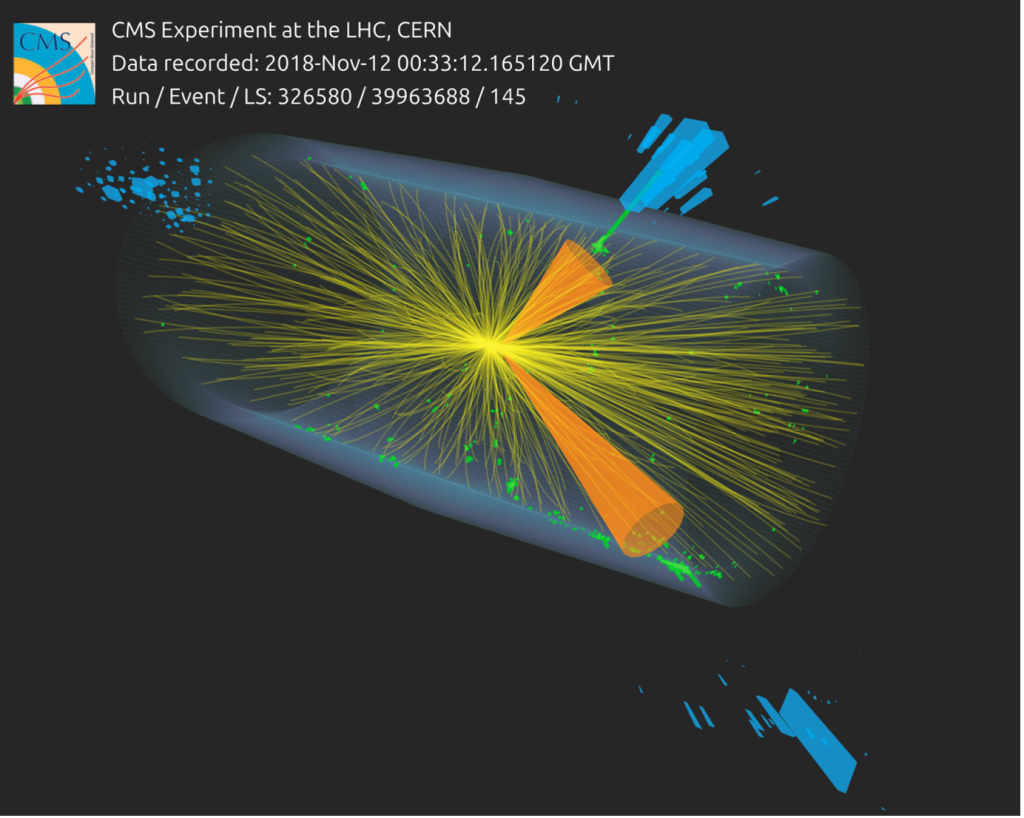
When heavy nuclei such as lead collide, energetic quarks and gluons – known collectively as partons – emerge in the form of sprays of particles called jets. As these partons travel through the QGP, they transfer some of their energy and momentum to the medium.
Understanding both the parton energy loss and how the QGP responds is essential for revealing the properties of the plasma. While the QGP’s impact on the parton jets was first observed more than two decades ago, experimental searches for signals from the response of the plasma, such as the wake effect, have proven much more challenging. The expected signals are subtle and can easily be obscured by other effects. Recent CMS measurements of collision events involving a particle known as the Z boson and a jet provided initial evidence of the wake phenomenon, but not a strong enough signal to confirm an observation.
As described in its recent paper, the CMS Collaboration built on recent theoretical advances to search for the wake signal using pairs of “back-to-back jets”, which travel in opposite directions when produced by heavy-ion collisions. These pairs of back-to-back jets provided a powerful opportunity to search for the wake effect, as they are produced far more frequently than a Z boson accompanied by a jet. In addition, the opposing directions of the two jets helped researchers disentangle the wake signal from other jet-induced effects. This latest measurement reveals a clear depletion of particles behind the jet direction, consistent with the predicted properties of a wake.
The researchers also investigated how the strength of the wake signal varied with the degree of overlap between the colliding lead nuclei. More QGP is formed the more the nuclei overlap, which is also when the strongest wake signal was observed.
“Observing and quantifying the QGP wake opens a new door to characterising the properties and dynamics of the quark–gluon plasma,” says Raghunath Pradhan, from the University of Illinois Chicago and lead analyser of the study. “This could provide new insights into the evolution of the early Universe.”