
Kicking off
Following the installation of kicker magnets that are more heat resistant and their successful tests during the SPS scrubbing run, the SPS is getting ready for High-Luminosity LHC operation.
Written by:
Kristiane Bernhard-Novotny
—
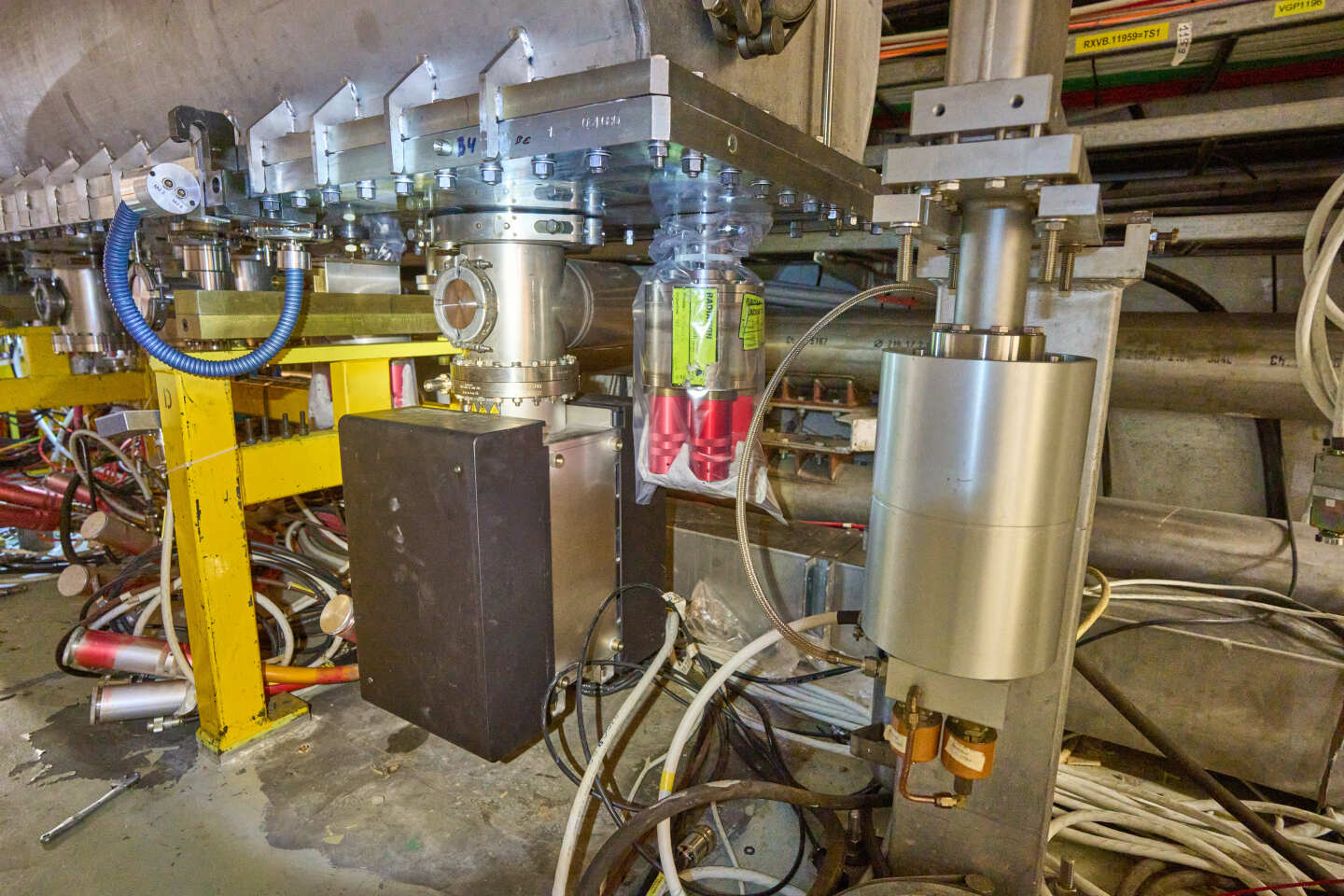
Upgrades for the future operation of the High-Luminosity LHC (HL-LHC) are under way in the whole accelerator complex. One of these upgrades is a new design to reduce the heating of some of the kicker magnets of the SPS to prepare them for future high-intensity beams. With their present design, these specific magnets would be heated to such an extent that they would temporarily lose their ability to bend the beam into the correct position. To avoid this, a special ceramic chamber that includes silver fingers has been installed. These fingers greatly reduce the electromagnetic interaction between the beam and the ferrite of the magnets, which is non-conductive. Thanks to this shielding effect, the magnets heat up much less. The new magnets were installed during the winter shutdown and have just passed their initial tests with beam with flying colours during the SPS scrubbing run that began on 24 March.
Sixteen fast-pulsing magnets (twelve small and four large) “kick” incoming beams from the PS accelerator into the correct orbit of the SPS beam. The magnetic pulse has to be timed precisely to prevent an accidental deflection of the circulating beams that could cause them to be lost in the accelerator. The circulating SPS beam, however, can cause significant heating of the larger kicker magnets, which are only used for LHC-type proton beams. This has already happened in the past, and the beam intensity had to be reduced to prevent the magnets from overheating. This problem has now been solved with the newly installed large kicker magnets.
The original kicker magnets were installed during the 1970s and replacing them turned out to be much more expensive than adapting the existing ones to the HL-LHC beams. The SY-ABT kicker team found a good compromise between reducing the heating of the magnets and achieving a sufficiently fast field rise time, as well as optimising the budget spent for the material of the magnets. The solution adopted is largely based on the approach that has proven to be successful with the SPS extraction kicker magnets. The main difference is that, in the case of the SPS magnets, the fingers were applied directly to the ferrite of the extraction magnets. In the new design, the fingers are placed on two U-shaped ceramic chambers, which are installed inside the kicker magnets. Each set of fingers is connected to the high-voltage end plate of the magnets, effectively limiting the electrical stress on them. Obtaining the required high-voltage performance while limiting the heating required several iterations of the design and close collaboration between the SY-ABT and BE-ABP teams.
“A significant challenge for the teams was that all components had to be prototyped and manufactured on a very short timescale,” says Laurent Ducimetière, who led the study together with Mike Barnes and Thomas Kramer. After the prototype kicker magnet passed the high-voltage tests in the lab, the team built up a completely new kicker magnet consisting of four of these magnets and installed it in the SPS.