
ALPHA measures tiny energy gap in antimatter with improved precision
The ALPHA Collaboration has increased the precision of its measurement of the ground-state hyperfine splitting of antihydrogen by two orders of magnitude
Written by:
Rory Harris
—
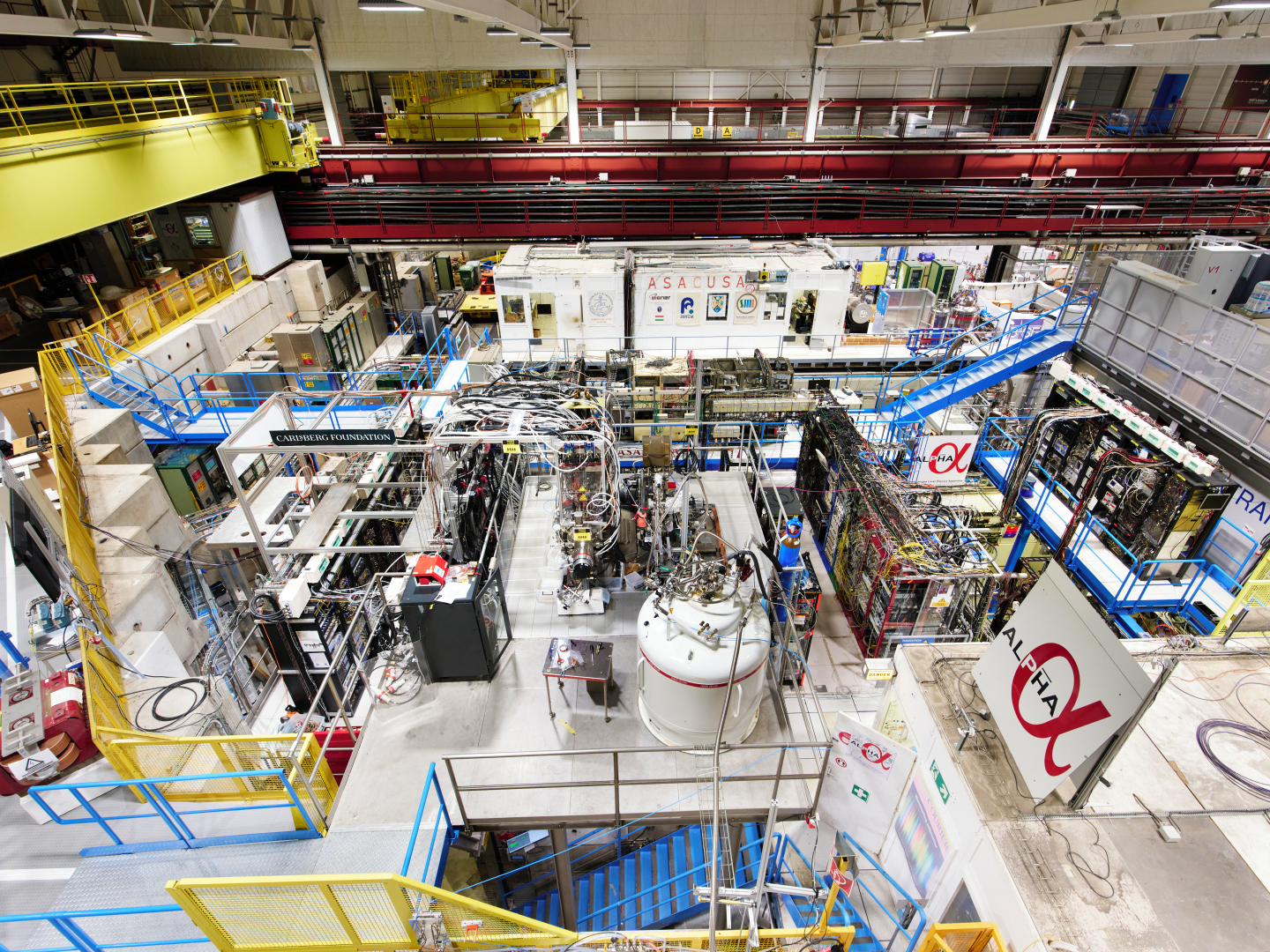
Researchers at the ALPHA experiment have achieved a hundredfold improvement in their measurement of a feature of the antimatter counterpart of the hydrogen atom. The result, published today in Nature, allows a precise comparison of hydrogen and antihydrogen.
In this study, the ALPHA Collaboration measured the ground-state hyperfine splitting of the antihydrogen atom, which comprises an antiproton orbited by a positron – the antimatter version of the electron. This is the tiny splitting of the atom’s lowest energy state due to the magnetic interaction between the antiproton and the positron. According to the fundamental symmetries of nature, this measurement of the hyperfine splitting should be identical to the equivalent effect seen in hydrogen.
Researchers have measured the ground-state hyperfine splitting of the hydrogen atom to extremely high precision, narrowing the value down to less than one part in a trillion. This landmark achievement allows stringent tests of quantum electrodynamics – the best-working theory explaining the interactions between charged particles and light – to be carried out.
“The ground-state hyperfine splitting of hydrogen is the origin of the so-called 21-cm line, beloved by radio astronomers and researchers searching for extraterrestrial intelligence,” explains Jeffrey Hangst, Spokesperson for the ALPHA experiment. “When the Antimatter Factory was conceived back in the 1990s, the hyperfine splitting of antihydrogen was one of the key targets for measurement that would justify constructing the facility.”
Measuring the hyperfine splitting of antihydrogen is incredibly challenging, given that it annihilates as soon as it comes into contact with normal matter. CERN’s Antimatter Factory produces antimatter by firing high-energy protons from the Proton Synchrotron at a block of metal, producing cascades of secondary particles, including antiprotons. These antiprotons can then be cooled down for the experiments at the facility to use. The ALPHA experiment specialises in producing antihydrogen by merging the antiprotons with positrons. Using magnetic fields, the researchers then can trap the antihydrogen and study it in greater depth.
Since it began taking data in 2006, the ALPHA Collaboration has conducted more and more refined studies of the antihydrogen atom. And in 2017, they observed the ground-state hyperfine splitting of antihydrogen with a precision of 400 parts per million.
Now, thanks to several significant advances, including a novel technique that allows 15 000 antihydrogen atoms to be produced in a matter of hours, the ALPHA researchers have measured the hyperfine splitting of antihydrogen with a precision of 4 parts per million, an improvement of two orders of magnitude.
“The current measurement represents the culmination of many years of effort,” says Hangst. “We have been pursuing the precise determination of the hyperfine splitting of antihydrogen since we demonstrated how to trap antimatter atoms in 2010. And now another group at the Antimatter Factory, the ASACUSA Collaboration, is also attempting to study this important transition. Their technique, if it can be demonstrated, has the potential to achieve even higher precision.”
With the current level of precision achieved by ALPHA, the hyperfine splitting measurement is sensitive to the effects of the internal structure of the antiproton at the centre of the antihydrogen atom. This result thus marks an important step in the effort to probe deeper into the nature of antimatter.