
Final collisions, new horizons
After 12 years in operation, a record amount of data and thousands of scientific results, the LHC is taking a break. It will be transformed into the HiLumi LHC, a better-performing machine
Written by:
Corinne Pralavorio
—
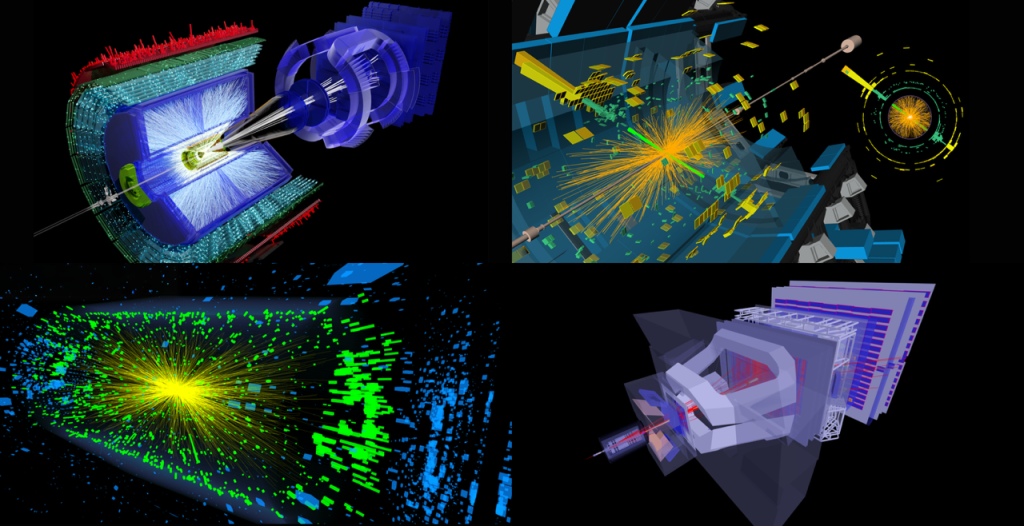
In the early hours of Sunday, 14 June, the experiments at the Large Hadron Collider (LHC) had their last hurrah. In the control rooms of ALICE, ATLAS, CMS and LHCb – the four major experiments at the accelerator – scientists watched the final collisions burst across their screens like colourful fireworks. The collisions for physics are over, but for two more weeks beams will continue to circulate in the LHC for high-intensity tests, before the machine shuts down completely. The LHC and its experiments will then be paused for four years of major upgrades. In 2030, the LHC will make way for the High-Luminosity (HiLumi) LHC and its experiments, which will be able to produce and detect far greater quantities of data.
In the meantime, it’s time to take stock of the three high-energy runs since 2010. The LHC delivered no fewer than 54 million billion proton collisions to each of the two experiments, ATLAS and CMS. In physicist’s terms, this represents an integrated luminosity of 540 inverse femtobarns delivered to ATLAS and CMS, exceeding what scientists had envisioned when they first conceived the machine. The LHC also delivered approximately 300 billion heavy-ion collisions to all experiments, not counting special runs with other atomic nuclei such as oxygen and neon.
One of the great achievements of the LHC experiments has been to measure phenomena with incredible precision, thanks to entirely novel analysis techniques combined with the processing of large volumes of data. The thousands of scientists in the LHC collaborations have truly broken new ground in unexplored areas of physics. Their work has culminated in the landmark discovery of the Higgs boson and increasingly precise studies of its properties. The LHC also opened the door to hundreds of major advances, including the discovery of more than 85 hadrons (particles composed of quarks), the setting of exclusion limits on the discovery of new particles, searches into the imbalance between matter and antimatter, the nature of the quark–gluon plasma that prevailed in the earliest moments of the Universe, and measurements with important implications for astrophysics. Data analyses carried out by LHC collaborations have resulted in approximately 4500 peer-reviewed scientific publications, not counting publications on detection techniques, conference proceedings and the like.
“We are turning a page, but the LHC data is far from having yielded all its results and will continue to be analysed by our collaborations in the years ahead,” said Gautier Hamel de Monchenault, CERN Director for Research and Computing. “In four years, our teams will open a new chapter with the high-luminosity version of the LHC and its experiments.” The HiLumi chapter promises to be a great one, with more data enabling scientists to study elementary particles with unprecedented precision – and perhaps even detect entirely new phenomena.
– Explore the history of the LHC from its inception to its final collisions in the LHC milestones video.
– Watch the CERN Control Centre’s special programme on the LHC’s latest collisions before HiLumi LHC: