
Students from Bangladesh, India, Türkiye, the UK and the USA win the 13th edition of Beamline for Schools
Five teams of secondary school pupils have been selected to carry out their own experiments using accelerator beams at CERN, DESY and the University of Bonn
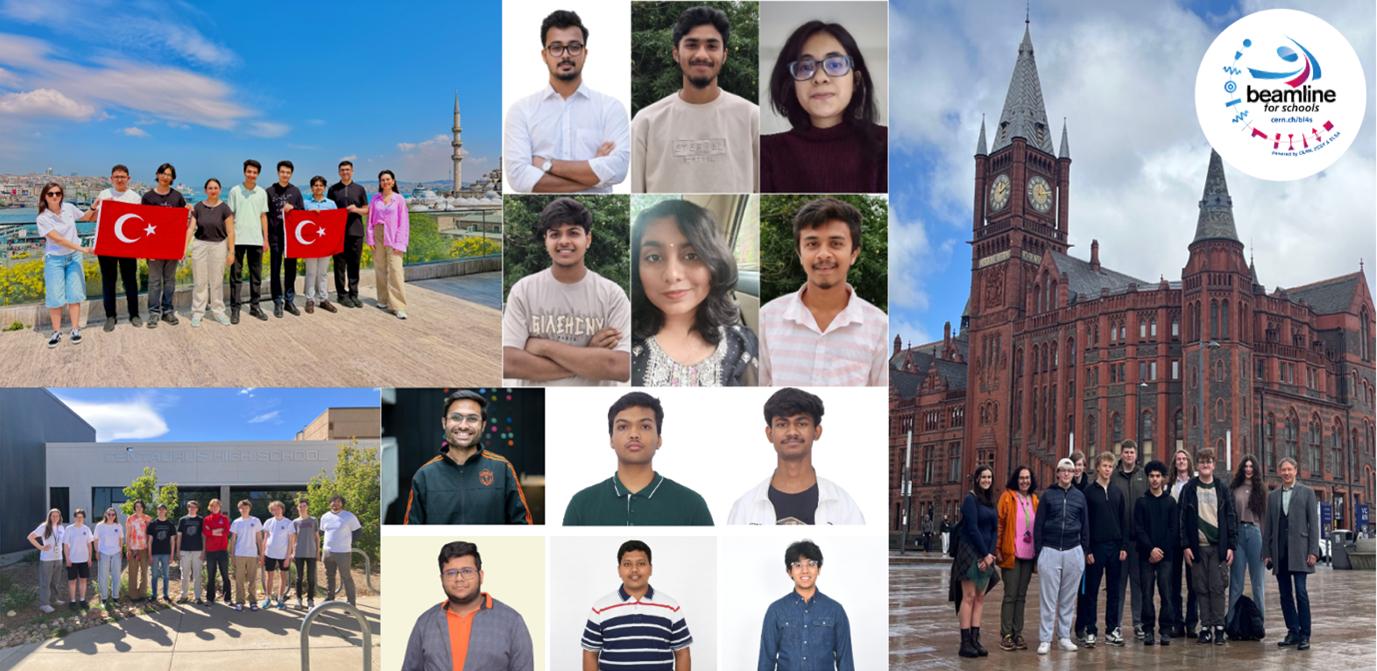
The winners of the 13th edition of the Beamline for Schools (BL4S) competition have been selected. BL4S is a physics competition that was initiated by CERN, the European Laboratory for Particle Physics, and is open to secondary school pupils from all around the world. Participants are invited to submit a proposal for a physics experiment to be undertaken at the beamline of a particle accelerator, either at CERN or at one of the partner institutes: DESY (Deutsches Elektronen-Synchrotron in Hamburg, Germany) and ELSA (Elektronen-Stretcher-Anlage of the University of Bonn, Germany). In 2026, five winning teams have been chosen, based on the scientific merit of their proposals.
The team “attoPION”, made up of students from several schools (Bansal Junior College Nizamabad, Greenwood High International School, The Shri Ram Global School, Greater Noida (W) and Purv International School Durgapur) in India, and the team “PionIST 3”, from several schools (Hüseyin Avni Sözen Anatolian High School, Validebağ Science High School, Araştırma Geliştirme Eğitim ve Uygulama Merkezi (ARGEM) High School and Doğan Cüceleoğlu Science High School) in Türkiye, will travel to CERN in August 2026 to perform their proposed experiments. The teams “Mobile MIPs” from the University of Liverpool Maths Schoolin the UK and “Centauri Stars” from Centaurus High School in the USA will carry out their experiment at a DESY beamline, while team “POLARIS” from several schools (Choumuhani Government Saleh Ahmed College, Noakhali, Birshreshtha Noor Mohammad Public College and Collectorate School and College, Rangpur (CSCR)) in Bangladesh will be welcomed at the ELSA accelerator of the University of Bonn.
A beamline is a facility that provides high-energy fluxes of subatomic particles that can be used to conduct experiments in different fields, including fundamental physics, material science and medicine.
The participation rate has been rising consistently since the launch of Beamline for Schools in 2014, with a record number of 712 teams from 89 countries submitting an experiment proposal in 2026. This is an increase of 40% compared with 2025 and the highest number of countries participating since 2014. More than 4500 high-school students participated this year, setting a record for student participation, with 38% being schoolgirls.
“CERN’s mission has always been to advance science and to inspire the generation that will carry it forward,” says Ursula Bassler, CERN Director for Stakeholder Relations. “This year’s successful participation shows that interest in science, technology, engineering and mathematics is growing all over the world. Together with DESY and the University of Bonn, we look forward to welcoming the winning teams and supporting them as they turn their ideas into real experiments.”
The fruitful collaboration between CERN and DESY started in 2019 during a long shutdown period of the CERN accelerators, and the collaboration with the electron accelerator ELSA at the University of Bonn in 2025. This is the eighth year that DESY has hosted competition winners and the second year for ELSA.
Beate Heinemann, Chair of the DESY Board of Directors, adds: “Beamline for Schools breaks yet another record this year with the highest ever number of submitted proposals. I am thrilled to see this enthusiasm for research in general and particle physics technologies in particular and very much look forward to again welcoming two teams at DESY: the Mobile MIPs from Liverpool, UK, and the Centauri Stars from Lafayette/CO, US. I hope their science experiments in Hamburg will be as momentous and as much fun for them as it was for the Beatles 64 years ago to perform on stage in the Star Club in St. Pauli.”
“Science thrives on curiosity and teamwork. It is particularly impressive to see young people engaging with particle physics to such a high standard. We would like to congratulate all the winning teams, and we are looking forward to welcoming Team POLARIS from Bangladesh to our ELSA particle accelerator to support them in carrying out their experiment. Interacting with such committed and inquisitive students is also a great experience for us,” says Klaus Desch, who is in charge of the ELSA accelerator facility.
“For us, winning Beamline for Schools means getting the chance to turn an idea into reality. Our experiment tests whether a thin polysiloxane scintillator sheet can work as a beam-profile monitor for high-energy electrons. We are grateful for this opportunity and excited to see what we will find,” say the members of team POLARIS from Bangladesh. “We are very excited to visit the ELSA facility of the University of Bonn!”
“Our project, Measuring Pion Charge Exchange in Lithium and Beryllium, measures how often charged pions turn into neutral pions when they cross light targets at momenta of a few GeV, similar to the energies that matter for pion interactions in the Deep Underground Neutrino Experiment, DUNE. Being selected to participate at CERN is an incredible honour and a dream for our team,” says team attoPION from India.
“It is a great honour to represent Türkiye on an international stage. We are thrilled to go to CERN,” say the members of team PionIST 3. “Our work focuses on the study of neutral pion production across varying target materials, thicknesses and emission angles, with the goal of understanding how nuclear mass and geometry influence π⁰ yields and angular distributions, questions that lie at the heart of hadronic physics.”
“Our team plans to test if the CMOS sensors in mobile phones can be used as a low-cost beam telescope using the electron beam at DESY,” explain Mobile MIPs, the team from the UK. “The CMOS sensors have a projected comparable resolution to current particle detectors and will later be used to study cosmic rays. We are delighted and honoured to be invited to DESY.”
“Our experiment proposes the application of silicon photomultipliers for the detection of internally reflected Cherenkov radiation in a glass bar, “says “Team Centauri Stars”, from the USA. “We are honoured to be chosen to conduct scientific research with world-class facilities at DESY alongside leading experts in the field of particle physics. We are beyond excited and grateful for this opportunity.”
The winning proposals were selected by a committee of CERN, DESY and ELSA scientists from a shortlist of 50 particularly promising experiments. In addition, three teams will be recognised for the most creative video proposals and another 15 teams for the quality of their physics outreach activities in their local communities, taking advantage of the knowledge they have gained by participating in BL4S.
Beamline for Schools is an education and outreach project funded through the CERN & Society Foundation and supported by individual donors, foundations and companies.This 13th edition is supported notably by ROLEX through its Perpetual Planet Initiative and by the Wilhelm and Else Heraeus Foundation in Germany.
Further information:
- BL4S website: https://cern.ch/bl4s
- Shortlisted teams and special prizes in 2026: https://cern.ch/bl4s/2026-edition/
- Previous winners: https://cern.ch/bl4s/all-editions/
- Shortlisted teams from Bangladesh, Brazil, Canada, China, Costa Rica, Cyprus, Czech Republic, Dominican Republic, Egypt, Germany, Hong Kong, India, Indonesia, Ireland, Italy, Mexico, Oman, Pakistan, Philippines, Portugal, Singapore, Spain, Türkiye, United Arab Emirates, United Kingdom, United States.
- The prizes awarded for the best outreach projects – 15 telescopes – have been kindly provided by the Belgian project “Stars Shine for Everyone”. The telescopes are signed by five Nobel Prize Laureates and CERN’s Director-General.