
Accelerator Report: From protons to ions – the LHC and its injectors prepare for the Run 3 finale
Written by:
Bettina Mikulec, Theodoros Argyropoulos, Francesco Velotti
—
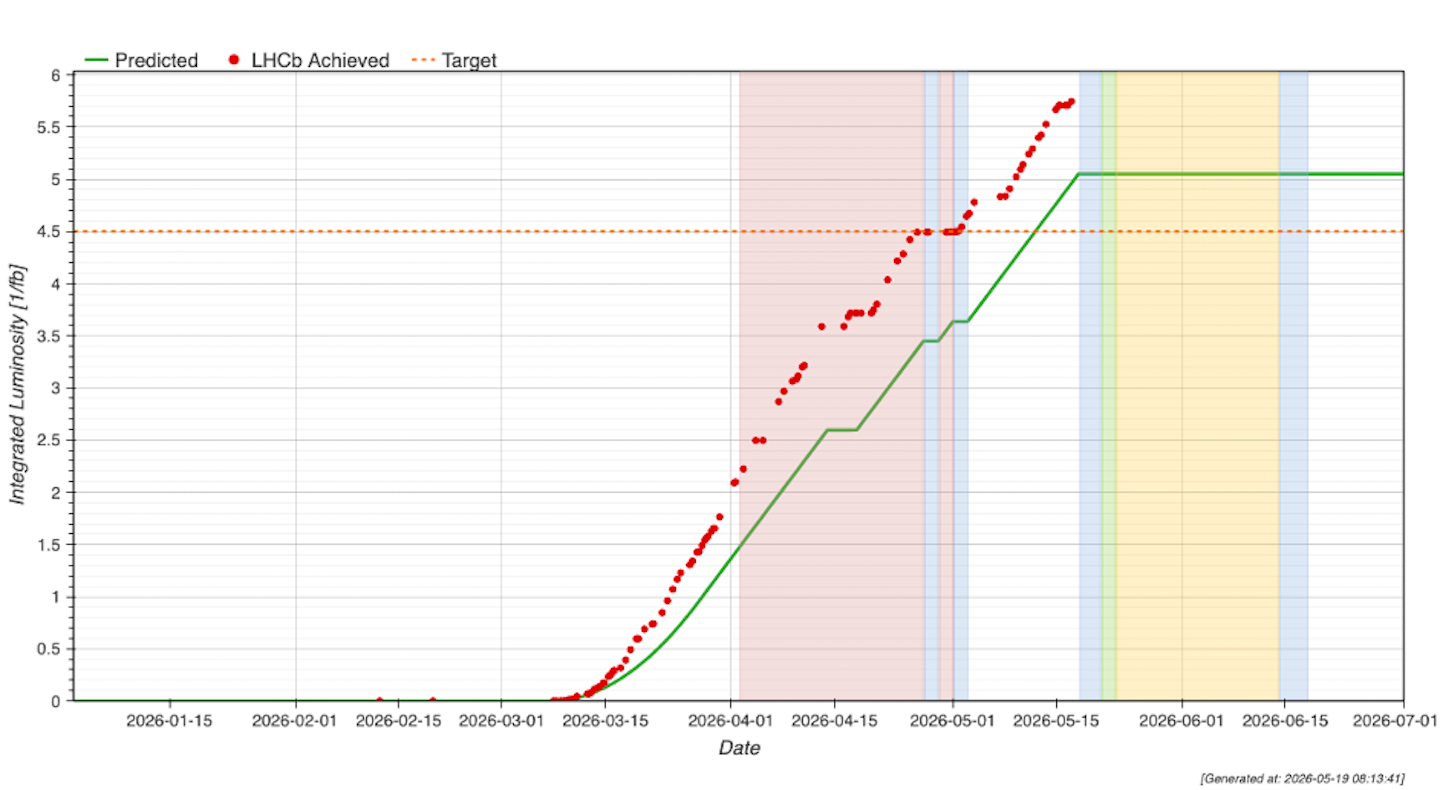
At 6 a.m. on 19 May, the LHC Run 3 proton physics programme officially came to an end. Thanks to the excellent performance and availability of both the LHC and its injector chain, this year’s integrated luminosity surpassed all expectations, with all four main LHC experiments recording values well above the original projections (fig. 1).
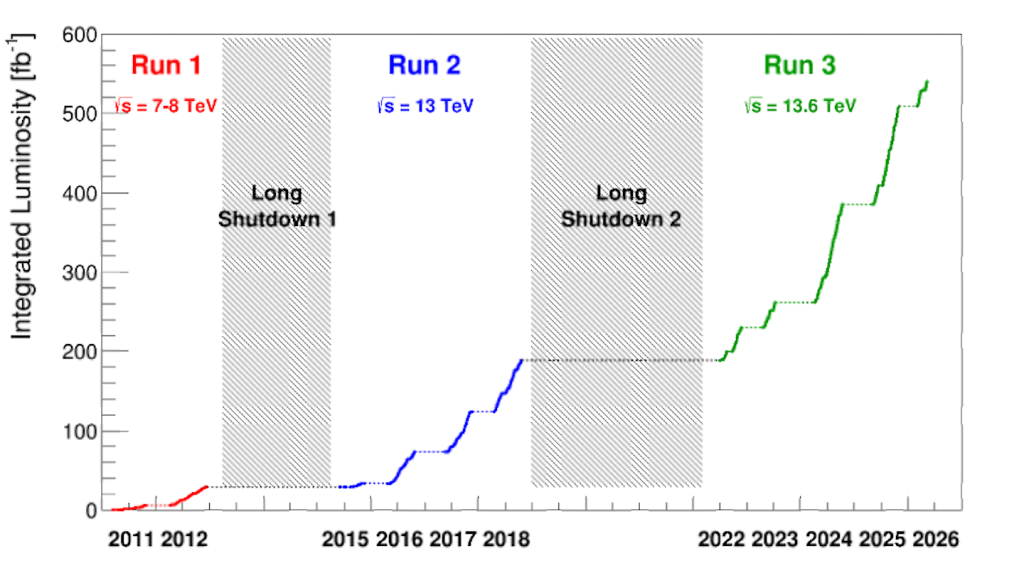
Run 3 has proven exceptional in many respects. Not only were the initial luminosity goals clearly exceeded, but the total integrated luminosity delivered during Run 3 more than doubled that achieved during Run 2 (fig. 2). Across all three operational periods of the LHC so far, around 540 fb⁻¹ have been accumulated by both ATLAS and CMS – far beyond the 300 fb⁻¹ for which the machine was originally designed. This remarkable achievement is the result of years of continuous optimisation, consolidation and operational experience across the entire CERN accelerator complex.
The end of proton physics, however, does not yet mark the conclusion of Run 3. Following a short technical stop on 21 and 22 May, the LHC is now preparing for its three-week lead-ion physics programme. Heavy-ion collisions recreate conditions similar to those just after the Big Bang, allowing physicists to study the quark–gluon plasma, a unique state of matter in which quarks and gluons are no longer confined inside protons and neutrons.
The final weeks before Long Shutdown 3 (LS3) will then be devoted to high-intensity tests, machine development studies and a short campaign of controlled magnet quenches. These activities will prepare the LHC for LS3, during which major upgrades will transform the machine into the High-Luminosity LHC (HiLumi LHC), opening a new era of precision physics from the end of the decade onwards.
While proton physics was concluding in the LHC, the injector complex has been focused on preparing the ion beam chain to ensure excellent beam quality from the very first day of LHC ion operation. Significant progress has already been achieved across the full chain of ion accelerators: Linac3, the Low Energy Ion Ring (LEIR), the Proton Synchrotron (PS) and the Super Proton Synchrotron (SPS).
Linac3 is now operating stably at currents of around 30 μA, successfully reaching the performance target set by the LHC Injectors Upgrade (LIU) project. In LEIR, extracted beam intensities have exceeded 10×10¹⁰ charges, surpassing the LIU objective of 9×10¹⁰. Following optimisations in the PS, the lead beam was transferred to the SPS, where three days of dedicated beam commissioning allowed four operational cycles to be commissioned successfully.
Particular attention was given to the SPS slip-stacking cycle, one of the most demanding beam manipulations required for ion operation. Building on the experience of recent years, extracted beam intensities soon reached values around 15% above the LIU target of 2×10⁸ ions per bunch.
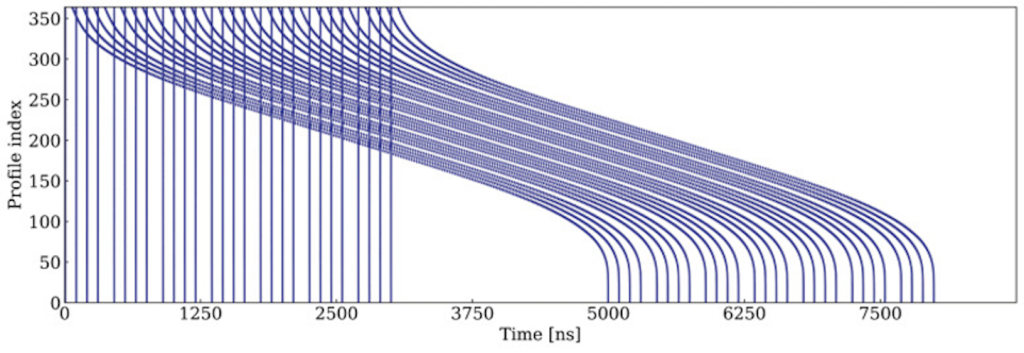
Slip stacking is a sophisticated radiofrequency manipulation developed within the LIU ion programme to increase the number of ion bunches delivered to the LHC. In simple terms, two groups of bunches are made to “slip” with respect to one another inside the SPS by applying slightly different radiofrequencies (fig. 3). As the two groups gradually interleave, they can then be recaptured into a single beam with twice the bunch density. This allows the SPS to deliver 56 bunches with 50-ns spacing to the LHC, substantially increasing the luminosity available for heavy-ion physics.
Alongside preparations for the ion run and routine delivery of beams to CERN’s many fixed-target experiments, the injector complex is also preparing for future generations of high-intensity experiments in the SPS North Area. One important challenge is reducing beam losses in the SPS extraction region, where unavoidable particle losses can lead to increased residual radiation levels.
To address this, a new multi-crystal array developed by the Sources, Targets and Interactions (STI) Group has entered its first operational test campaign using nominal-intensity beam. The studies are being led by the Accelerator Beam Transfer (ABT) Group, with support from the Operations (OP) Group for deployment and coordination.
The principle relies on specially aligned crystals that channel a fraction of the beam halo away from sensitive components. The first operational results are highly encouraging: losses on the SPS electrostatic septum – the most exposed component in the slow-extraction region – were reduced by almost a factor of four when the crystal array was in operation, in excellent agreement with beam-dynamics simulations.
The ultimate objective, however, is not only to reduce instantaneous losses, but also to limit the residual radiation that accumulates over time and complicates maintenance interventions. To quantify this effect, the campaign is being carried out in close collaboration with the Radiation Protection (RP) and the Controls Electronics and Mechatronics (CEM) Groups. A robotic survey system measures residual radiation levels in the extraction region before and after operation with the crystal array. These measurements will determine how effectively the observed beam-loss reductions translate into lower activation of accelerator components – an essential step towards handling the even higher beam intensities planned for future projects such as the Search for Hidden Particles (SHiP) and the High-Intensity ECN3 facility.
Write excerpt / subtitle here.
Written by:
Author
—
Add excerpt / subtitle here.
Title
Write feature content here.
Subtitle 01
Write content for subtitle 01 here.
Subtitle 02
Write content for subtitle 02 here.
Additional context or note.