
ATLAS observes new composite particle
The ATLAS Collaboration reports the first observation of the Bc*+ meson, an excited counterpart of a particle made up of a charm quark and a bottom antiquark
Written by:
ATLAS Collaboration
—
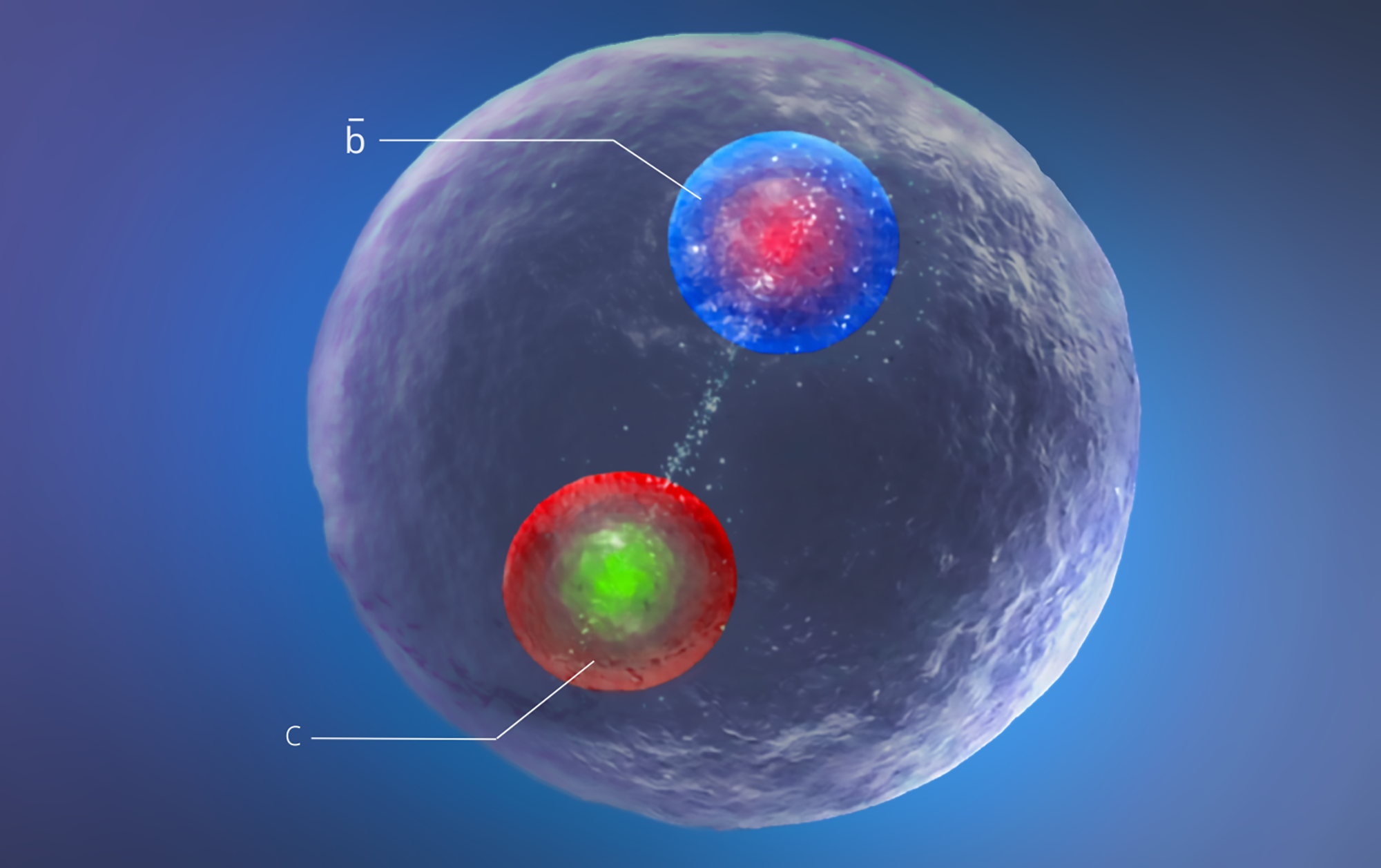
Artist’s impression of the Bc*+ meson. (Image: Daniel Dominguez/CERN).
At the Large Hadron Collider Physics conference this week, physicists from the ATLAS Collaboration reported the first observation of a new particle with properties consistent with the Bc*+ meson. This particle is an excited version of the Bc+ meson – both consist of a charm quark and a bottom antiquark – and brings the number of new hadrons discovered at the Large Hadron Collider to 84. Studying this particle may provide a deeper understanding of the strong force – one of the four fundamental forces of the Standard Model of particle physics.
Despite decades of study, many aspects of the strong nuclear force remain poorly understood – particularly the way it binds quarks together. Particles made of heavy quarks, such as bottom and charm quarks, can provide an important laboratory for testing theoretical models of the strong force. Physicists are particularly interested in Bc+ mesons, as studying a system with a large mass difference between the constituent particles can offer unique insights into the dynamics that bind them together.
This new excited member of the Bc+ family was produced in high-energy proton–proton collisions at the Large Hadron Collider before quickly decaying into a Bc+ meson and a photon. Detecting this photon along with the decay products of the Bc+ meson would provide the researchers with the “smoking gun” demonstrating the presence of the Bc*+ meson. However, the main challenge is that the expected mass of the Bc*+ meson is only slightly larger than that of the Bc+ meson, which means the photon produced in the decay carries very little energy. In fact, the energy is so low that it cannot be easily detected through the normal approach.
Rather than using standard photon-identification techniques, researchers instead looked for the photon converting into an electron–positron pair within the ATLAS tracking detector, leaving behind closely spaced charged-particle tracks originating from a common point displaced from the initial proton–proton collision. These tracks can have transverse momenta as low as 100 MeV – significantly lower than those typically studied in ATLAS analyses. This required researchers to deploy a dedicated track-reconstruction procedure to be able to successfully reconstruct the photons and thus identify the Bc*+ meson.
The measured mass difference between the Bc*+ meson and the Bc+ meson is 64.5 ± 1.4 MeV. This is within the range of the available theoretical expectations, though slightly deviating from the most recent, high-precision modern calculations. This result provides valuable new input for theoretical models describing the masses of particles containing the heavier quarks and will help to improve the understanding of the strong nuclear force.