
Getting under the skin of atomic nuclei using antimatter
The AEgIS Collaboration lays the groundwork for a new tool to probe the outer periphery of atomic nuclei
Written by:
Rory Harris
—
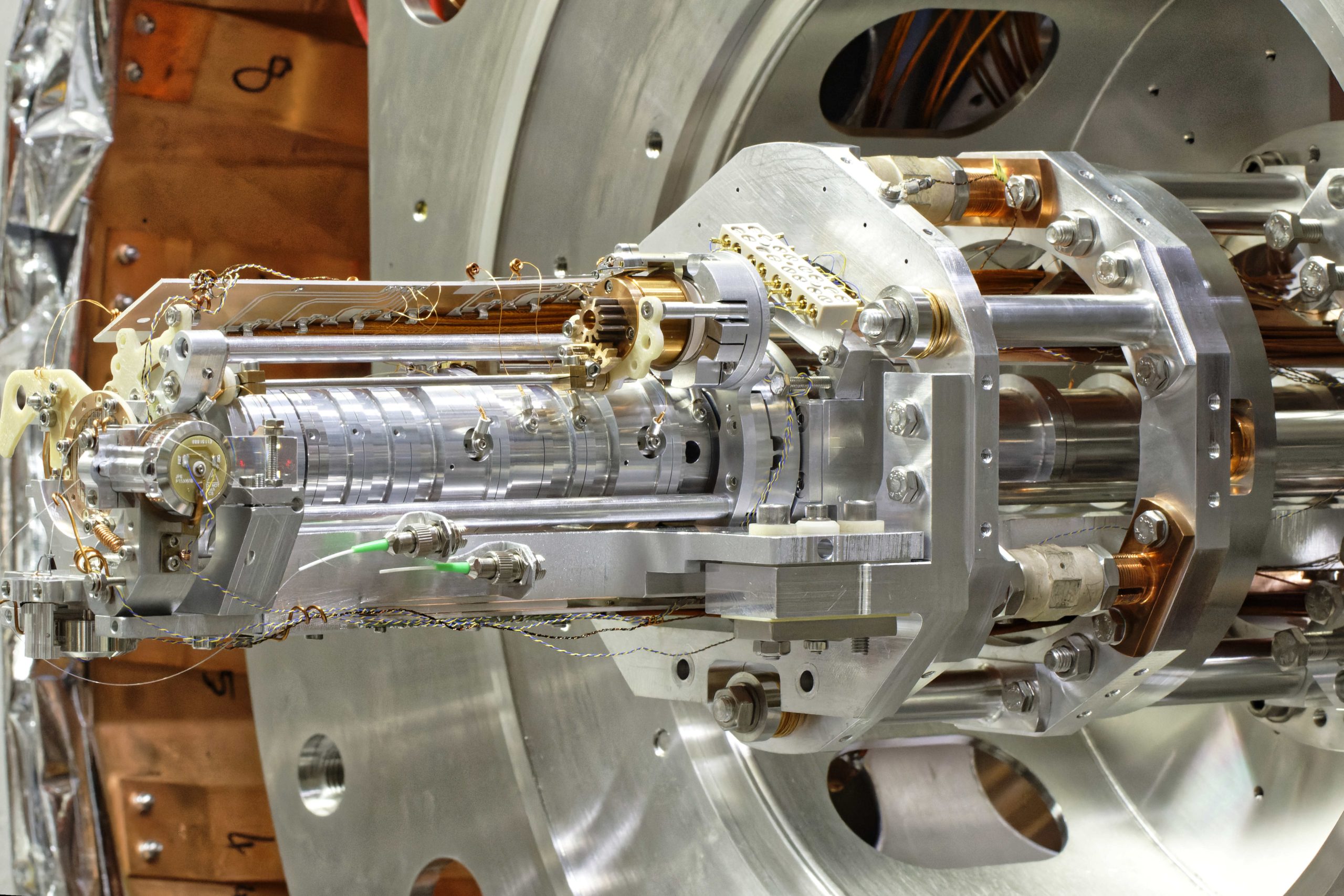
Researchers at the AEgIS experiment have piloted a new method to delve into the heart of atoms. This proof-of-principle study, recently reported in Physical Review Research, shows how antiprotons – the antimatter counterparts of protons – could be used to probe the outer edges of a wider range of atomic nuclei. And with CERN’s recent world-first demonstration of antiproton transportation, this technique could become accessible to laboratories across Europe.
Understanding in detail how protons and neutrons arrange themselves within the nucleus may give a deeper insight into the strong nuclear force that holds these particles together. It could also shed light on the structure of neutron stars – the dense astronomical objects left behind after a massive star explodes as a supernova. The interior of a neutron star is not, as the name suggests, just neutrons but is still somewhat of a mystery and some researchers think they could be a useful testing ground for fundamental physics.
Previous experiments investigating nuclear structure have found that, in many nuclei, there are more neutrons around the periphery of the nucleus, a feature that is known as a neutron skin. Measuring the neutron skin is very challenging given its scale – a fraction of a femtometre, which is a quadrillionth of a metre. And recent measurements of this phenomenon have given results that differ so much that they cannot be accurately explained by theory. This has led researchers to search for new ways of measuring the neutron skin.
A particularly sensitive probe is the antiproton. When it approaches a nucleus, the antiproton may annihilate with one of the protons or neutrons at the edge of the nucleus. In most cases, the energy released as a result of this annihilation is enough to tear the nucleus apart, yet roughly 10–20% of the nuclei may avoid the fallout from the annihilation, in what is called a “cold” annihilation event.
Researchers can identify and study the nuclei that are left behind to determine if a proton or neutron was lost to the cold annihilation. The ratio of protons and neutrons lost provides an indication of the neutron-to-proton ratio at the annihilation site. This, in combination with x-ray measurements that indicate how far out from the centre of the nucleus the antiproton was before its annihilation, allows researchers to determine the neutron skin thickness.
Previous experiments have identified the nuclei that are left after the cold annihilation by measuring their radioactive decay. However, this approach left a significant gap in the nuclei whose neutron skins could be investigated, as many nuclei would not undergo radioactive decay after a cold antiproton annihilation.
To address this issue, the AEgIS Collaboration presents a novel technique that lays the groundwork to identify the post-annihilation nuclei, including the previously invisible non-radioactive ones, via time-of-flight spectrometry. This new technique aims to exploit the fact that the antiproton, on its path to annihilation at the nucleus, strips away a large number of electrons orbiting that nucleus. In such events, what remains is a highly charged ion (HCI), at the centre of which is the nucleus that the researchers want to identify. These HCIs can be captured in the antimatter traps at the AEgIS experiment, which are able to contain charged particles with electromagnetic fields.
In this recent proof-of-principle study, the AEgIS Collaboration used argon and helium as test subjects for their study. The researchers successfully demonstrated the core methodology for capturing and studying HCIs produced when the antiprotons annihilate inside the antimatter trap by identifying the helium and argon ion species via time-of-flight spectrometry. This approach is only now possible thanks to the technical advancements at CERN’s Antimatter Factory, where millions of antiprotons can be produced and held in sophisticated antimatter traps in a matter of minutes. Future experiments using this technique could provide new insight into the outer edge of the nucleus that would complement other methods, such as that set to be used at CERN’s upcoming PUMA experiment.
“Our study establishes a foundation for capturing and directly studying the HCIs left behind after cold antiproton annihilations for a wider range of nuclei,” says Fredrik Parnefjord Gustafsson, the lead author of the experiment. “We hope this new method, combined with portable antimatter traps, could allow laboratories, big and small, to use antiprotons as a tool for nuclear research.”