
Accelerator Report: Final countdown – CERN’s injector complex enters its last stretch before LS3
With the LHC already in shutdown, the rest of the accelerator complex enters its last intense days of beam operation, until 31 August, when the Operations team will hand over the keys to the LS3 coordination team. See you on the other side of LS3!
Written by:
Bettina Mikulec, Leader of the Operations Group (BE-OP)
—
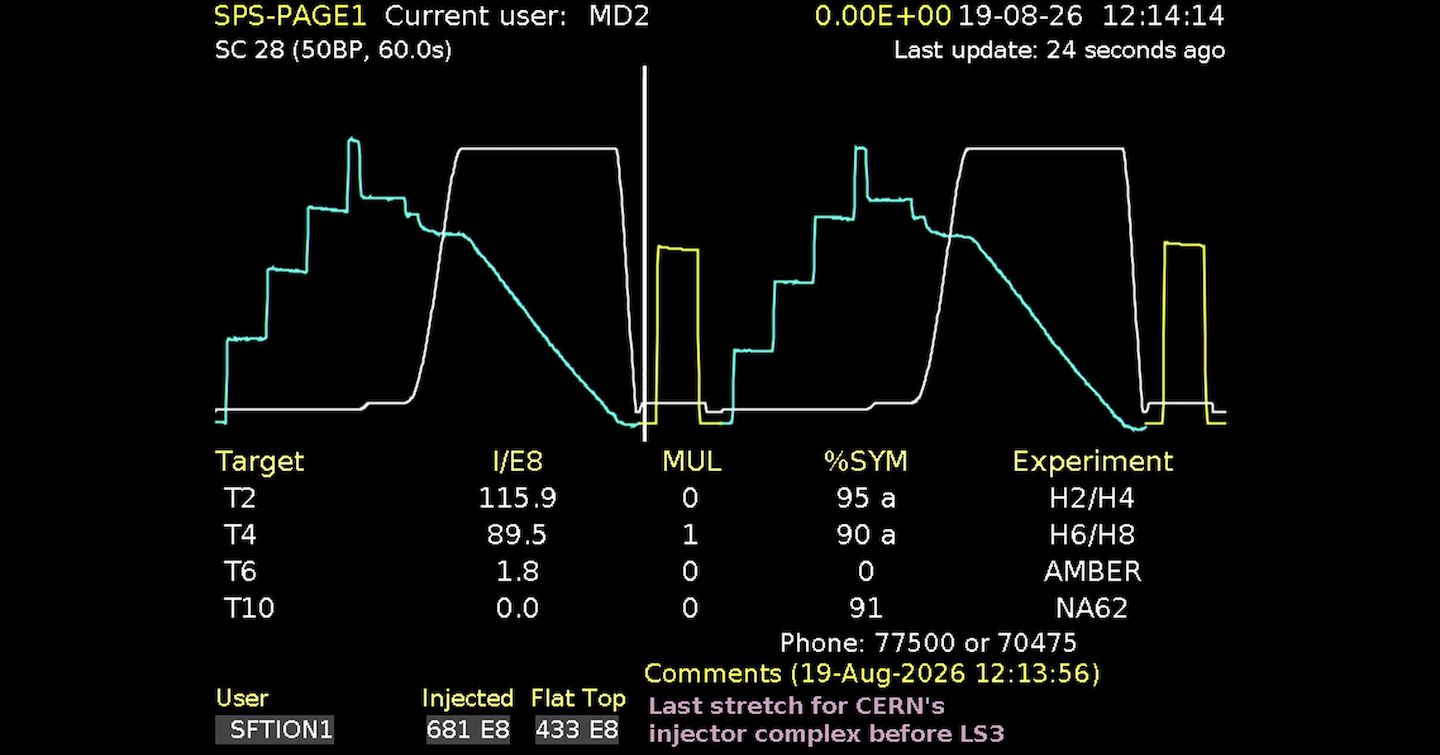
The LHC has already fallen silent for Long Shutdown 3 (LS3), but elsewhere across CERN’s accelerator complex the pace remains intense. With just a week and a half of beam operation remaining, the countdown has begun for all the machines, which will switch off their beams at 6.00 a.m. on Monday, 31 August, marking the start of LS3 for the rest of the complex.
Although the finish line is now in sight, this final stretch is far from quiet. The accelerators continue to deliver proton and ion beams for physics while also providing crucial opportunities to collect data, refine machine performance and prepare for the future.
A busy final stretch for users and machine teams
One of the main activities during these last days is the delivery of lead-ion beams to the North Area, supporting an active physics programme before the shutdown begins. At the same time, a special beam test was prepared for Monday, 17 August, during which both lead ions and low-energy proton beams were sent for the first time to the HiRadMat (High Radiation to Materials) facility. The aim was to evaluate whether the range of studies possible at HiRadMat can be expanded in the future, opening new opportunities for testing materials and equipment under extreme beam conditions.
The final days of operation are also particularly valuable for the people who run and study the machines. Beam physicists, operators and equipment specialists are making the most of the remaining beam time to obtain measurements and results that are precious for doctoral research, technical studies and the final adjustments to be made during the shutdown. These last data sets will help ensure that the accelerator complex is as well prepared as possible for the start of Run 4.
HEARTS: testing the radiation limits of electronic components
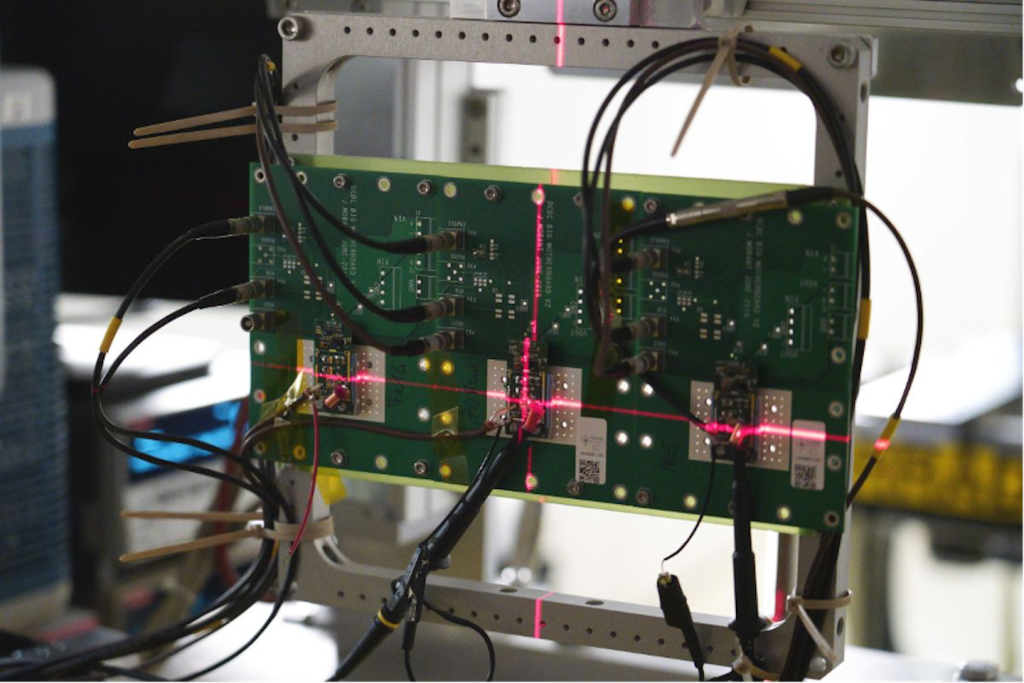
Another important milestone was reached on 19 August, when the physics run of the EU-funded HEARTS (High-Energy Accelerators for Radiation Testing and Shielding) project began in the East Area. During this campaign, lead-ion beams of different energies and intensities are delivered from the Proton Synchrotron (PS) to the T8 line in the East Area, where users require highly controlled irradiation conditions to qualify microelectronic components. The users, who are both external and internal to CERN, are testing applications that will be used in satellites and spaceflight, as well as in CERN’s large experimental detectors.
The run itself may last only a short time, but its preparation began several months ago. Meeting the stringent user requirements calls for exceptional control of beam stability, beam intensity, spill quality and beam-spot uniformity, in addition to fast and frequent changes of these parameters. Large beam spots are needed to irradiate microelectronic components uniformly, while precise knowledge of the delivered dose is essential for reliable conclusions. Different beam energies also allow researchers to probe different levels of radiation tolerance and depths inside materials and devices.
Looking ahead to Run 4
As the final proton and ion beams are delivered over the coming days, attention is already turning towards the future. Following the long shutdown, CERN’s accelerator complex will gradually come back to life, beginning with Linac4, the PS Booster and ISOLDE at the start of 2028. The work carried out during these last busy weeks, together with the extensive activities planned during LS3, will help lay the foundations for a successful restart and an exciting new era of accelerator operation.
For now, however, the focus remains firmly on the present: making every remaining hour of beam time count before the accelerators pause for their next major transformation.
_____
With this, the Operations team has published its final Accelerator Report from the LHC era. To make sure you don’t miss anything happening during Long Shutdown 3 (LS3), follow the progress of the work on this dedicated page. The operators look forward to seeing you on the other side, ready for new (high-luminosity) adventures.