
SND@LHC prepares to push the neutrino frontier
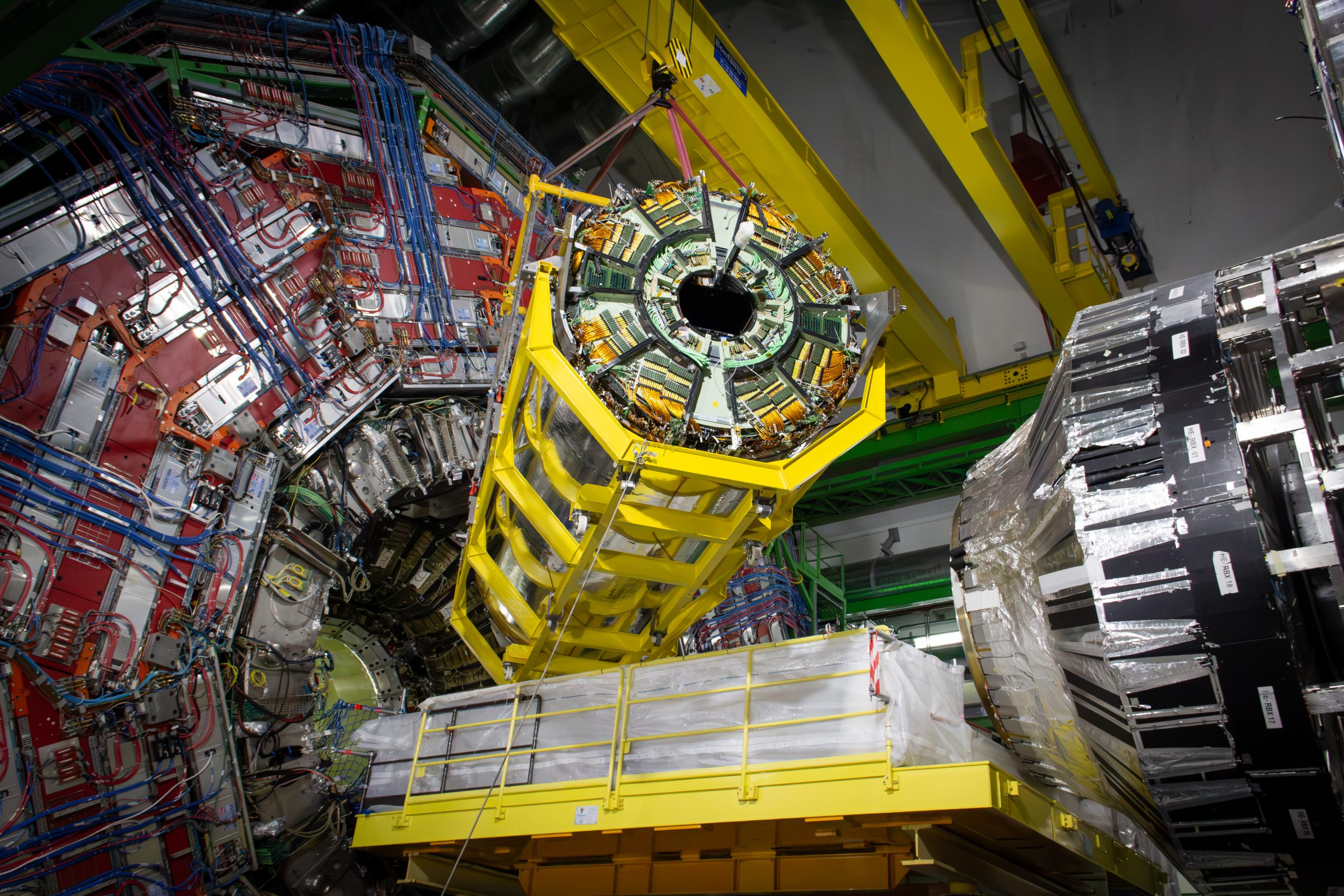
The silicon tracker just removed from the CMS detector is being repurposed for SND@LHC as the experiment prepares for HiLumi
Written by:
Paola Catapano
—
Neutrinos – vanishingly light particles that scarcely interact with matter – remain deeply mysterious even 70 years after their discovery. These fundamental particles come in three flavours: electron, muon and tau. Experiments across the globe have worked to uncover the properties of these different flavours but the antimatter partner of the tau neutrino has still not been observed, making it the only particle in the Standard Model yet to be detected. With the High-Luminosity Large Hadron Collider (HiLumi LHC), researchers hope that this could change.
HiLumi LHC will not only deliver many more collisions to the large detectors at the four interaction points but will also produce a much higher number of neutrinos. The Scattering and Neutrino Detector at the LHC (SND@LHC) is now being prepared to exploit what will be the most energetic source of man-made neutrinos. Most neutrino experiments study neutrinos coming from outer space, Earth or nuclear reactors. But SND@LHC and FASER, also at the LHC, are the only neutrino experiments to use a particle collider as a neutrino source.
SND@LHC is located 480 metres downstream of the ATLAS interaction point and has been taking data throughout Run 3 of the LHC, which began in July 2022 and finished this June. Using this data, the SND@LHC Collaboration has already published the first studies of muon neutrino interactions with matter and observed electron neutrinos.
While the analysis of the Run 3 dataset continues, the Collaboration is preparing to completely disassemble the detector for a major upgrade. The nuclear emulsion films that were previously used in the detector will not withstand the significant increase in the number of particles from HiLumi LHC, so the Collaboration has opted to use silicon sensors instead and build the world’s first neutrino detector based entirely on silicon technology.
For this, SND@LHC has inherited 1680 silicon microstrip modules from the outer barrel of the CMS Tracker, which CMS will no longer be able to use due to the high amount of radiation expected during HiLumi LHC. However, these modules will be perfectly suited for SND@LHC, which is located far enough away from the interaction point to be able to withstand the increased radiation. Although the nuclear emulsion films have higher position resolution, the silicon modules will compensate for this by providing high spatial resolution combined with real-time readout.
The researchers are also planning a second major upgrade for SND@LHC: the development of a magnet to allow researchers to distinguish neutrinos from anti-neutrinos. This will be essential for observing the tau antineutrino, the last particle of the Standard Model still awaiting observation, a key goal of SND@LHC in the HiLumi era. The SND@LHC Collaboration has already developed a prototype of the upgraded detector, which it is currently testing at CERN with particle beams. This marks an important step in the experiment’s journey towards the HiLumi era.