
CERN-made HiLumi LHC quadrupoles ready for installation
The completion of these new quadrupole magnets – known as the inner triplet magnets – marks the culmination of more than three decades of research and development in niobium-tin (Nb₃Sn) superconducting magnet technology
Written by:
Florence Thompson & Anaïs Schaeffer
—
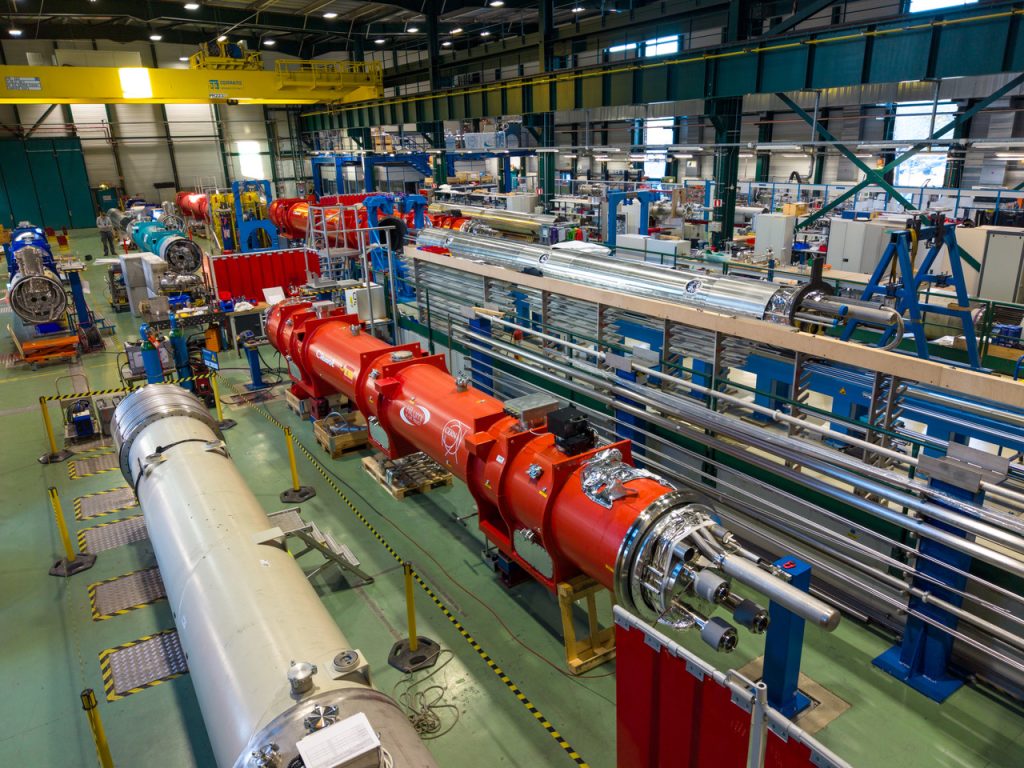
After years of design, manufacturing and testing, the High-Luminosity (HiLumi) LHC magnet programme has reached a landmark point: all eight new CERN-made quadrupole magnets, plus two spares, are ready for installation in the tunnel. Known as the new inner triplets, these magnets are now complete and have been fully validated through extensive tests. Together with their associated corrector magnets, produced by CERN’s Spanish collaborators at CIEMAT, they will provide the powerful focusing needed to squeeze the proton beams more tightly as they pass through the ATLAS and CMS experiments.
“Completing the production of all eight CERN-made quadrupoles is a major achievement for the HiLumi project and for everyone involved in developing, manufacturing and testing these magnets,” says Susana Izquierdo Bermúdez, engineer in charge of the HiLumi LHC interaction region magnets. “It is particularly rewarding to see that the magnets we have developed over many years are now ready to take their place in the accelerator.”
The completion of these magnets – manufactured and assembled at CERN – marks the culmination of three decades of research and development in niobium-tin (Nb₃Sn) superconducting magnet technology. These quadrupoles have a nominal peak field of 11.3 tesla and a magnetic length of 7.2 metres, making them the longest accelerator-quality Nb₃Sn magnets ever built. Compared with the niobium-titanium (Nb-Ti) quadrupoles used in the LHC, which have a nominal peak field of 8.6 tesla, their larger 150-millimetre aperture and higher magnetic field will enable stronger beam focusing and contribute to the increased luminosity of the HiLumi LHC.
These new magnets are the result of a long-standing international effort, initially developed through the LHC Accelerator Research Program (LARP) and subsequently advanced through collaboration between CERN and US partners. Developing accelerator-quality Nb₃Sn magnets at the required seven-metre scale presented significant challenges: “After successfully developing short models of the magnet, scaling to the lengths required for an accelerator magnet constituted a significant challenge,” explains Izquierdo Bermúdez. “We had to take a close look at what was causing initial performance shortcomings and make iterative improvements in coil fabrication and magnet assembly. But happily, these corrective strategies meant that the magnets now consistently demonstrate excellent performance and robustness!”
Eight assemblies (plus two spares) of a slightly different type are also needed for the accelerator upgrade: instead of one long quadrupole and a corrector magnet, these assemblies contain two shorter quadrupoles, each measuring 4.2 metres. Equally powerful and also made of Nb3Sn coils, they form part of the final interaction region on each side of ATLAS and CMS. They are currently being produced by the HiLumi US collaboration, which is also making steady progress: seven of the assemblies have already arrived at CERN.
The other HiLumi LHC magnet assemblies for the CMS and ATLAS interaction regions – the separation and recombination dipoles, which split the beams into two separate beam pipes and then combine them into a single pipe, and the corrector magnets, which correct the beam parameters and trajectory – are also approaching the finish line, with 70% of these assemblies completed.
The final magnets also benefit from the extensive testing carried out at the IT String, the full-scale test facility designed to reproduce the future HiLumi LHC interaction region near the ATLAS and CMS experiments. In July, the inner triplet magnets installed in the IT String successfully reached their nominal operating current. All 17 electrical circuits of the string were subsequently powered to their operating currents, providing an important validation of the integrated magnet system and its associated equipment.
In a few months, the focus will move to the installation of these assemblies in the accelerator. The first magnets to be lowered into the tunnel are expected to be installed in 2028. To make sure you don’t miss anything happening during Long Shutdown 3 (LS3), follow the progress of the work on this dedicated page.
________
Read more technical details and results on the HiLumi LHC website.