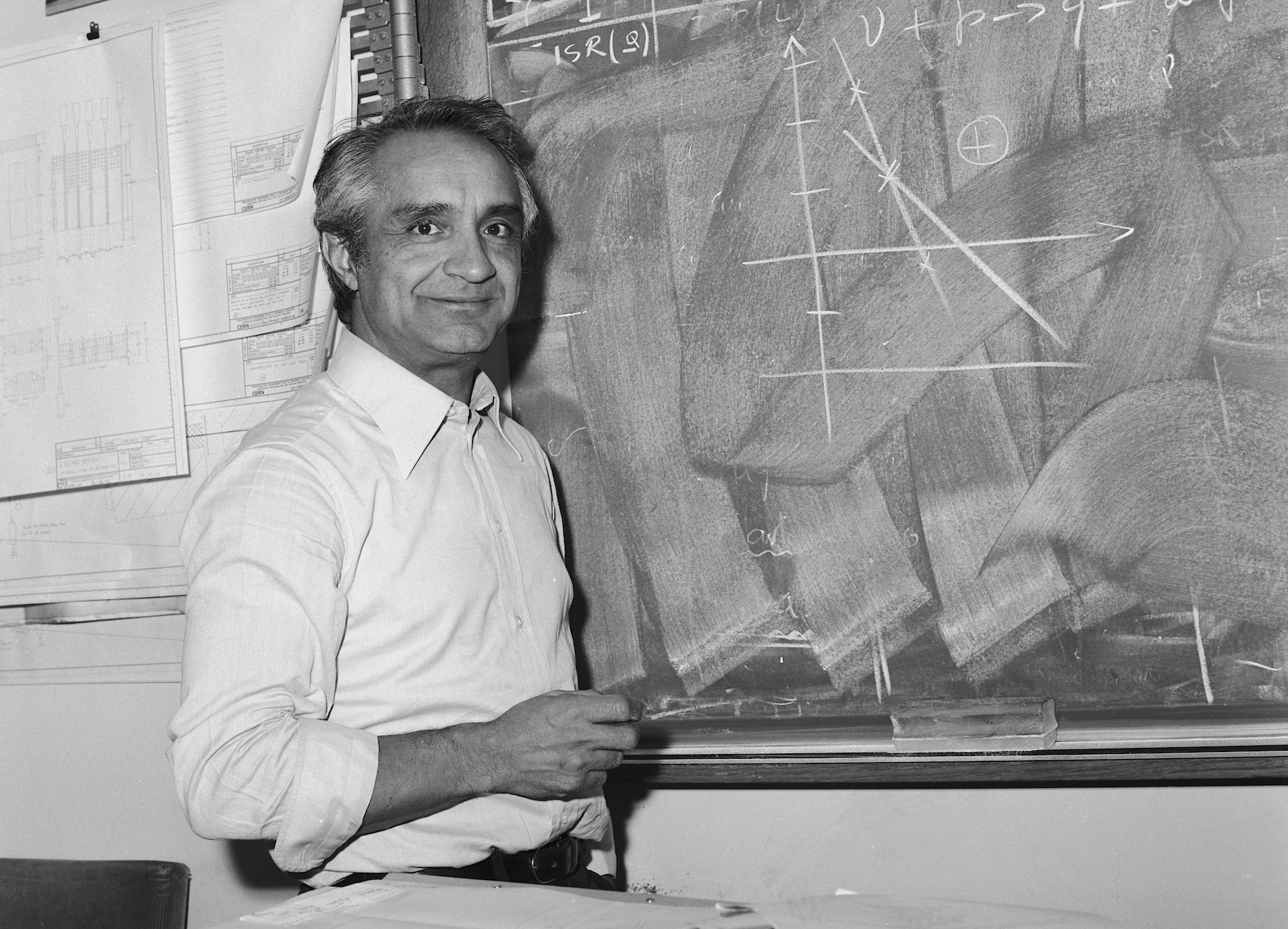
Antonino Zichichi, one of the most influential figures in high-energy physics, passed away on Monday, 9 February 2026 at the age of 96.
A native of Sicily, he graduated from the University of Palermo in the early 1950s and joined CERN in 1955, becoming one of the pioneers of CERN’s experimental programme. He participated in the first muon g - 2 experiment, which started to take data in 1959 at the Synchrocyclotron. He later led an experiment at the Proton Synchrotron, culminating in the discovery of the antideuteron in 1965. This observation - made simultaneously at Brookhaven National Laboratory in the United States - provided confirmation of the existence of antimatter nuclei.
Appointed professor at the University of Bologna in 1960, Zichichi led the Bologna-CERN-Frascati collaboration and participated in numerous CERN experiments, including at the Intersecting Storage Rings, the Super Proton Synchrotron and the L3 experiment at the Large Electron-Positron collider, and in experiments carried out in Italy and the United States. Throughout his career, he authored several hundred scientific papers. His contributions include the study of lepton pairs produced in hadron interactions, the proposition of the existence of a heavy lepton, the development of a new method for searching for such a heavy lepton in electron-positron interactions, the evidence of the effective energy in quantum chromodynamics as well as studies of proton structure and stability.
Zichichi also played a crucial role in developing innovative detection technologies, securing Italian funding for the Lepton Asymmetry Analyser (LAA) project at CERN. This allowed the development of microelectronics at CERN which, together with the design of silicon strip and pixel detectors, would later become an essential component of the experiments at the Large Hadron Collider. He was particularly involved in the ALICE experiment, serving for over 20 years as the project leader of one of the experiment’s key subdetectors, the Time-of-Flight detector, and overseeing the large-scale implementation of the Multigap Resistive Plate Chamber, a detection technology that was later adopted by several other experiments.
A visionary leader, Zichichi was instrumental in establishing major research facilities. The Laboratori Nazionali del Gran Sasso was created under his presidency of the Italian National Institute of Nuclear Physics (INFN) (1977–1982). He was one of the founders of the European Physical Society, which he chaired between 1978 and 1980. He was also co-founder of the World Federation of Scientists, which focused on addressing planetary emergencies through science, and of the World Laboratory, an association supporting scientific research in developing countries.
Committed to science education and outreach, he founded the Ettore Majorana Foundation and Centre for Scientific Culture in Erice, Sicily in 1963, which became a hub for international scientific collaboration, particularly through its International School of Subnuclear Physics, where he served as director.
Zichichi received numerous honours and awards for his contributions to science, including the Knight Grand Cross of the Order of Merit of the Italian Republic, the Enrico Fermi Award from the Italian Physical Society, and recognition from academic institutions worldwide.
A full obituary will appear later in the CERN Courier.